A PC case houses the motherboard, power supply, storage, and cooling components of a desktop computer while regulating airflow and noise. Case selection affects thermal performance, build compatibility, and long-term upgrade options, since the chassis sets hard limits on motherboard size, graphics card length, radiator dimensions, and cable routing.
The cases in this guide represent distinct approaches to the same engineering problem: moving air past a CPU and GPU without excessive noise. Corsair’s Air 5400 isolates heat sources into separate chambers, while Fractal Design’s Torrent inverts the traditional layout to push air upward through the graphics card. Lian Li’s Lancool 216 and O11 Vision Compact prioritize value and dual-chamber cable management, respectively, and NZXT’s H7 Flow and Phanteks’ Eclipse G500A compete in the mainstream mesh-front segment.
Each entry below documents motherboard support, radiator and fan capacity, GPU clearance, and drive bays, since these figures determine whether a specific build fits inside the chassis. Pricing reflects manufacturer or retailer listings current as of testing and varies by region, finish, and fan configuration.
The comparisons that follow evaluate airflow design, size, and price against the other cases in this list, and the closing section explains the criteria that matter most when narrowing a shortlist to a single case.
Best PC Case To Buy
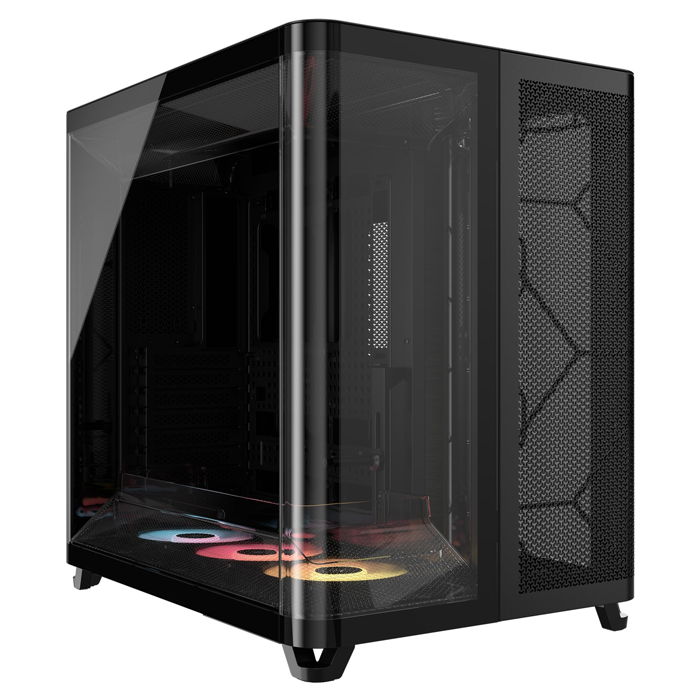
Corsair Air 5400
CHECK PRICE
PROS
CONS
| Specification | Detail |
|---|---|
| Case type | Triple-chamber ATX mid-tower |
| Dimensions (H x D x W) | 470 x 467 x 340 mm |
| Motherboard support | Mini-ITX, Micro-ATX, ATX, E-ATX, reverse-connector boards |
| Radiator support | Up to 360 mm in a dedicated front chamber; 360 mm top or bottom |
| Fan mounts | 3x 120 mm front, top, and bottom (up to 10 total) |
| Included fans | 3x 120 mm reverse-rotor (bottom intake) |
| GPU max length | 360 mm |
| Drive bays | 1x 3.5-inch, 2x 2.5-inch |
| Front I/O | 1x USB 3.2 Gen 2×2 Type-C, 2x USB 3.2 Gen 1 Type-C, audio combo jack |
| Expansion slots | 7 |
| Weight | 16.7 kg |
| Price | $229.99 (RS-R ARGB) to $309.99 (LX-R RGB iCUE LINK) |
The Corsair Air 5400 is a triple-chamber ATX mid-tower case that isolates the CPU radiator, the main motherboard and GPU compartment, and the power supply and storage into three separate sections. Corsair introduced the chamber layout as a successor to the 2013 Air 540, and the 5400 keeps the wraparound tempered-glass exterior while adding a dedicated radiator bay that vents heat directly out of the chassis instead of circulating it past other components.
The main chamber routes intake air through Venturi-style ducts at the top and bottom, which increases airflow velocity toward the GPU and motherboard. The dedicated third chamber accepts a radiator up to 360 mm and exhausts its heat separately, so CPU cooling does not raise ambient temperature inside the GPU chamber. A second chamber behind the motherboard tray isolates the power supply, cabling, and drive trays.
The motherboard tray accepts Mini-ITX, Micro-ATX, standard ATX, and E-ATX boards, and it includes cutouts for reverse-connector boards from ASUS, MSI, and GIGABYTE. A magnetic strip covers the exposed edge around the 24-pin connector when a reverse-connector board is installed, which keeps the panoramic glass view free of visible gaps. Standard ATX boards install without modification, since the chamber width accommodates the full board depth alongside the isolated radiator bay.
Compared with the Fractal Design Torrent, the Air 5400 trades raw fan count and radiator flexibility for a more segmented thermal design; the Torrent supports up to 420 mm radiators in two locations, while the Air 5400 caps out at 360 mm in its dedicated chamber. Against the Lian Li O11 Vision Compact, another dual/triple-chamber design, the Air 5400 offers a larger main chamber and higher-capacity radiator bay, but at a higher entry price and a larger overall footprint.
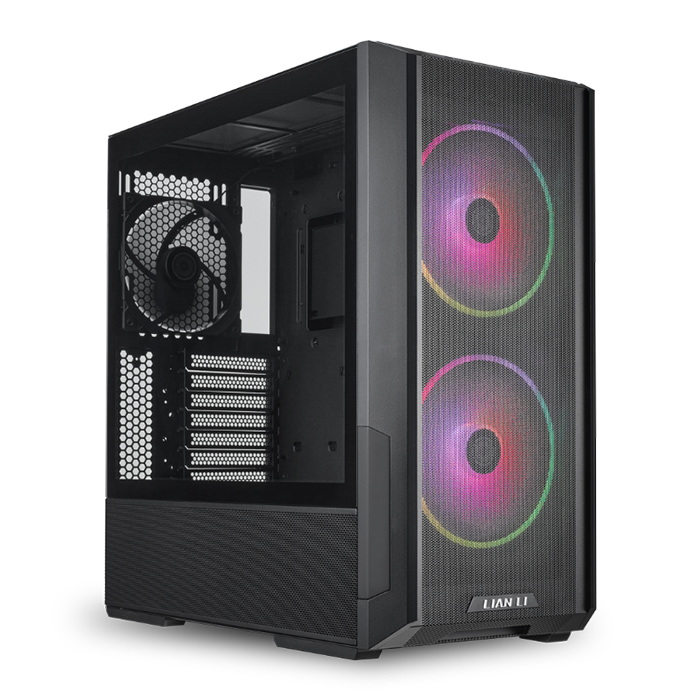
Lian Li Lancool 216
CHECK PRICE
PROS
CONS
| Specification | Detail |
|---|---|
| Case type | ATX mid-tower, airflow-focused |
| Dimensions (D x W x H) | 480.9 x 235 x 491.7 mm |
| Motherboard support | Mini-ITX, Micro-ATX, ATX, E-ATX under 280 mm width |
| Radiator support | Front and top: 360, 280, or 240 mm; bottom: 240 mm |
| Fan mounts | Front 3x 120/2x 140/2x 160 mm; top 3x 120/2x 140 mm; PSU shroud 2x 120/2x 140 mm; rear 1x 120/140 mm |
| Included fans | 2x 160 mm front, 1x 140 mm rear |
| GPU max length | 392 mm |
| CPU cooler max height | 180.5 mm |
| Drive bays | 2x 3.5-inch, up to 6x 2.5-inch |
| Front I/O | 2x USB 3.0, 1x USB Type-C, audio combo jack |
| Expansion slots | 7 |
| Weight | 10.5 kg |
| Price | Approximately $99.99 (base), $115 (RGB) |
The Lian Li Lancool 216 is an airflow-focused ATX mid-tower built around two 160 mm front intake fans and a rotatable rear PCIe fan bracket. Lian Li positioned the 216 below its O11 series as a value-oriented case, and it retains features from the more expensive Lancool III, including a modular motherboard I/O position and a symmetrical dual-chamber layout.
Mesh panels cover the front, top, and PSU-shroud side of the case to maximize intake and exhaust. The two included 160 mm front fans can be swapped for 3x 120 mm or 2x 140 mm fans when a radiator is installed, and the front panel supports radiators up to 360 mm. A SATA-powered fan hub behind the motherboard tray manages up to four additional PWM or ARGB fans.
The case supports ATX, Micro-ATX, and Mini-ITX boards without adjustment, and it accepts E-ATX boards up to 280 mm wide once the cable-grommet bar is flipped 180 degrees. Wider E-ATX boards exceed the tray’s clearance and do not fit. The symmetrical chamber design keeps cable-management space consistent regardless of which side the motherboard I/O panel is installed on.
Against the Fractal Design North XL, the Lancool 216 covers a narrower motherboard range and a smaller GPU length allowance, but its price sits roughly $100 to $120 lower. Compared with the NZXT H7 Flow, the two cases share similar external dimensions and E-ATX support, though the Lancool 216 includes larger stock fans while the H7 Flow includes bottom-mounted fan positions the Lancool 216 lacks.
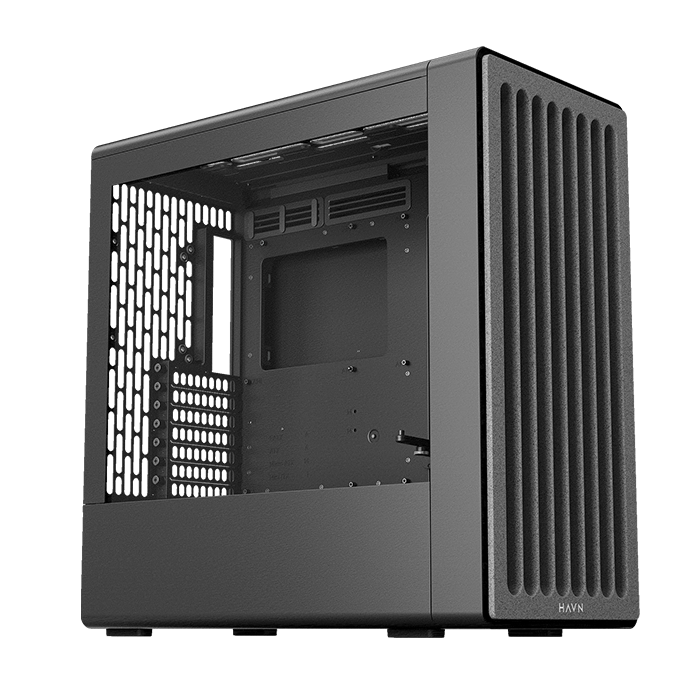
Havn BF 360
CHECK PRICE
PROS
CONS
| Specification | Detail |
|---|---|
| Case type | ATX mid-tower, semi-open frame |
| Dimensions (L x W x H) | 515 x 254 x 522.6 mm |
| Motherboard support | Mini-ITX, Micro-ATX, ATX, E-ATX (GPU bracket removal required) |
| Radiator support | Front: 420, 360, 280, or 240 mm; top: 360, 280, or 240 mm |
| Fan mounts | Front 3x 120/3x 140/2x 180 mm; top 3x 120/2x 140/2x 180 mm; rear 1x 120/140 mm |
| Included fans | None (BF 360); 2x 180 mm H18 front, 1x 140 mm H14 rear (BF 360 Flow) |
| GPU max length | 410 mm |
| CPU cooler max height | 195 mm |
| PSU support | ATX or SFX up to 200 mm |
| Cable routing space | 33 mm behind motherboard tray |
| Price | $179.99 (BF 360), $229.99 (BF 360 Flow) |
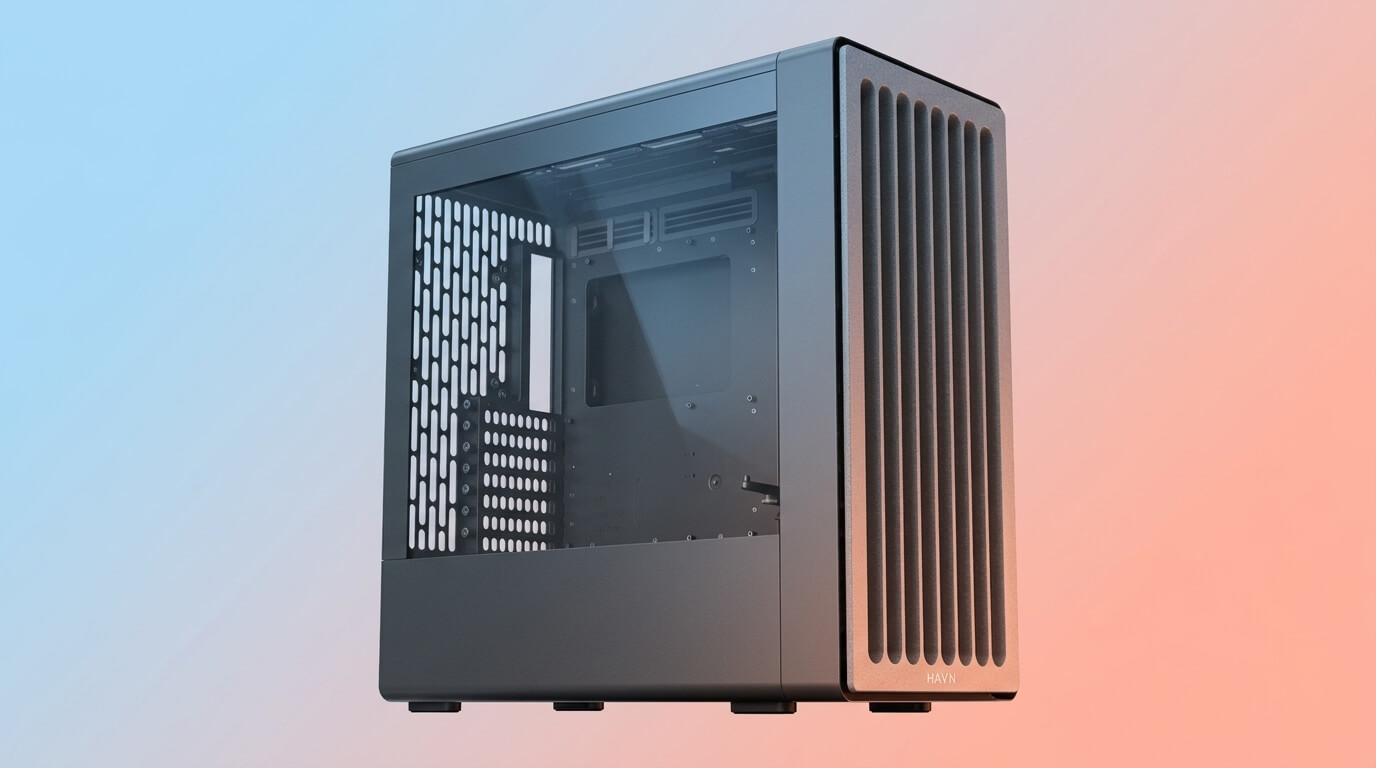
The Havn BF 360 is an ATX mid-tower with a semi-open frame and a textured, vented front panel designed for high airflow with low fan noise. Havn built the BF 360 around a “SimpliCable” routing channel that runs 33 mm behind the motherboard tray, and the case ships in two configurations: a bare BF 360 with no included fans, and a BF 360 Flow variant with two 180 mm front intake fans and one 140 mm rear exhaust fan.
Vibration-dampened fan brackets and rubber isolation mounts reduce the acoustic output of the reinforced steel and tempered-glass panels. The Flow variant’s H18 front fans use fluid dynamic bearings, which Havn markets as a quieter alternative to the sleeve or ball bearings found in many stock case fans.
The tray accepts Mini-ITX, Micro-ATX, and standard ATX boards without modification. E-ATX boards fit once the built-in GPU support bracket is removed, since the bracket otherwise occupies the clearance an E-ATX board’s wider edge requires. This trade-off means E-ATX builders lose the bracket’s GPU sag support.
Against the Fractal Design Torrent, the BF 360 matches front radiator support at 420 mm but weighs several kilograms more due to its reinforced frame. Compared with the Corsair Air 5400, the BF 360 uses a conventional single-chamber layout rather than a segmented design, which simplifies cooler installation but does not isolate CPU heat from the GPU compartment the way the Air 5400 does.
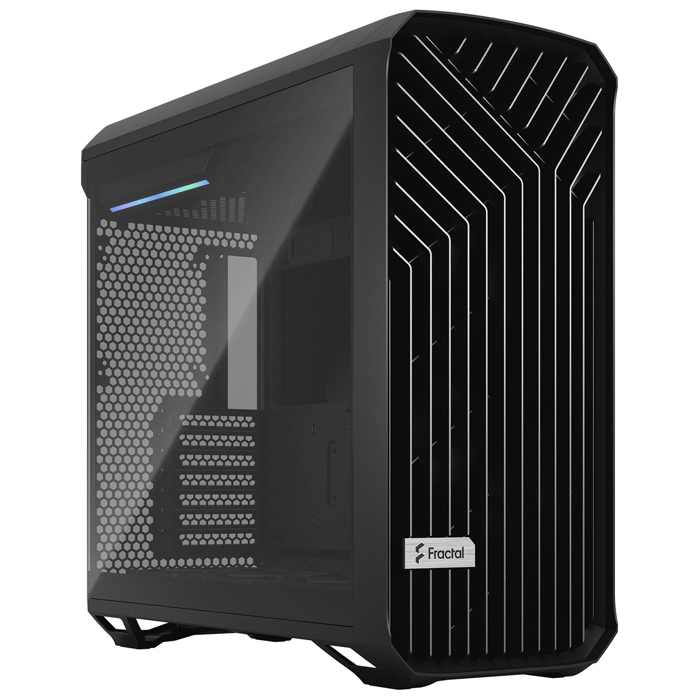
Fractal Design Torrent
CHECK PRICE
PROS
CONS
| Specification | Detail |
|---|---|
| Case type | ATX mid-tower, updraft airflow layout |
| Dimensions (D x W x H) | 544 x 242 x 530 mm |
| Motherboard support | Mini-ITX, Micro-ATX, ATX, E-ATX, SSI-EEB, SSI-CEB |
| Radiator support | Front and bottom: up to 420 mm; rear: 120 or 140 mm |
| Fan mounts | Front 3x 120/140 mm or 2x 180 mm; bottom 3x 120/140 mm or 2x 180 mm; rear 1x 120/140 mm |
| Included fans | 2x 180 mm bottom intake, 3x 140 mm front intake |
| GPU max length | 461 mm |
| CPU cooler max height | 188 mm |
| PSU support | ATX up to 230 mm, mounted in a roof compartment |
| Drive bays | 2x 3.5-inch/2.5-inch combined, 4x 2.5-inch |
| Front I/O | 1x USB 3.2 Gen 2 Type-C, 2x USB 3.0/3.2 Gen 1 Type-A, audio jacks |
| Expansion slots | 7 |
| Weight | 10.4 to 11.1 kg net |
| Price | $179.99 to $239.99 depending on panel and RGB configuration |
The Fractal Design Torrent uses an inverted, updraft cooling layout that departs from the conventional front-to-back airflow path found in most ATX cases. Two 180 mm fans intake air through the base of the case directly beneath the GPU, three 140 mm fans intake through the front, and the power supply sits in a separate compartment in the roof rather than the rear.
This layout creates strong positive air pressure through the main chamber, since intake fan area substantially exceeds the case’s exhaust openings. The floor accepts radiators up to 420 mm, and Fractal Design includes fan brackets for mounting smaller 120 mm or 140 mm fans in place of the stock 180 mm units when installing a radiator.
The Torrent accepts Mini-ITX through E-ATX boards, plus the workstation-oriented SSI-EEB and SSI-CEB form factors, without a size-limited caveat like the narrower E-ATX allowances found on some competing cases. Because the power supply sits in the roof rather than beside the motherboard, the tray has fewer obstructions along its lower edge, which simplifies routing cables to boards with bottom-mounted headers.
Compared with the NZXT H7 Flow, the Torrent supports a larger 420 mm front radiator against the H7 Flow’s matching 420 mm front but smaller 360 mm top allowance, and the Torrent ships with two additional stock fans. Against the Havn BF 360, both cases match at 420 mm front radiator support, but the Torrent’s updraft design routes the PSU into the roof instead of a rear compartment, which changes how builders route the 24-pin and CPU power cables.
NZXT H7 Flow
CHECK PRICE
PROS
CONS
| Specification | Detail |
|---|---|
| Case type | ATX mid-tower, perforated airflow |
| Dimensions (H x W x D) | 544 x 244 x 468 mm |
| Motherboard support | Mini-ITX, Micro-ATX, ATX, E-ATX up to 277 mm |
| Radiator support | Front: up to 420 mm; top: up to 360 mm; rear: 140 mm |
| Fan mounts | Front 3x 120/140 mm; top 3x 120/2x 140 mm; bottom 3x 120 mm; rear 1x 120/140 mm |
| Included fans | 3x 120 mm F120Q (non-RGB variant) |
| GPU max length | 410 mm |
| CPU cooler max height | 185 mm |
| PSU support | Separate rear compartment, up to 200 mm |
| Cable routing space | 34.5 mm behind motherboard tray |
| Front I/O | 2x USB 3.2 Type-A, 1x USB 3.2 Gen 2×2 Type-C, audio jack |
| Price | Approximately $129.99 (non-RGB), $20 more for RGB |
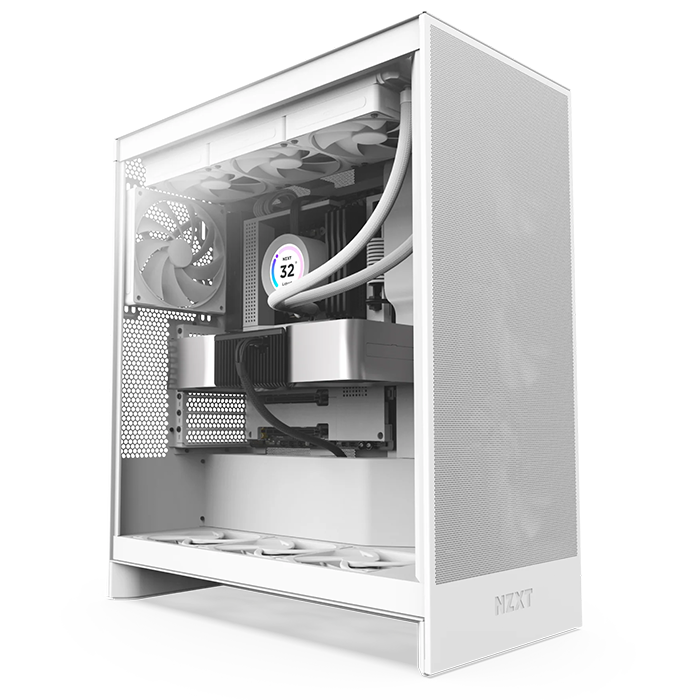
The NZXT H7 Flow (2024) is a perforated ATX mid-tower that revised NZXT’s earlier H7 Flow by inverting the power supply orientation to free up floor space for three additional 120 mm intake fans beneath the graphics card. The mesh front and top panels maximize intake and exhaust, and NZXT increased the internal width over the prior generation to support E-ATX motherboards up to 277 mm wide.
The bottom fan position feeds air directly upward past the graphics card, which NZXT designed specifically to counter thermal throttling in high-wattage GPUs. A single bridged front-I/O cable simplifies the case’s internal wiring compared with cases that route each port separately.
The H7 Flow supports Mini-ITX, Micro-ATX, and standard ATX boards natively, and its 2024 revision extended the tray to fit E-ATX boards up to 277 mm wide, a size limit narrower than the 280 mm allowance on the Havn BF 360 or Lian Li Lancool 216. Builders with wider server-class E-ATX boards should confirm board width before purchase, since boards exceeding 277 mm do not fit the tray’s standoff pattern.
Against the Phanteks Eclipse G500A, both cases target the same price bracket and mesh-front airflow category, but the H7 Flow’s bottom fan position gives it a direct-GPU-cooling advantage the G500A does not offer. Compared with the Fractal Design Torrent, the H7 Flow uses a conventional rear PSU compartment rather than a roof-mounted one, which results in a more familiar cable-routing layout at the cost of the Torrent’s larger 420 mm bottom radiator option.

Phanteks Eclipse G500A
CHECK PRICE
PROS
CONS
| Specification | Detail |
|---|---|
| Case type | ATX mid-tower, high-airflow mesh |
| Dimensions (W x D x H) | 240 x 500 x 515 mm |
| Motherboard support | Mini-ITX, Micro-ATX, ATX, E-ATX up to 280 mm wide |
| Radiator support | Front: up to 420 mm; top: up to 360 mm |
| Fan mounts | Front 3x, top 3x, rear 1x (120 mm positions) |
| Included fans | 4x M25-140 (Performance edition, non-RGB); 3x M25-140 D-RGB (D-RGB edition) |
| Drive bays | 2x 3.5-inch pre-installed, expandable to 10x 3.5-inch; up to 9x 2.5-inch |
| Front I/O | 2x USB 3.0 Type-A, 1x USB 3.2 Gen 2 Type-C, audio combo jack, D-RGB mode and color buttons |
| Expansion slots | 7 |
| Price | $128.99 (Performance edition) to $149.99 (D-RGB edition) |
The Phanteks Eclipse G500A is an ATX mid-tower built around Ultra-Fine Performance Mesh panels on the front and top, designed to combine high airflow with built-in dust filtration that reduces the need for separate filter maintenance. Phanteks sells the G500A in a four-fan Performance edition with standard black fans and a three-fan D-RGB edition with addressable lighting synced to a front-panel controller.
Two digital-RGB zones run along the front panel and the power-supply shroud on D-RGB models, and both zones can be controlled through physical front-panel buttons without requiring motherboard software. The case includes stackable 3.5-inch drive brackets that expand storage capacity well beyond the two bays installed by default.
The tray supports Mini-ITX, Micro-ATX, and standard ATX boards directly, and E-ATX boards up to 280 mm wide fit without additional modification, matching the E-ATX allowance on the Lian Li Lancool 216. Optional vertical GPU mounting is available through a separate bracket or riser cable, which is not included with the base case.
Compared with the NZXT H7 Flow, the G500A includes more stock fans on its Performance edition but lacks a bottom fan position, so it cannot direct air as directly at the graphics card. Against the Corsair Air 5400, the G500A costs roughly $100 to $180 less depending on configuration, though it does not offer the Air 5400’s chamber isolation or 20 Gbps USB-C front port.
Lian Li O11 Vision Compact
CHECK PRICE
PROS
CONS
| Specification | Detail |
|---|---|
| Case type | ATX mid-tower, dual-chamber |
| Dimensions (H x D x W) | 446.4 x 447.5 x 287.5 mm |
| Motherboard support | Mini-ITX, Micro-ATX, ATX, back-connect ATX, E-ATX under 280 mm |
| Radiator support | Top: up to 360 or 280 mm; side: up to 360 mm; bottom: up to 360 mm |
| Fan mounts | Top 3x 120/2x 140 mm; side 3x 120 mm; bottom 3x 120 mm; rear 2x 120 mm |
| GPU max length | 408 mm |
| CPU cooler max height | 164 mm |
| PSU support | ATX under 220 mm |
| Drive bays | 2x 3.5-inch/2.5-inch in a cage, 2x 2.5-inch behind the tray |
| Front I/O | 2x USB 3.0, 1x USB 3.1 Type-C, audio combo jack |
| Expansion slots | 6+1 |
| Weight | Approximately 11.35 kg |
| Price | Approximately $155.99 |
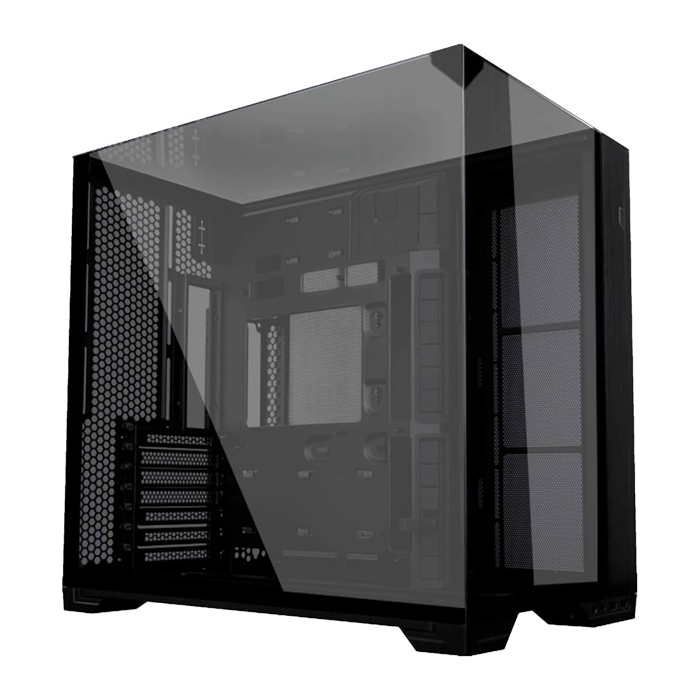
The Lian Li O11 Vision Compact is a dual-chamber ATX mid-tower that separates the visible build area from the power supply and cable-management compartment, following the layout Lian Li established with its original O11 Dynamic series. A swappable top panel lets builders choose between a mesh panel for radiator airflow or a tempered-glass panel for an unobstructed view of a top-mounted AIO.
The case includes a removable GPU anti-sag bracket that adjusts to hold cards between 278 mm and 408 mm long, and Lian Li’s hidden-tubing channel routes AIO lines from a side-mounted radiator into the second chamber, keeping tubing out of view from the front glass panel.
The motherboard tray supports Mini-ITX, Micro-ATX, and standard ATX boards, plus back-connect ATX boards through dedicated cutouts that hide power and data cables behind the tray. E-ATX support is limited to boards no wider than 280 mm, the same limit found on the Lancool 216 and Eclipse G500A, since the second chamber’s width constrains how far the tray can extend.
Against the Corsair Air 5400, the O11 Vision Compact offers a smaller footprint and lower price but supports a maximum CPU cooler height of only 164 mm, well below the Air 5400’s clearance. Compared with the Fractal Design Torrent, the Vision Compact prioritizes a clean visual layout over the Torrent’s raw airflow capacity, trading a 420 mm front radiator option for a 360 mm side-mounted position hidden behind the second chamber.

Fractal Design North XL
CHECK PRICE
PROS
CONS
| Specification | Detail |
|---|---|
| Case type | E-ATX full tower |
| Dimensions (H x D x W) | 509 x 503 x 240 mm |
| Motherboard support | Mini-ITX, Micro-ATX, ATX, E-ATX |
| Radiator support | Front: up to 420 mm; top: up to 360 mm (reduced to 240 mm alongside a full front radiator) |
| Fan mounts | Front 3x 120/140 mm; side 2x 120/140 mm; top 3x 120 or 2x 140/180 mm; rear 1x 120/140 mm |
| Included fans | 3x 140 mm Aspect PWM (front) |
| GPU max length | 413 mm (380 mm with a 420 mm front radiator installed) |
| CPU cooler max height | 176 to 185 mm depending on side-bracket configuration |
| PSU support | Up to 290 mm |
| Drive bays | 2x 3.5-inch/2.5-inch combined, 2x dedicated 2.5-inch |
| Front I/O | 2x USB Type-A (5 Gbps), 1x USB Type-C (20 Gbps), audio and microphone jacks |
| Expansion slots | 7 |
| Price | Approximately $195 to $220 |
The Fractal Design North XL is an E-ATX-capable full tower that scales up the wood-accented design of the original Fractal North to a larger chassis with room for bigger motherboards and radiators. Front panel slats made from FSC-certified oak or walnut wrap around an open mesh or tempered-glass side panel, and three 140 mm Aspect PWM fans come pre-installed as front intakes.
The larger interior volume over the standard North increases GPU clearance to 413 mm and adds side fan mounts absent from the smaller model. A rear PCIe-area exhaust position and a 240 or 360 mm top radiator mount round out the cooling options, though front and top radiator capacity cannot both be maximized simultaneously due to internal clearance limits.
The North XL accommodates Mini-ITX through full E-ATX motherboards without a stated width restriction, unlike the narrower E-ATX allowances on the Lancool 216, Eclipse G500A, and O11 Vision Compact. This makes the North XL a suitable option for Threadripper or other workstation-class boards that exceed the roughly 280 mm width limit common on smaller mid-towers. A separate RC variant supports reverse-connector ATX and Micro-ATX boards for cleaner cable presentation.
Compared with the Corsair Air 5400, the North XL offers unrestricted E-ATX support and a larger 420 mm front radiator allowance, though it lacks the Air 5400’s chamber isolation for CPU heat. Against the Fractal Design Torrent, the North XL supports the same 420 mm front radiator size but caps top radiator capacity at 360 mm versus the Torrent’s 420 mm bottom-mounted option, reflecting the North XL’s more conventional airflow path.
How To Choose the Best PC Case
Choosing the best PC case requires matching motherboard size, cooling method, and graphics card length to a chassis with sufficient clearance for all three. A case that fits an ATX board but not a 400 mm graphics card, or one that supports a 360 mm radiator but not the CPU cooler height a builder already owns, forces a compromise before the build even starts.
Motherboard size is the first constraint to confirm, since it determines which cases qualify at all. Mini-ITX and Micro-ATX boards fit inside nearly every case in this guide, while E-ATX boards require checking a case’s stated width limit; several mid-towers cap E-ATX support at 277 mm to 280 mm, while full towers such as the Fractal Design North XL accept E-ATX boards without a width restriction.
Radiator and fan support determine cooling ceiling. A case’s front, top, and bottom mounts each list a maximum radiator size in millimeters, and builders planning liquid cooling should confirm that the intended radiator size does not conflict with GPU clearance, since several cases reduce maximum graphics-card length when a large front radiator is installed. Air-cooled builds should instead prioritize CPU cooler height clearance, which ranges from roughly 164 mm to 195 mm across the cases in this guide.
GPU length clearance should be checked against the specific graphics card a build will use, since flagship cards frequently exceed 300 mm and some surpass 400 mm. Cases with lower clearance, particularly compact or dual-chamber designs, may require removing a front fan or radiator to fit the longest cards.
Airflow layout affects both temperature and noise. Conventional front-to-back designs with mesh panels, such as the NZXT H7 Flow and Phanteks Eclipse G500A, rely on multiple smaller fans and generally run quieter at idle. Updraft or chambered designs, such as the Fractal Design Torrent and Corsair Air 5400, use fewer, larger fans or isolated compartments to move more air per fan, which can lower noise at a given airflow level but adds design complexity to cable routing and radiator installation.
Price scales with feature count and material quality rather than performance alone. Value-oriented cases like the Lian Li Lancool 216 and Phanteks Eclipse G500A deliver strong airflow and fan counts near $100 to $150, while premium chambered or full-tower designs such as the Corsair Air 5400 and Fractal Design North XL charge $200 or more for isolated cooling zones, wider motherboard support, or distinctive materials such as wood front panels.