
Table of Contents
The Ryzen 7 7700X is an 8-core, 16-thread AM5 desktop processor with a 105 W base TDP and a boost clock that draws up to 142 W under PBO. A compatible motherboard must supply stable VRM current at this power level, support DDR5 memory on the AM5 platform, and provide the PCIe 4.0 or PCIe 5.0 connectivity the 7700X’s integrated PCIe lanes expose for graphics and storage.
The AM5 socket accepts three chipset tiers for this processor: B650, B650E, and X670E. B650 and B650E share the same socket and CPU power delivery requirements, differing mainly in guaranteed PCIe 5.0 support for the graphics slot and a second M.2 slot. Six boards across these tiers cover the price-to-feature range a 7700X buyer typically evaluates: three ATX boards built around 14+2+1 or larger VRM designs, one micro-ATX board for compact builds, and two boards positioned for extended I/O or premium power delivery.
Selecting among them depends on VRM phase count and current rating, M.2 slot generation, memory speed ceiling, networking hardware, and form factor. A 7700X does not require the largest VRM on the market, since its 142 W boost power sits well inside the delivery capacity of every board covered below, but phase count and cooling still affect long-term thermal headroom during sustained multi-core workloads.
The sections that follow review each motherboard’s specifications, working relationship with the 7700X, and comparative position against the other five boards, followed by a guide for narrowing the choice by use case.
THE SHORTLIST
This guide, at a glance
Compare the products covered below, then explore the strengths, limitations, and specifications that matter to you.
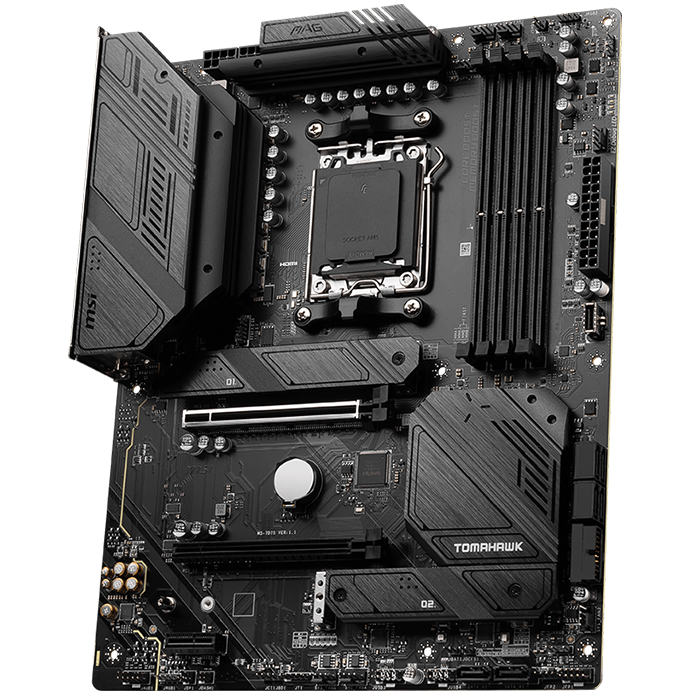 Check current priceView on Amazon: MSI MAG B650 Tomahawk WiFi (opens in a new tab)
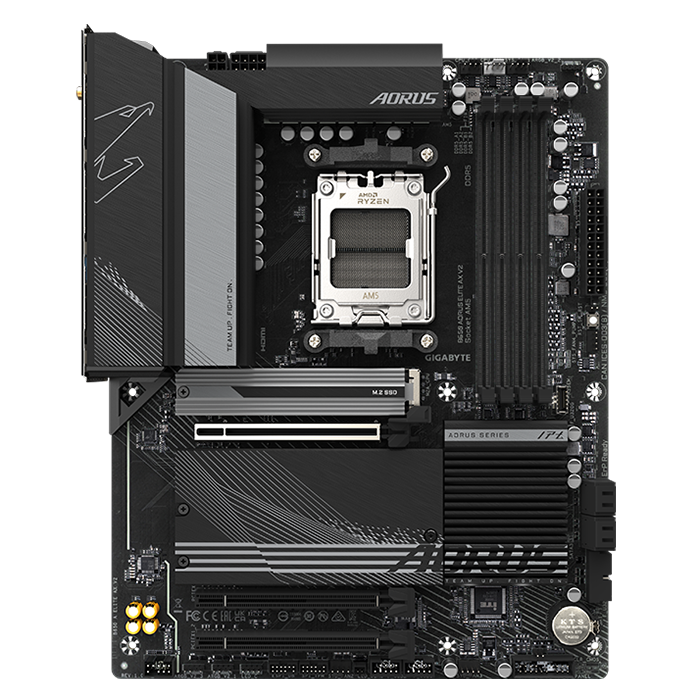 Check current priceView on Amazon: Gigabyte B650 AORUS Elite AX (opens in a new tab)
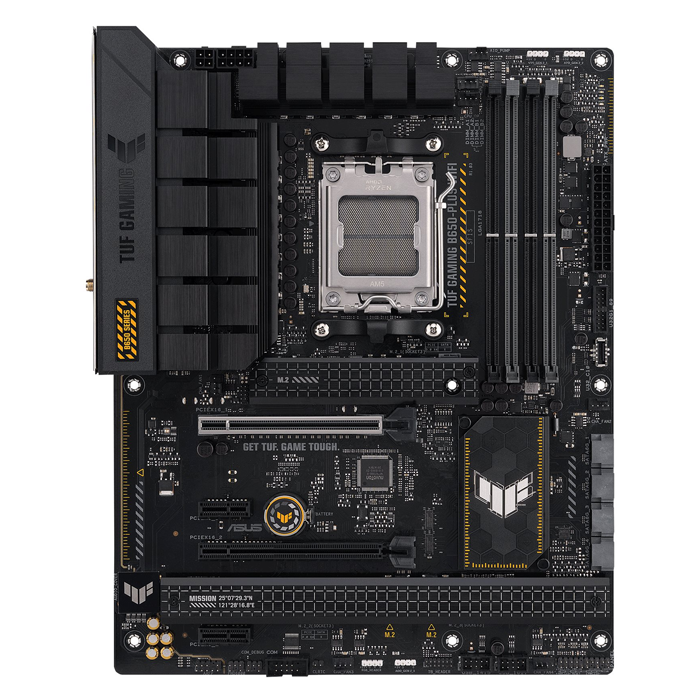 Check current priceView on Amazon: ASUS TUF Gaming B650-Plus WiFi (opens in a new tab)
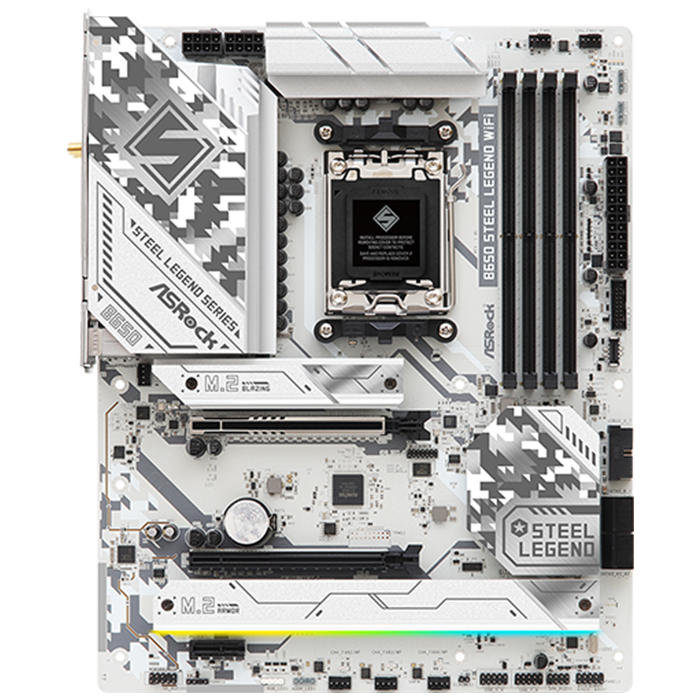 Check current priceView on Amazon: ASRock B650 Steel Legend WiFi (opens in a new tab)
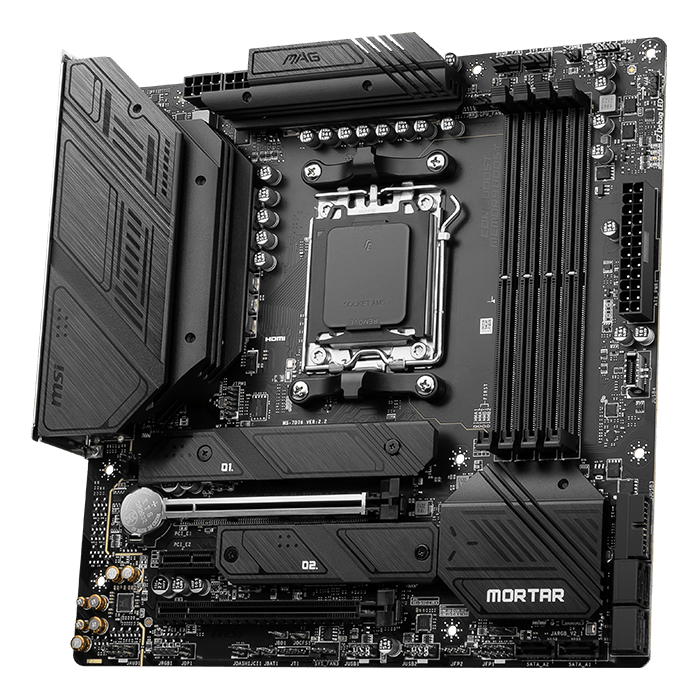 Check current priceView on Amazon: MSI MAG B650M Mortar WiFi (opens in a new tab)
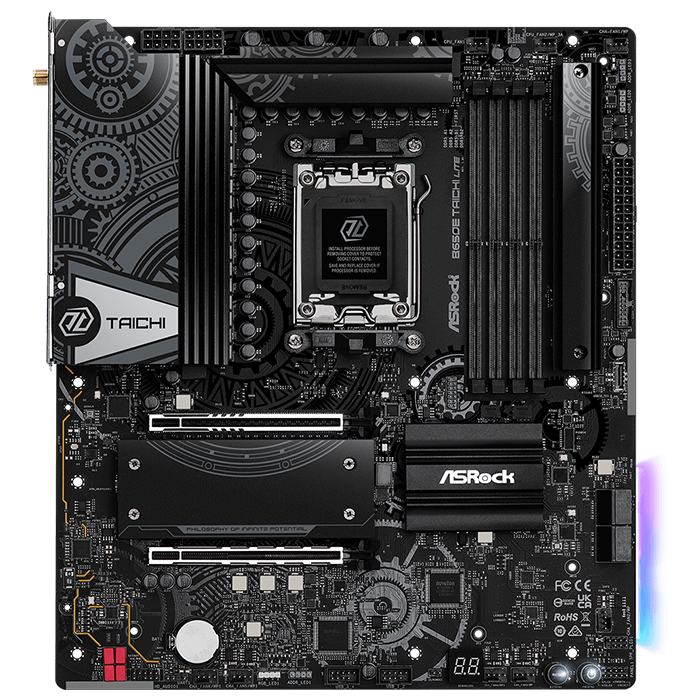 Check current priceView on Amazon: ASRock B650E Taichi Lite (opens in a new tab)
Purchase links open Amazon. Confirm the exact model, price, availability, and seller terms before ordering.
Best Motherboards for AMD Ryzen 7 7700X CPU
MSI MAG B650 Tomahawk WiFi
Pricing and availability on Amazon
Pros & cons
Strengths
- Its 14+2+1 VRM comfortably exceeds the Ryzen 7 7700X's power requirements.
- Three M.2 slots include dedicated thermal shields for improved cooling.
- Integrated 2.5GbE and WiFi 6E provide fast connectivity without add-in cards.
Limitations
- It lacks PCIe 5.0 support for both graphics and M.2 slots.
- Only two SATA-adjacent expansion slots limit additional traditional storage options.
Review notes
The MSI MAG B650 Tomahawk WiFi is a full-ATX B650 motherboard built around a 14+2+1 phase VRM rated at 80 A per phase and fed by dual 8-pin CPU power connectors. This VRM configuration sustains the 7700X’s 142 W PBO boost power without throttling, since the board’s rated CPU power ceiling of 170 W leaves headroom above the processor’s peak draw. An extended VRM heatsink paired with 7 W/mK thermal pads keeps MOSFET temperatures in check during multi-threaded workloads such as rendering or compilation.
The board carries four DDR5 DIMM slots supporting up to 256 GB of memory, with AMD EXPO profiles enabling overclocked speeds up to 7600 MHz. Storage runs through three M.2 slots, all wired to PCIe 4.0 rather than PCIe 5.0, since the standard B650 chipset does not guarantee Gen5 M.2 bandwidth the way B650E does. Networking includes a Realtek 2.5 Gbps LAN controller alongside integrated Wi-Fi 6E and Bluetooth 5.2. A rear USB 3.2 Gen 2×2 Type-C port delivers 20 Gbps transfer speeds, and audio runs through a 7.1-channel HD codec with Audio Boost 5.
Compared with the other five boards, the Tomahawk WiFi offers stronger VRM cooling than the ASUS TUF Gaming B650-Plus WiFi and the MSI MAG B650M Mortar WiFi, while lacking the PCIe 5.0 M.2 slot found on the Gigabyte B650 AORUS Elite AX, ASRock B650 Steel Legend WiFi, and ASRock B650E Taichi Lite. Its price positions it below the Taichi Lite and Steel Legend WiFi while matching the TUF Gaming B650-Plus WiFi in the mainstream ATX tier.
Specs & configuration
| Specification | Detail |
|---|---|
| Form factor | ATX |
| Chipset | AMD B650 |
| VRM | 14+2+1 phases, 80 A per phase |
| Memory | 4x DDR5 DIMM, up to 256 GB, EXPO to 7600 MHz |
| M.2 slots | 3x PCIe 4.0 x4 |
| PCIe slots | 2x PCIe 4.0/3.0 x16 |
| Networking | 2.5 Gbps LAN, Wi-Fi 6E, Bluetooth 5.2 |
| Rear USB | USB 3.2 Gen 2×2 Type-C (20 Gbps) |
| Audio | 7.1-channel HD Audio, Audio Boost 5 |
Gigabyte B650 AORUS Elite AX
Pricing and availability on Amazon
Pros & cons
Strengths
- A PCIe 5.0 M.2 slot supports future Gen5 SSD upgrades.
- Q-Flash Plus enables BIOS updates without an installed CPU or memory.
- EZ-Latch provides screwless installation for PCIe and M.2 components.
Limitations
- Rear USB Type-C connectivity is limited to 10Gbps speeds.
- Two PCIe 3.0 x1 slots limit additional expansion beyond the graphics card.
Review notes
The Gigabyte B650 AORUS Elite AX is an ATX B650 motherboard built around a twin 14+2+1 digital VRM design using 70 A smart power stages across an 8-layer, 2x copper PCB. The board draws CPU power through an 8+4 pin solid-pin connector arrangement, and its fully covered MOSFET heatsinks paired with a 6 mm mega-heatpipe manage sustained thermal load from the 7700X’s 142 W boost power.
Four DDR5 DIMM slots support dual-channel memory with AMD EXPO profiles. Storage runs through three M.2 slots: one PCIe 5.0 x4 slot and two PCIe 4.0 x4 slots, each protected by an M.2 Thermal Guard. The primary PCIe x16 slot supports PCIe 4.0 and carries Gigabyte’s Ultra Durable armor for physical reinforcement. Networking includes 2.5 Gbps LAN and Wi-Fi 6E, while rear I/O provides a 10 Gbps USB Type-C port alongside a 20 Gbps front-panel USB Type-C header.
Against the other five boards, the AORUS Elite AX is one of three boards in this lineup offering a PCIe 5.0 M.2 slot, alongside the ASRock B650 Steel Legend WiFi and ASRock B650E Taichi Lite. Its 70 A power stages place it above the MSI MAG B650M Mortar WiFi and ASUS TUF Gaming B650-Plus WiFi in per-phase current rating, while its VRM phase count matches the Tomahawk WiFi.
Specs & configuration
| Specification | Detail |
|---|---|
| Form factor | ATX |
| Chipset | AMD B650 |
| VRM | Twin 14+2+1 phases, 70 A power stages |
| Memory | 4x DDR5 DIMM, dual channel, EXPO supported |
| M.2 slots | 1x PCIe 5.0 x4, 2x PCIe 4.0 x4 |
| PCIe slots | 1x PCIe 4.0 x16, 2x PCIe 3.0 x1 |
| Networking | 2.5 Gbps LAN, Wi-Fi 6E |
| Rear USB | USB Type-C 10 Gbps; front USB Type-C header 20 Gbps |
| BIOS recovery | Q-Flash Plus |
ASUS TUF Gaming B650-Plus WiFi
Pricing and availability on Amazon
Pros & cons
Strengths
- The USB4 header supports Thunderbolt 4 peripherals, unlike the other five boards.
- PCIe 5.0 x16 graphics and M.2 support provide fast connectivity with the 7700X.
- Reinforced military-grade capacitors and chokes support durability under higher temperatures.
Limitations
- Its lower phase count trails the Tomahawk WiFi and AORUS Elite AX.
- WiFi 6 provides less 6GHz support than newer WiFi 6E.
Review notes
The ASUS TUF Gaming B650-Plus WiFi is an ATX B650 motherboard powered by a 12+2+2 power-stage design rated at 60 A per stage, delivered through ASUS ProCool CPU power connectors. This configuration reliably powers CPUs drawing up to approximately 225 W, placing the 7700X’s 142 W boost power well within its operating range. Military-grade TUF chokes and 5K black metallic capacitors extend component lifespan under sustained load.
Memory support spans four DDR5 DIMM slots with a stated maximum of 256 GB and EXPO overclocking profiles reaching 7600 MHz and above. Storage includes three M.2 slots, with the first slot supporting PCIe 5.0 x4 when paired with Ryzen 9000 or 7000 series processors and PCIe 4.0 x4 when paired with Ryzen 8000 series APUs; the 7700X uses the PCIe 5.0 path. Networking runs through 2.5 Gbps Realtek LAN and Wi-Fi 6, and the board includes a USB4 header supporting Thunderbolt 4 connectivity alongside a rear USB 3.2 Gen 2×2 Type-C port.
Relative to the other five boards, the TUF Gaming B650-Plus WiFi is the only board in this lineup offering a USB4 header, giving it an I/O advantage the Tomahawk WiFi, Mortar WiFi, and AORUS Elite AX do not match. Its 12+2+2 power-stage count sits below the 14+2+1 designs on the Tomahawk WiFi and AORUS Elite AX, though its 60 A-plus effective CPU power budget remains sufficient for the 7700X.
Specs & configuration
| Specification | Detail |
|---|---|
| Form factor | ATX |
| Chipset | AMD B650 |
| VRM | 12+2+2 power stages, 60 A rated |
| Memory | 4x DDR5 DIMM, up to 256 GB, EXPO to 7600+ MHz |
| M.2 slots | 3x M.2 (1x PCIe 5.0 x4 with Ryzen 7000/9000, 2x PCIe 4.0) |
| PCIe slots | PCIe 5.0 x16 primary slot |
| Networking | 2.5 Gbps LAN, Wi-Fi 6 |
| Rear USB | USB4 header, USB 3.2 Gen 2×2 Type-C |
| Cooling | Enlarged VRM and PCH heatsinks, M.2 heatsinks |
ASRock B650 Steel Legend WiFi
Pricing and availability on Amazon
Pros & cons
Strengths
- PCIe 5.0 x16 graphics and M.2 support provide fast connectivity on B650.
- Its high USB port count suits peripheral-heavy builds.
- 80A Dr.MOS power stages provide ample headroom for the Ryzen 7 7700X.
Limitations
- Only two SATA 6Gb/s ports limit traditional storage expansion.
- Its 192GB memory limit is lower than several competing boards.
Review notes
The ASRock B650 Steel Legend WiFi is an ATX B650 motherboard built on a 14+2+1 phase power design using 80 A Dr.MOS power stages. This VRM configuration handles the 7700X’s 142 W boost power with margin to spare, and an 8-layer PCB improves signal integrity for both power delivery and memory overclocking.
Four DDR5 DIMM slots support up to 192 GB of memory, with EXPO profiles enabling speeds up to 7200 MHz and beyond. Storage runs through three M.2 slots: one PCIe 5.0 x4 “Blazing” slot and two PCIe 4.0 x4 “Hyper” slots. Expansion includes a PCIe 5.0 x16 primary slot alongside a PCIe 3.0 x16 slot and a PCIe 4.0 x1 slot. Networking includes Wi-Fi 6E and Bluetooth 5.2, though the board carries only two SATA 6 Gb/s ports rather than four. USB connectivity totals 17 ports, including a rear USB 3.2 Gen 2×2 Type-C port.
Against the other five boards, the Steel Legend WiFi shares PCIe 5.0 M.2 support with the AORUS Elite AX and Taichi Lite, distinguishing it from the Tomahawk WiFi and Mortar WiFi, which are limited to PCIe 4.0 storage. Its 192 GB memory ceiling is lower than the 256 GB supported by the Tomahawk WiFi, AORUS Elite AX, and TUF Gaming B650-Plus WiFi.
Specs & configuration
| Specification | Detail |
|---|---|
| Form factor | ATX |
| Chipset | AMD B650 |
| VRM | 14+2+1 phases, 80 A Dr.MOS |
| Memory | 4x DDR5 DIMM, up to 192 GB, EXPO to 7200+ MHz |
| M.2 slots | 1x PCIe 5.0 x4, 2x PCIe 4.0 x4 |
| PCIe slots | 1x PCIe 5.0 x16, 1x PCIe 3.0 x16, 1x PCIe 4.0 x1 |
| Networking | Wi-Fi 6E, Bluetooth 5.2 |
| SATA | 2x SATA 6 Gb/s |
| USB | 17 total ports, including USB 3.2 Gen 2×2 Type-C |
MSI MAG B650M Mortar WiFi
Pricing and availability on Amazon
Pros & cons
Strengths
- Its compact micro-ATX design fits smaller cases while retaining 2.5GbE and WiFi 6E.
- Six SATA ports support larger traditional storage arrays than most boards listed.
- 80A DrMOS power stages provide sufficient headroom for the Ryzen 7 7700X.
Limitations
- Two PCIe 4.0 M.2 slots provide the lowest storage capacity in this lineup.
- Its 6400 MHz memory ceiling trails the higher ratings of ATX boards.
Review notes
The MSI MAG B650M Mortar WiFi is a micro-ATX B650 motherboard built around a 12+2+1 phase VRM using 80 A DrMOS power stages, fed by dual 8-pin EPS connectors. This configuration supplies the 7700X’s 142 W boost power without difficulty, and an 8-layer, 2 oz. copper-thickened PCB reduces electrical losses during sustained loads.
Four DDR5 DIMM slots support up to 256 GB of memory, though the board’s EXPO-rated overclocking ceiling of 6400 MHz sits below the 7600 MHz ratings of the full-ATX boards in this lineup, since Infinity Fabric on the 7700X operates in 1:1 mode only up to roughly 6000 MHz regardless. Storage includes two M.2 slots, both wired to PCIe 4.0 rather than PCIe 5.0. Networking runs through 2.5 Gbps LAN, Wi-Fi 6E, and Bluetooth 5.3, and the board includes six SATA 6 Gb/s ports.
Compared with the other five boards, the Mortar WiFi is the only micro-ATX option, making it the choice for compact-case builds using the 7700X. Its two M.2 slots trail the three-slot configurations on the Tomahawk WiFi, AORUS Elite AX, TUF Gaming B650-Plus WiFi, and Steel Legend WiFi, but its six SATA ports exceed the two-port allocation on the Steel Legend WiFi.
Specs & configuration
| Specification | Detail |
|---|---|
| Form factor | Micro-ATX |
| Chipset | AMD B650 |
| VRM | 12+2+1 phases, 80 A DrMOS |
| Memory | 4x DDR5 DIMM, up to 256 GB, EXPO to 6400 MHz |
| M.2 slots | 2x PCIe 4.0 x4 |
| Networking | 2.5 Gbps LAN, Wi-Fi 6E, Bluetooth 5.3 |
| SATA | 6x SATA 6 Gb/s |
| Audio | 7.1-channel HD Audio |
ASRock B650E Taichi Lite
Pricing and availability on Amazon
Pros & cons
Strengths
- Its 105A power stages provide exceptional power delivery for the Ryzen 7 7700X.
- USB4 connectivity delivers fast 40Gbps data transfer speeds.
- Premium audio hardware provides better sound quality than competing boards.
Limitations
- Its E-ATX form factor requires a compatible case with sufficient clearance.
- Its high price exceeds what most Ryzen 7 7700X builds require.
Review notes
The ASRock B650E Taichi Lite is an EATX B650E motherboard built around a 24+2+1 phase VRM using 105 A Smart Power Stages, the same power delivery hardware used on ASRock’s X670E Taichi and B650E Taichi. Twin 8-pin CPU power connectors feed this VRM, and the resulting current capacity exceeds what the 7700X’s 142 W boost power requires by a wide margin, leaving substantial thermal and overclocking headroom.
Four DDR5 DIMM slots support up to 192 GB of memory, with EXPO profiles reaching 7600 MHz and beyond. Storage runs through three M.2 slots: one PCIe 5.0 x4 “Blazing” slot and two PCIe 4.0 x4 “Hyper” slots, alongside four SATA 6 Gb/s ports connected through an ASMedia controller. Expansion includes both a PCIe 5.0 x16 slot and a PCIe 4.0 x16 slot. The board supports USB4 connectivity and carries a 5.1-channel HD audio section using a Realtek ALC4082 codec paired with an ESS SABRE9218 DAC.
Against the other five boards, the Taichi Lite carries the highest per-phase current rating in this lineup at 105 A, exceeding the 70-80 A stages used on the Tomahawk WiFi, AORUS Elite AX, Steel Legend WiFi, and Mortar WiFi. Its EATX form factor is the largest in this comparison, and its price positions it above every other board reviewed here.
Specs & configuration
| Specification | Detail |
|---|---|
| Form factor | EATX |
| Chipset | AMD B650E |
| VRM | 24+2+1 phases, 105 A SPS |
| Memory | 4x DDR5 DIMM, up to 192 GB, EXPO to 7600+ MHz |
| M.2 slots | 1x PCIe 5.0 x4, 2x PCIe 4.0 x4 |
| PCIe slots | 1x PCIe 5.0 x16, 1x PCIe 4.0 x16 |
| SATA | 4x SATA 6 Gb/s |
| USB | USB4 (40 Gbps) |
| Audio | 5.1-channel HD Audio, ALC4082 codec, ESS SABRE9218 DAC |
How to Choose a motherboard for Ryzen 7 7700X
The right motherboard for a Ryzen 7 7700X depends on case size, storage plans, and networking needs rather than raw VRM capacity, since every board in this lineup supplies enough power for the processor’s 142 W boost draw. A builder using a standard mid-tower case with three or more M.2 drives benefits from the ASUS TUF Gaming B650-Plus WiFi or ASRock B650 Steel Legend WiFi, both of which pair PCIe 5.0 storage with mainstream ATX pricing. A builder prioritizing compact form factor over expansion slots should select the MSI MAG B650M Mortar WiFi, the only micro-ATX board in this comparison. A builder who wants maximum power delivery margin or premium audio should choose the ASRock B650E Taichi Lite, accepting its EATX size and higher price in exchange for 105 A power stages and USB4 connectivity.
Buyers who need six SATA ports for large storage arrays should weigh the Mortar WiFi against the two-SATA-port Steel Legend WiFi. Buyers who value integrated 2.5 Gbps LAN and Wi-Fi 6E without added cost should consider the MSI MAG B650 Tomahawk WiFi or Gigabyte B650 AORUS Elite AX, both of which combine this networking hardware with a 14+2+1 VRM at ATX-standard pricing. In every case, confirm the motherboard’s BIOS version supports the 7700X out of the box or update it before installation, since several boards in this lineup shipped initial BIOS revisions built for earlier Ryzen 7000 series launch timing.
JOIN THE CONVERSATION
Leave a comment
Have a question or something to add? Share it with our editorial team. Comments are reviewed privately and are not published automatically.