A gaming motherboard connects the CPU, memory, graphics card, and storage into a single functioning platform, and it directly shapes how much performance a build can extract from those components. The socket and chipset determine which processors a board accepts, the VRM (voltage regulator module) determines how much sustained power the CPU receives under load, and the PCIe and M.2 layout determine how fast a graphics card and NVMe storage can transfer data. A weak VRM throttles a high-core-count CPU during extended gaming sessions, while a limited M.2 layout forces a compromise between primary game storage and secondary drives.
Three CPU platforms currently define the gaming motherboard market: AMD’s AM5 socket (covering X870E, X870, B850, and B840 chipsets, and the older X670E, X670, and B650 chipsets), and Intel’s LGA1851 socket (covering Z890, B860, and H810 chipsets for Core Ultra Series 2 processors), alongside boards built for the previous-generation LGA1700 socket that still supports 12th, 13th, and 14th Gen Intel Core processors. Each chipset tier trades overclocking headroom, PCIe 5.0 availability, and connectivity for price, so the right board depends on which CPU generation a build targets and how much of that CPU’s power draw the board needs to sustain.
Beyond the socket, four attributes separate a capable gaming board from a limiting one: VRM phase count and amperage, PCIe generation on the graphics slot, the number and generation of M.2 slots, and networking and USB connectivity. A 14-phase, 80A VRM comfortably runs a mid-range CPU but will throttle an unlocked flagship chip under sustained all-core load, while a 20-plus-phase VRM with high-current power stages keeps the same flagship chip stable through extended benchmarking or streaming sessions. PCIe 5.0 support on the primary graphics slot and on at least one M.2 slot matters more for future storage upgrades than for current-generation GPUs, since no consumer graphics card yet saturates PCIe 4.0 x16 bandwidth.
The following sections review thirteen gaming motherboards spanning AMD’s AM5 platform, Intel’s LGA1851 platform, and Intel’s LGA1700 platform, from entry-level micro-ATX boards to flagship E-ATX designs. Each review covers the board’s specifications, how it works with its supported processor family, how it compares with other boards in this lineup, and its practical strengths and limitations.
Best Motherboards for Gaming To Buy
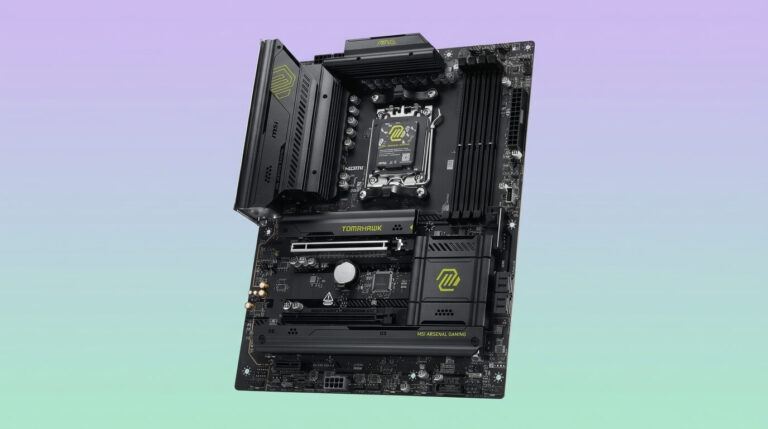
MSI MAG X870 Tomahawk WiFi
The MSI MAG X870 Tomahawk WiFi is an ATX motherboard built on AMD’s X870 chipset for AM5 Socket processors. It supports AMD Ryzen 9000, Ryzen 8000, and Ryzen 7000 series desktop processors, and it pairs a 14+2+1 Duet Rail Power System rated at 80 A per phase with dual 8-pin CPU power connectors. This configuration is suited to CPUs in the 65 W to roughly 140 W TDP range; it can power higher-TDP Ryzen 9 chips at stock settings, though sustained heavy overclocking is not the board’s strength given its mid-range VRM class.
Four DDR5 DIMM slots support dual-channel memory up to 8400+ MT/s (OC) with a maximum capacity of 256 GB. The board offers three PCIe x16-length slots — one running at PCIe 5.0 for the graphics card, one at PCIe 4.0, and one at PCIe 3.0 — alongside two M.2 Gen5 x4 slots, one M.2 Gen4 x4 slot, and one M.2 Gen4 x2 slot, plus four SATA 6 Gbps ports. Networking runs through a Realtek 5G LAN controller and a true Wi-Fi 7 module with Bluetooth 5.4, while connectivity includes two USB4 40 Gbps Type-C ports, seven USB 5 Gbps ports, and a Realtek ALC4080 audio codec. Video output through HDMI 2.1 and USB-C DisplayPort only functions when paired with a Ryzen processor that includes integrated graphics.
With AMD Ryzen 9000 and 7000 series processors, the MAG X870 Tomahawk WiFi delivers full PCIe 5.0 bandwidth to both the primary graphics slot and the fastest M.2 slot, and its Memory Boost circuit isolation helps maintain signal integrity at higher DDR5 overclocking speeds. Compared with the ASRock X870E Taichi, the Tomahawk WiFi uses a lighter 14-phase VRM against the Taichi’s 24-phase, 110 A design and offers a single PCIe 5.0 x16 slot rather than the Taichi’s dual full-bandwidth slots, reflecting the X870 chipset’s narrower feature set relative to X870E. Against the MSI MPG X670E Carbon WiFi from the previous chipset generation, the Tomahawk WiFi adds Wi-Fi 7 and USB4 connectivity that the older board lacks, while the Carbon WiFi’s 18+2+1 VRM offers more sustained current for heavy overclocking.
- VRM headroom: The 80 A, 14-phase design comfortably runs mainstream and upper-mainstream Ryzen CPUs but is not built for extreme all-core overclocking.
- Connectivity: Wi-Fi 7, 5G LAN, and dual USB4 ports place this board ahead of same-tier competitors on networking speed.
- Storage flexibility: Two Gen5 M.2 slots allow a primary and secondary drive to both run at full PCIe 5.0 speed.
- Limited slot bandwidth: The second and third x16 slots drop to PCIe 4.0 and 3.0, restricting multi-card or expansion-card throughput.
- No integrated display outputs without iGPU: HDMI and USB-C video only work with Ryzen chips that include graphics, which most gaming-focused Ryzen CPUs omit.
| Specification | Detail |
|---|---|
| Socket / Chipset | AM5 / AMD X870 |
| CPU Support | Ryzen 9000 / 8000 / 7000 Series |
| VRM | 14+2+1 phases, 80 A, dual 8-pin |
| Memory | 4x DDR5 DIMM, up to 8400+ MT/s (OC), 256 GB max |
| PCIe Slots | 1x PCIe 5.0 x16, 1x PCIe 4.0 x16, 1x PCIe 3.0 x16 |
| Storage | 2x M.2 Gen5 x4, 1x M.2 Gen4 x4, 1x M.2 Gen4 x2, 4x SATA 6 Gbps |
| USB | 2x USB4 (40 Gbps), 1x USB 20 Gbps, 3x USB 10 Gbps, 7x USB 5 Gbps |
| Networking | Wi-Fi 7, 5G LAN, Bluetooth 5.4 |
| Audio | Realtek ALC4080 |
| Form Factor | ATX |
ASRock X870E Taichi
The ASRock X870E Taichi is an E-ATX flagship motherboard built on AMD’s X870E chipset for AM5 Socket processors, supporting Ryzen 9000 and Ryzen 7000 series desktop CPUs. Its power delivery uses a 24+2+1 phase configuration rated at 110 A per phase for VCore and SOC, built on an 8-layer, 2 oz copper “server-grade” low-loss PCB, and reinforced with 20K-rated black capacitors carrying 1000 µF capacitance for extended operating life.
Four DDR5 DIMM slots support memory up to 8200+ MHz (OC). The board provides two full-bandwidth PCIe 5.0 x16 slots for graphics cards, along with four M.2 slots — one Gen5 x4 “Blazing M.2,” three Gen4 x4 “Hyper M.2” slots — and six SATA 6 Gbps ports. Connectivity includes two USB4 Type-C ports at 40 Gbps, ten additional USB Type-A ports of varying speeds, 5G LAN, Wi-Fi 7, and a flagship-class Realtek ALC4082 audio codec paired with an ESS SABRE9219 DAC. The X870E Taichi carries a manufacturer-listed retail price of $449.
Paired with a Ryzen 9 9950X or 9900X, the Taichi’s 110 A power stages and dual 8-pin EPS connectors sustain full-core overclocking without the thermal throttling that lighter VRM designs experience under prolonged load. Compared with the MSI MAG X870 Tomahawk WiFi, the Taichi doubles the number of full-bandwidth PCIe 5.0 x16 slots and adds two more M.2 sockets, at roughly $150 more in retail price. Against the Asus ROG Maximus Z890 Hero — a comparable flagship board on Intel’s platform — the Taichi offers fewer total M.2 slots (four versus six) but a similarly robust VRM tier, reflecting each manufacturer’s approach to their respective flagship X870E and Z890 designs.
- VRM class: The 24-phase, 110 A design ranks among the strongest available on X870E, suited to sustained overclocking of flagship Ryzen CPUs.
- Dual full-bandwidth PCIe 5.0 slots: Both x16 slots run true PCIe 5.0, a feature many competing boards reserve for a single slot.
- Toolless storage: All four M.2 sockets use latch-based, screwless installation.
- E-ATX size: The larger form factor may not fit compact or mid-tower cases with limited motherboard clearance.
- Premium price: At $449, the Taichi costs significantly more than mid-range X870 or B850 alternatives that cover most gaming use cases.
| Specification | Detail |
|---|---|
| Socket / Chipset | AM5 / AMD X870E |
| CPU Support | Ryzen 9000 / 7000 Series |
| VRM | 24+2+1 phases, 110 A SPS |
| Memory | 4x DDR5 DIMM, up to 8200+ MHz (OC) |
| PCIe Slots | 2x PCIe 5.0 x16 (full bandwidth) |
| Storage | 1x M.2 Gen5 x4, 3x M.2 Gen4 x4, 6x SATA 6 Gbps |
| USB | 2x USB4 (40 Gbps), 10x USB Type-A (mixed speeds) |
| Networking | Wi-Fi 7, 5G LAN |
| Audio | Realtek ALC4082 + ESS SABRE9219 DAC |
| Form Factor | E-ATX |
| Price | $449 (MSRP) |
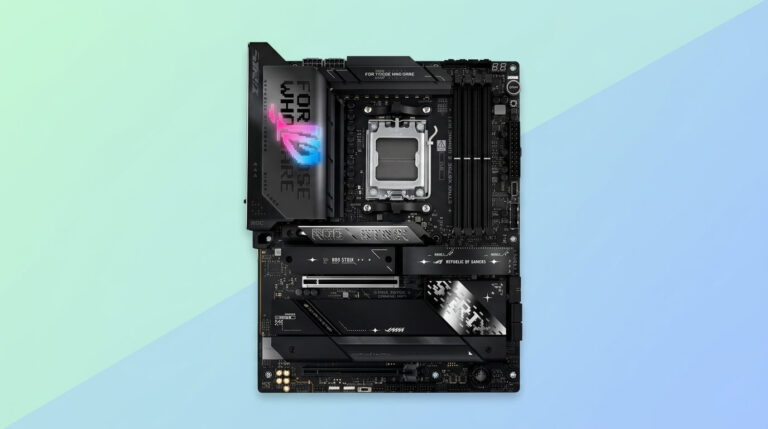
Asus ROG Strix B850-F Gaming WiFi
The Asus ROG Strix B850-F Gaming WiFi is an ATX motherboard built on AMD’s B850 chipset for AM5 Socket processors, supporting Ryzen 9000, Ryzen 8000, and Ryzen 7000 series desktop CPUs. Its VRM uses a 16+2+2 power-stage design rated at 80 A per stage, paired with dual ProCool power connectors, alloy chokes, and durable capacitors intended to handle multi-core Ryzen processors without thermal stress.
Four DDR5 DIMM slots, supported by Asus’s AEMP (AMD Enhanced Memory Profile) firmware feature, allow overclocked DDR5 kits with capacity up to 192 GB. The primary PCIe 5.0 x16 slot uses a SafeSlot retention bracket rated for heavy graphics cards, and the board includes four total M.2 slots — two running PCIe 5.0 x4 and two running PCIe 4.0 (x4 or x2 depending on installed CPU) — alongside two SATA 6 Gbps ports. Connectivity totals 19 USB ports including a 20 Gbps USB-C port, and networking is handled through Wi-Fi 7 and 2.5 GbE LAN.
Running a Ryzen 7000 or 9000 series CPU, the Strix B850-F’s 16+2+2 VRM handles even the more demanding Ryzen 9 chips without sustained thermal throttling, while the primary M.2 slots deliver full PCIe 5.0 x4 (16 GB/s) bandwidth exclusively when paired with a Ryzen 9000-series processor; Ryzen 8000-series chips step the same slots down to PCIe 4.0. Compared with the MSI MAG X870 Tomahawk WiFi, the Strix B850-F trades the X870 chipset’s USB4 ports and 5G LAN for a lower price point while matching its Wi-Fi 7 support and PCIe 5.0 graphics slot. Against ASRock’s X870E Taichi, the B850-F offers half as many full-bandwidth PCIe 5.0 x16 slots and two fewer M.2 sockets, positioning it as a mid-range alternative to the Taichi’s flagship feature set.
- Balanced VRM: 16+2+2 power stages at 80 A each comfortably support current Ryzen 9 processors in typical gaming and light overclocking scenarios.
- Storage speed: Two PCIe 5.0 M.2 slots (with a compatible Ryzen 9000 CPU) reach 16 GB/s, ahead of many same-tier boards limited to a single Gen5 slot.
- Broad USB support: 19 total USB ports, including a fast 20 Gbps Type-C connector, exceed typical B-series board connectivity.
- CPU-dependent M.2 speed: Full PCIe 5.0 M.2 performance requires a Ryzen 9000 series processor; earlier Ryzen chips run the same slots at PCIe 4.0.
- Fewer SATA ports: Two SATA 6 Gbps ports limit expansion for builds relying on multiple traditional hard drives or SATA SSDs.
| Specification | Detail |
|---|---|
| Socket / Chipset | AM5 / AMD B850 |
| CPU Support | Ryzen 9000 / 8000 / 7000 Series |
| VRM | 16+2+2 power stages, 80 A |
| Memory | 4x DDR5 DIMM, up to 192 GB, AEMP support |
| PCIe Slots | Primary PCIe 5.0 x16 (SafeSlot) |
| Storage | 2x M.2 PCIe 5.0 x4, 2x M.2 PCIe 4.0, 2x SATA 6 Gbps |
| USB | 19 total ports, incl. 20 Gbps Type-C |
| Networking | Wi-Fi 7, 2.5 GbE LAN |
| Form Factor | ATX |
Gigabyte B850I AORUS Pro
The Gigabyte B850I AORUS Pro is a Mini-ITX motherboard built on AMD’s B850 chipset for AM5 Socket processors, supporting Ryzen 9000, Ryzen 8000, and Ryzen 7000 series desktop CPUs. Its compact layout uses an 8+2+1 phase power design rated at 80 A per Smart Power Stage, cooled by VRM Thermal Armor Advanced and an M.2 Thermal Guard.
Two DDR5 DIMM slots support up to 128 GB of memory with overclocking speeds up to 8200–8400 MHz. The board includes a single PCIe 5.0 x16 slot for the graphics card and two M.2 slots, including one PCIe 5.0 x4 socket, reflecting the space constraints of the Mini-ITX form factor. Networking covers 2.5 GbE LAN and Wi-Fi 7 with a directional high-gain antenna, and connectivity includes USB-C along with GIGABYTE’s X3D Turbo Mode BIOS feature for optimizing frame rates on compatible Ryzen chips. The board retails at approximately $260.
With a Ryzen 7 or Ryzen 9 processor, the B850I AORUS Pro’s 80 A, 8-phase VRM works best for CPUs in the 65–105 W TDP range; it can run higher-TDP chips at stock but is more likely to experience thermal throttling under sustained heavy loads than a full-size ATX board with more phases. Compared with the Asus ROG Strix B850-F Gaming WiFi, the B850I AORUS Pro trades the Strix’s 16+2+2 VRM and four M.2 slots for a Mini-ITX footprint suited to small-form-factor gaming builds, at a lower price than most ATX B850 boards. Against other Mini-ITX AM5 boards, reviewers have noted it undercuts the Asus ROG Strix B850-I Gaming WiFi on price while including comparable Wi-Fi 7 and PCIe 5.0 support.
- Small-form-factor fit: Full PCIe 5.0 support and DDR5 memory in a Mini-ITX footprint suit compact gaming builds without sacrificing current-generation connectivity.
- Value positioning: At roughly $260, it undercuts many ATX B850 boards while retaining Wi-Fi 7 and a Gen5 M.2 slot.
- Effective cooling for its size: An M.2 cooling fan and double-sided heatsinks help manage thermals despite the compact PCB.
- Limited VRM headroom: The 8-phase, 80 A design is best matched to mid-TDP Ryzen CPUs rather than flagship Ryzen 9 chips under sustained overclocking.
- Two DIMM slots only: Memory capacity tops out at 128 GB across two slots, compared with 192–256 GB on four-DIMM ATX boards.
| Specification | Detail |
|---|---|
| Socket / Chipset | AM5 / AMD B850 |
| CPU Support | Ryzen 9000 / 8000 / 7000 Series |
| VRM | 8+2+1 phases, 80 A Smart Power Stage |
| Memory | 2x DDR5 DIMM, up to 128 GB, 8200–8400 MHz (OC) |
| PCIe Slots | 1x PCIe 5.0 x16 |
| Storage | 2x M.2 (incl. 1x PCIe 5.0 x4) |
| USB | USB-C, USB 3.2 Gen 2 |
| Networking | Wi-Fi 7, 2.5 GbE LAN |
| Form Factor | Mini-ITX |
| Price | ~$260 |
Gigabyte B840M DS3H
The Gigabyte B840M DS3H is a micro-ATX motherboard built on AMD’s entry-level B840 chipset for AM5 Socket processors, supporting Ryzen 9000, Ryzen 8000, and Ryzen 7000 series desktop CPUs. It uses a Digital 8+2+2 phase VRM solution and a UD Solid Pin 8-pin CPU power connector, positioning it as a budget-focused board within the AM5 lineup.
Four DDR5 DIMM slots support dual-channel memory with AMD EXPO compatibility, overclocking up to 8200 MHz, and a maximum capacity of 128 GB. The B840M DS3H provides one PCIe 4.0 x16 slot and one PCIe 3.0 x4 slot, along with two PCIe 4.0 M.2 slots and four SATA 6 Gbps ports supporting RAID 0, 1, 5, and 10 configurations. Connectivity includes 2.5 GbE LAN and USB 3.2 Gen 1 ports, and the board omits PCIe 5.0 and Wi-Fi in its base configuration. It retails for approximately $185.
Paired with a mid-range Ryzen chip such as the Ryzen 5 8500G or Ryzen 5 7600, the B840M DS3H’s 8+2+2 VRM works best for CPUs in the 65–105 W TDP range and can technically run higher-TDP processors at stock, though it will likely throttle under sustained heavy loads. Compared with the Gigabyte B850I AORUS Pro, the B840M DS3H drops PCIe 5.0 support entirely and offers no integrated Wi-Fi, reflecting the B840 chipset’s position below B850 in Gigabyte’s AM5 lineup, at roughly $75 less. Against the Asus Prime H810M-A WiFi on Intel’s platform, the B840M DS3H targets a similar budget-conscious buyer but on AMD’s more upgrade-friendly AM5 socket, which Intel’s LGA1851 platform does not match in longevity commitments.
- Budget AM5 entry point: DDR5 support and AM5 socket compatibility at an entry-level price make this a low-cost route into the current AMD platform.
- Solid RAID support: Four SATA ports with RAID 0/1/5/10 give budget builders flexible storage configuration options.
- X3D Turbo Mode: A one-click BIOS feature aims to improve gaming frame rates on compatible Ryzen chips without manual tuning.
- No PCIe 5.0: The single PCIe 4.0 x16 graphics slot and PCIe 4.0 M.2 slots limit future-proofing against next-generation GPUs and SSDs.
- No integrated wireless: Builders need a separate Wi-Fi adapter or wired connection, since the base DS3H model lacks Wi-Fi hardware.
| Specification | Detail |
|---|---|
| Socket / Chipset | AM5 / AMD B840 |
| CPU Support | Ryzen 9000 / 8000 / 7000 Series |
| VRM | 8+2+2 phases (Digital) |
| Memory | 4x DDR5 DIMM, up to 128 GB, 8200 MHz (OC) |
| PCIe Slots | 1x PCIe 4.0 x16, 1x PCIe 3.0 x4 |
| Storage | 2x M.2 PCIe 4.0, 4x SATA 6 Gbps (RAID 0/1/5/10) |
| USB | USB 3.2 Gen 1 |
| Networking | 2.5 GbE LAN (no integrated Wi-Fi) |
| Form Factor | Micro-ATX |
| Price | ~$185 |
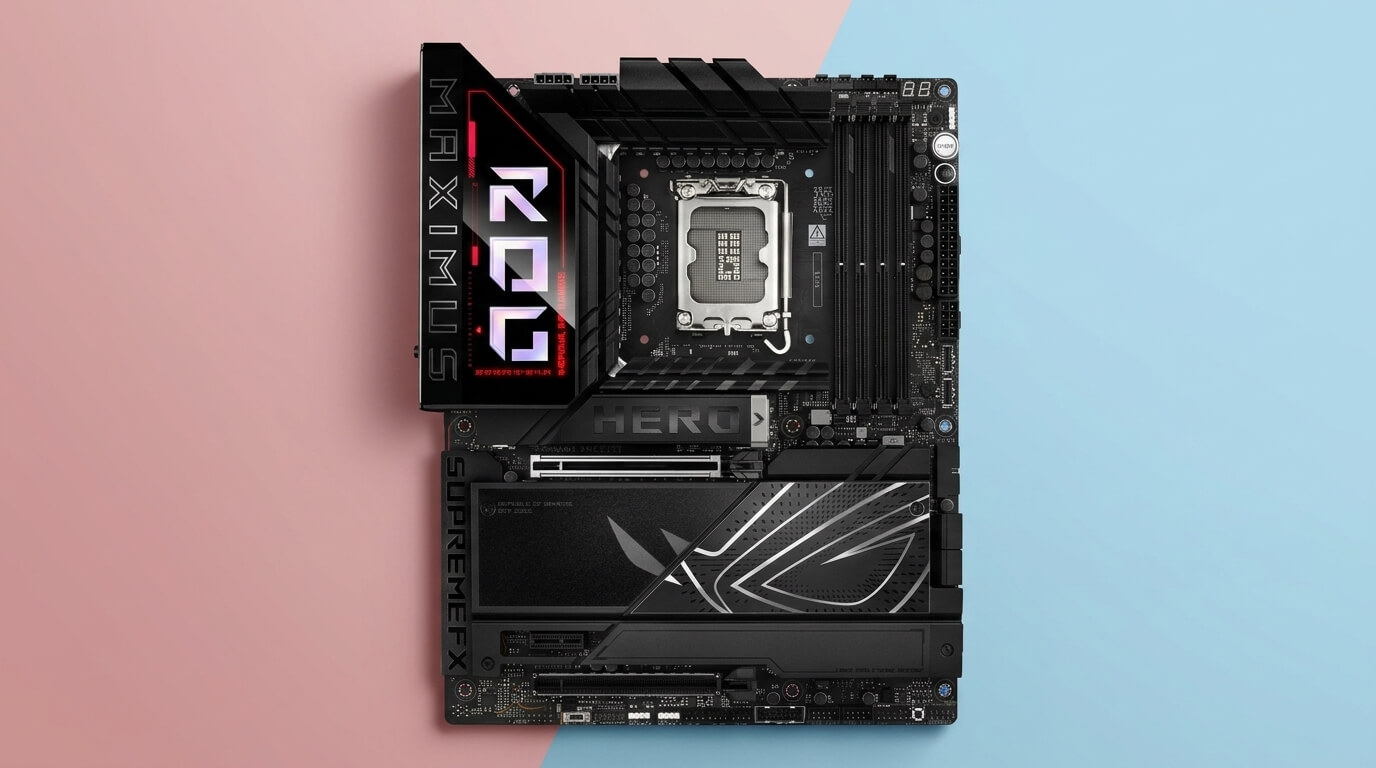
Asus ROG Maximus Z890 Hero
The Asus ROG Maximus Z890 Hero is a flagship ATX motherboard built on Intel’s Z890 chipset for LGA1851 Socket processors, supporting Intel Core Ultra Series 2 desktop CPUs. Its power delivery uses a 22+2+1+2 stage design, with a VRM heatsink connected to the aluminum I/O cover through an embedded heatpipe to maximize thermal dissipation mass.
Four DDR5 DIMM slots support up to 256 GB of memory using Asus’s NitroPath DRAM technology, DIMM Fit, DIMM Flex, and AEMP III tuning features. The board includes a primary PCIe 5.0 x16 SafeSlot with Q-Release Slim, a secondary PCIe 4.0 x16 slot, and a PCIe 4.0 x1 slot. Storage totals six M.2 slots — three capable of PCIe 5.0 x4 speeds and three running PCIe 4.0 x4 — plus a SlimSAS connector and four SATA 6 Gbps ports. Audio runs through a SupremeFX ALC4082 codec paired with an ESS ES9219 DAC and Dolby Atmos support, and networking includes Wi-Fi 7. A single Thunderbolt 4 header is present, though the board omits a Thunderbolt 5 header.
With an Intel Core Ultra 9 285K, independent testing found the Maximus Z890 Hero’s 22-phase VRM sustained over 320 W to the CPU package while keeping VRM temperatures controlled, reflecting the board’s flagship-tier power delivery. Compared with the ASRock X870E Taichi on AMD’s platform, the Maximus Z890 Hero offers two additional M.2 slots (six versus four) and a comparably robust VRM, illustrating each manufacturer’s flagship approach on their respective 2025-era platforms. Against the ASRock B860 Steel Legend WiFi within Intel’s own LGA1851 lineup, the Maximus Z890 Hero adds Thunderbolt 4, three additional M.2 slots, and unrestricted overclocking support that the B-series chipset does not offer.
- Exceptional VRM headroom: 22+2+1+2 power stages sustain flagship Core Ultra 9 processors well beyond their rated power limits without excessive thermal stress.
- Extensive M.2 storage: Six M.2 slots, three at PCIe 5.0 speeds, exceed most competing Z890 boards.
- Premium audio: The SupremeFX ALC4082 and ESS ES9219 DAC combination delivers audio quality closer to dedicated sound cards than typical onboard solutions.
- No Thunderbolt 5: Despite its flagship positioning, the board includes only Thunderbolt 4, not the newer, faster Thunderbolt 5 standard.
- High price and power draw: The board’s premium components and VRM design carry a correspondingly high price and are only fully justified with a high-end Core Ultra 9 CPU.
| Specification | Detail |
|---|---|
| Socket / Chipset | LGA1851 / Intel Z890 |
| CPU Support | Intel Core Ultra Series 2 |
| VRM | 22+2+1+2 power stages |
| Memory | 4x DDR5 DIMM, up to 256 GB |
| PCIe Slots | 1x PCIe 5.0 x16, 1x PCIe 4.0 x16, 1x PCIe 4.0 x1 |
| Storage | 6x M.2 (3x PCIe 5.0 x4, 3x PCIe 4.0 x4), SlimSAS, 4x SATA 6 Gbps |
| USB | Thunderbolt 4, USB 20 Gbps front panel |
| Networking | Wi-Fi 7 |
| Audio | SupremeFX ALC4082 + ESS ES9219 DAC |
| Form Factor | ATX |
ASRock B860 Steel Legend WiFi
The ASRock B860 Steel Legend WiFi is an ATX motherboard built on Intel’s B860 chipset for LGA1851 Socket processors, supporting Intel Core Ultra Series 2 desktop CPUs. Its power delivery uses a 14+1+1+1+1 phase design with 80 A Dr.MOS power stages (Vishay SiC659) controlled by a Richtek RT3638AJ PWM controller, covering VCore, GT, and SA power rails.
Four DDR5 DIMM slots support memory up to 8666+ MHz (OC) with Clocked Unbuffered DIMM (CUDIMM) compatibility and a maximum capacity of 256 GB. Expansion includes a PCIe 5.0 x16 slot for the graphics card and a secondary PCIe 4.0 x16 slot, alongside four M.2 slots — one PCIe 5.0 x4 “Blazing M.2,” two PCIe 4.0 x4 “Hyper M.2,” and one PCIe 4.0 x2 slot — plus four SATA 6 Gbps ports. Connectivity includes a rear Thunderbolt 4/USB4 Type-C port, a front-panel USB 3.2 Gen2x2 Type-C header, and networking through 2.5G LAN and Wi-Fi 6E. The board retails at approximately $200.
With a Core Ultra 5 or Core Ultra 7 processor, independent testing recorded a VRM temperature of 45°C and a peak CPU package power of 223 W under Cinebench load, indicating the 14-phase VRM keeps pace with mid-range and upper-mid-range Core Ultra chips without overheating. Because the B860 chipset does not support CPU overclocking, the Steel Legend WiFi is best paired with non-K-equivalent Core Ultra processors rather than parts intended for manual frequency tuning. Compared with the Asus ROG Maximus Z890 Hero, the Steel Legend WiFi drops Thunderbolt 5, overclocking support, and two-thirds of the Hero’s M.2 slot count, but costs roughly half as much. Against the ASRock B760M PG Sonic WiFi from the previous LGA1700 generation, the Steel Legend WiFi adds a full PCIe 5.0 M.2 slot and Thunderbolt 4 connectivity absent from the older board.
- Strong VRM for its tier: 80 A Dr.MOS stages and effective cooling kept VRM temperatures at 45°C under sustained load in independent testing, competitive with pricier Z890 boards.
- PCIe 5.0 storage: A dedicated Blazing M.2 Gen5 slot stayed at a peak 69°C in testing, cooler than several higher-priced Z890 competitors’ Gen5 SSD implementations.
- Thunderbolt 4 at a mid-range price: Few B-series boards in this price range include a rear Thunderbolt 4 port.
- No overclocking support: The B860 chipset does not unlock CPU multiplier adjustment, limiting the board’s appeal for tuning enthusiasts.
- Wi-Fi 6E rather than Wi-Fi 7: ASRock omitted the newer wireless standard on this model despite its otherwise current feature set.
| Specification | Detail |
|---|---|
| Socket / Chipset | LGA1851 / Intel B860 |
| CPU Support | Intel Core Ultra Series 2 |
| VRM | 14+1+1+1+1 phases, 80 A Dr.MOS |
| Memory | 4x DDR5 DIMM, up to 8666+ MHz (OC), 256 GB max |
| PCIe Slots | 1x PCIe 5.0 x16, 1x PCIe 4.0 x16 |
| Storage | 1x M.2 PCIe 5.0 x4, 2x M.2 PCIe 4.0 x4, 1x M.2 PCIe 4.0 x2, 4x SATA 6 Gbps |
| USB | Thunderbolt 4/USB4 Type-C, USB 3.2 Gen2x2 front |
| Networking | 2.5G LAN, Wi-Fi 6E |
| Form Factor | ATX |
| Price | ~$200 |
Asus Prime H810M-A WiFi
The Asus Prime H810M-A WiFi is a micro-ATX motherboard built on Intel’s entry-level H810 chipset for LGA1851 Socket processors, supporting Intel Core Ultra Series 2 desktop CPUs. Its power delivery uses a 6+1+1+1 Discrete MOS design on a 4-layer PCB, reflecting the board’s position as a budget option rather than a performance-oriented one.
Two DDR5 DIMM slots support memory up to 6400 MT/s with a maximum capacity of 96 GB. The board provides a single PCIe 4.0 x16 slot and a PCIe 4.0 x1 slot, along with two M.2 slots — one PCIe 4.0 x4 and one PCIe 4.0 x2 — and four SATA 6 Gbps ports. Rear connectivity includes two USB 10 Gbps Type-A ports and four USB 2.0 ports, with a front-panel USB 5 Gbps Type-C header. Networking covers Wi-Fi 6 and Gigabit Ethernet, and audio runs through a Realtek 7.1 surround codec. The board retails at approximately $130.
Paired with a non-overclockable Core Ultra 5 or entry Core Ultra 7 processor, the H810M-A WiFi’s 6-phase VRM is rated for roughly 143 W of sustained power delivery, about 57% of what a flagship Core Ultra 9 chip draws under load, making it a better match for mid-range processors than top-tier ones. Compared with the ASRock B860 Steel Legend WiFi, the H810M-A WiFi drops to two DIMM slots from four, a single PCIe 4.0 M.2 from a PCIe 5.0 Gen5 slot, and Wi-Fi 6 from Wi-Fi 6E, reflecting the H810 chipset’s position at the bottom of Intel’s 800-series lineup. Against the Gigabyte B840M DS3H on AMD’s platform, the H810M-A WiFi similarly targets budget-conscious builders but with less memory capacity and fewer M.2 slots.
- Lowest entry cost on LGA1851: At roughly $130, this is among the least expensive routes into Intel’s Core Ultra Series 2 platform.
- Basic RGB and cooling support: Three Addressable Gen 2 headers allow limited Aura Sync lighting customization despite the budget positioning.
- Q-Design conveniences: Q-Dashboard, Q-DIMM, and Q-LED Core diagnostics simplify troubleshooting for first-time builders.
- Two DIMM slots only: Memory capacity tops out at 96 GB, and only dual-channel configurations with two modules are possible.
- Limited expansion: A single PCIe 4.0 x16 slot and two PCIe 4.0 M.2 slots restrict this board to basic gaming builds without PCIe 5.0 components.
| Specification | Detail |
|---|---|
| Socket / Chipset | LGA1851 / Intel H810 |
| CPU Support | Intel Core Ultra Series 2 |
| VRM | 6+1+1+1 Discrete MOS |
| Memory | 2x DDR5 DIMM, up to 96 GB, 6400 MT/s |
| PCIe Slots | 1x PCIe 4.0 x16, 1x PCIe 4.0 x1 |
| Storage | 1x M.2 PCIe 4.0 x4, 1x M.2 PCIe 4.0 x2, 4x SATA 6 Gbps |
| USB | 2x USB 10 Gbps, 4x USB 2.0, front USB 5 Gbps Type-C |
| Networking | Wi-Fi 6, Gigabit Ethernet |
| Audio | Realtek 7.1 Surround |
| Form Factor | Micro-ATX |
| Price | ~$130 |
MSI MAG B650 Tomahawk WiFi
The MSI MAG B650 Tomahawk WiFi is an ATX motherboard built on AMD’s B650 chipset for AM5 Socket processors, supporting Ryzen 9000, Ryzen 8000, and Ryzen 7000 series desktop CPUs. Its 14+2+1 power stage design, paired with dual 8-pin power connectors and MSI’s Core Boost technology, is rated to sustain CPU power loads of up to 170 W.
Four DDR5 DIMM slots support dual-channel memory with AMD EXPO compatibility. The board provides two PCIe 4.0/3.0 x16 slots, with the primary slot reinforced by MSI’s Steel Armor, along with three M.2 slots — two wired to the CPU at up to PCIe 4.0 x4 and one wired to the chipset — plus six SATA 6 Gbps ports. Connectivity includes a USB 3.2 Gen2x2 Type-C port at 20 Gbps, and networking covers 2.5G LAN through a Realtek RTL8125BG controller, Wi-Fi 6E, and Bluetooth 5.2. Audio runs through a 7.1-channel codec with Audio Boost 5. The MAG B650 Tomahawk WiFi launched at a $259 MSRP and has since been observed selling for as low as roughly $172.
With a Ryzen 7 7700X or Ryzen 5 7600X, the MAG B650 Tomahawk WiFi’s VRM handles either processor without difficulty; it can also run a Ryzen 9 7950X, though that CPU is not the board’s ideal match given the more modest 14-phase design compared with X870E-tier boards. Compared with the MSI MAG X870 Tomahawk WiFi, the B650 Tomahawk WiFi lacks PCIe 5.0 entirely on both the graphics slot and M.2 slots, and drops from Wi-Fi 7 to Wi-Fi 6E, reflecting the generational gap between the B650 and X870 chipsets. Against the Gigabyte X670 AORUS Elite AX, the B650 Tomahawk WiFi offers one fewer M.2 slot but a comparable VRM tier at a similar or lower price, making it a frequently recommended value pick within the AM5 lineup.
- Reliable value pick: Reviewers have repeatedly cited this board as delivering strong VRM performance and connectivity relative to its price, particularly at its reduced current street price.
- Ample SATA connectivity: Six SATA 6 Gbps ports exceed what most same-tier B650 boards provide.
- Effective thermal design: MSI’s M.2 Shield Frozr and extended VRM heatsink keep temperatures controlled without requiring active cooling.
- No PCIe 5.0 support: Neither the graphics slot nor any M.2 slot reaches PCIe 5.0 speeds, a gap compared with newer X870-series boards.
- Wi-Fi 6E instead of Wi-Fi 7: Builders wanting the latest wireless standard need to look to the X870 Tomahawk or a comparable newer board.
| Specification | Detail |
|---|---|
| Socket / Chipset | AM5 / AMD B650 |
| CPU Support | Ryzen 9000 / 8000 / 7000 Series |
| VRM | 14+2+1 phases (up to 170 W sustained) |
| Memory | 4x DDR5 DIMM, AMD EXPO support |
| PCIe Slots | 2x PCIe 4.0/3.0 x16 |
| Storage | 3x M.2 (up to PCIe 4.0 x4), 6x SATA 6 Gbps |
| USB | USB 3.2 Gen2x2 Type-C (20 Gbps) |
| Networking | 2.5G LAN, Wi-Fi 6E, Bluetooth 5.2 |
| Form Factor | ATX |
| Price | $259 MSRP (street price from ~$172) |
MSI MPG X670E Carbon WiFi
The MSI MPG X670E Carbon WiFi is an ATX motherboard built on AMD’s X670E chipset for AM5 Socket processors, supporting Ryzen 9000 and Ryzen 7000 series desktop CPUs. Its power design uses an 18+2+1 Duet Rail Power System built on Infineon TDA21490 90 A power stages controlled by an XDPE192C3B PWM controller, the same components MSI uses on its higher-tier MEG X670E ACE, laid out across an 8-layer, 2 oz copper server-grade PCB.
Four DDR5 DIMM slots support up to 128 GB of memory. The board includes two PCIe 5.0 x16 slots (running x16/x0 or x8/x8 when both are populated) plus a PCIe 4.0 x16 slot wired at x4, and four M.2 slots — two PCIe 5.0 x4 “Lightning Gen 5” slots wired to the CPU and two PCIe 4.0 x4 slots wired to the chipset. Connectivity includes a USB 3.2 Gen2x2 Type-C port at 20 Gbps and multiple USB 3.2 Gen2 10 Gbps ports, alongside Wi-Fi 6E, 2.5 GbE LAN, and Bluetooth 5.3.
With a Ryzen 9 7950X, the Carbon WiFi’s 18-phase, 90 A power stages sustain CPU power loads up to 170 W without the throttling risk of lighter B650-tier boards, and its double-sided M.2 Shield Frozr keeps Gen5 SSDs from thermal throttling during sustained sequential transfers. Compared with the ASRock X870E Taichi, the Carbon WiFi predates the X870E generation and lacks USB4 and Wi-Fi 7, though its VRM component quality (Infineon 90 A stages) is comparable to the Taichi’s 110 A SPS design. Against the MSI MAG B650 Tomahawk WiFi, the Carbon WiFi adds a second PCIe 5.0 M.2 slot, a stronger 18-phase VRM, and dual full-bandwidth-capable PCIe 5.0 graphics slots, reflecting the price gap between B650 and X670E boards.
- Strong VRM component quality: 90 A Infineon power stages shared with MSI’s higher-tier MEG boards support sustained overclocking on flagship Ryzen 9 CPUs.
- Dual Gen5 M.2 slots: Two PCIe 5.0 x4 M.2 sockets from the CPU allow two fast primary drives rather than one.
- Physical RGB disable switch: A dedicated switch turns off all onboard lighting without needing software, a convenience many competing boards omit.
- No USB4 or Wi-Fi 7: As an X670E-generation board, it lacks the USB4 ports and Wi-Fi 7 module found on newer X870E boards like the ASRock X870E Taichi.
- Reduced M.2 clearance: The wider gap between the CPU socket and the first PCIe slot needed to fit two M.2 sockets lowers the mounting position of installed graphics cards.
| Specification | Detail |
|---|---|
| Socket / Chipset | AM5 / AMD X670E |
| CPU Support | Ryzen 9000 / 7000 Series |
| VRM | 18+2+1 phases, 90 A (Infineon TDA21490) |
| Memory | 4x DDR5 DIMM, up to 128 GB |
| PCIe Slots | 2x PCIe 5.0 x16, 1x PCIe 4.0 x16 (x4) |
| Storage | 2x M.2 PCIe 5.0 x4, 2x M.2 PCIe 4.0 x4 |
| USB | USB 3.2 Gen2x2 Type-C (20 Gbps), multiple USB 3.2 Gen2 |
| Networking | Wi-Fi 6E, 2.5 GbE LAN, Bluetooth 5.3 |
| Form Factor | ATX |
Gigabyte X670 AORUS Elite AX
The Gigabyte X670 AORUS Elite AX is an ATX motherboard built on AMD’s X670 chipset for AM5 Socket processors, supporting Ryzen 7000, Ryzen 8000, and Ryzen 9000 series desktop CPUs. Its VRM uses a 16+2+2 digital design with 70 A smart power stages, described by Gigabyte as an “8+8 phases parallel power design,” cooled by an 8 mm mega-heatpipe running through the VRM heatsink.
Four DDR5 DIMM slots support up to 256 GB of memory with overclocking speeds up to 8000 MHz. Expansion includes one full PCIe 4.0 x16 slot, a second PCIe 4.0 x16 slot operating at x4, and a PCIe 3.0 x16 slot operating at x2, alongside four M.2 slots — one PCIe 5.0 x4 wired to the CPU and three PCIe 4.0 x4 slots wired to the chipset — and four SATA 6 Gbps ports. Networking runs through an integrated 802.11ax (Wi-Fi 6E) module, and the board notably omits onboard RGB lighting in favor of a minimalist black-and-space-gray design.
With a Ryzen 7 7700X or similar mid-range Ryzen chip, the X670 AORUS Elite AX’s 70 A power stages provide comfortable headroom, and reviewers running the board for extended periods reported no VRM-related stability issues even without extreme overclocking. Compared with the MSI MPG X670E Carbon WiFi, the AORUS Elite AX offers PCIe 4.0 rather than PCIe 5.0 on its graphics slots, since the X670 chipset (versus X670E) does not guarantee Gen5 GPU bandwidth, though both boards share the same one-Gen5-M.2-slot allowance from the CPU. Against the Gigabyte B850I AORUS Pro, the X670 AORUS Elite AX offers twice the M.2 slot count and a larger ATX form factor, at the cost of the newer B850 chipset’s updated I/O.
- Reliable mid-tier VRM: 16+2+2 phases at 70 A per stage provide stable power delivery for mainstream and upper-mid-range Ryzen CPUs.
- Four M.2 slots: One PCIe 5.0 and three PCIe 4.0 sockets give more storage flexibility than many same-price competitors.
- EZ-Latch mechanisms: Toolless PCIe and M.2 latches simplify installation and component swaps.
- PCIe 4.0 graphics slot only: The X670 (non-E) chipset does not guarantee PCIe 5.0 bandwidth to the graphics card, unlike X670E boards such as the MSI MPG X670E Carbon WiFi.
- No onboard RGB: Builders wanting integrated lighting effects will need to add their own RGB components, since the board includes headers but no onboard LEDs.
| Specification | Detail |
|---|---|
| Socket / Chipset | AM5 / AMD X670 |
| CPU Support | Ryzen 9000 / 8000 / 7000 Series |
| VRM | 16+2+2 phases, 70 A Smart Power Stage |
| Memory | 4x DDR5 DIMM, up to 256 GB, 8000 MHz (OC) |
| PCIe Slots | 1x PCIe 4.0 x16, 1x PCIe 4.0 x16 (x4), 1x PCIe 3.0 x16 (x2) |
| Storage | 1x M.2 PCIe 5.0 x4, 3x M.2 PCIe 4.0 x4, 4x SATA 6 Gbps |
| USB | USB 3.2 Gen2x2 Type-C, 8x USB 3.2 Gen1 |
| Networking | Wi-Fi 6E (802.11ax) |
| Form Factor | ATX |
MSI MAG Z790 Tomahawk WiFi
The MSI MAG Z790 Tomahawk WiFi is an ATX motherboard built on Intel’s Z790 chipset for LGA1700 Socket processors, supporting 12th, 13th, and 14th Gen Intel Core desktop CPUs. Its power delivery uses a 16+1+1 Mirrored Power Arrangement with 90 A SPS stages and dual 8-pin CPU power connectors, built on a 6-layer server-grade PCB.
Four DDR5 DIMM slots support current-generation Intel memory configurations. The board includes a PCIe 5.0 x16 slot for the graphics card, a secondary PCIe 4.0 x16 slot operating at x4, and a PCIe 3.0 x1 slot, alongside four M.2 slots — one PCIe 5.0 x4 slot that shares bandwidth with the graphics slot, and three PCIe 4.0 x4 slots — plus seven SATA 6 Gbps ports. Connectivity includes a USB 3.2 Gen2x2 port, and networking covers Wi-Fi 6E and 2.5G LAN through an Intel I225-V controller, with audio running through a Realtek ALC4080 codec.
With an Intel Core i9-13900K, PC Gamer’s testing found the Z790 Tomahawk’s VRM to be a standout feature relative to competing boards in its price range, comfortably handling the CPU’s power draw under sustained load. Compared with the ASRock B860 Steel Legend WiFi on Intel’s newer LGA1851 platform, the Z790 Tomahawk offers seven SATA ports against the Steel Legend’s four, reflecting older-generation Z790 boards’ emphasis on SATA connectivity, though the Steel Legend gains Thunderbolt 4 and CUDIMM memory support that the Z790-era board lacks. Against the Asus ROG Maximus Z890 Hero, the Z790 Tomahawk is a previous-generation, lower-tier alternative that trades away six total M.2 slots and Thunderbolt 4 for a substantially lower price on the outgoing LGA1700 platform.
- Excellent SATA connectivity: Seven SATA 6 Gbps ports exceed what most current-generation boards, including many Z890 models, provide.
- Strong VRM for its price class: Independent reviews highlighted the 16+1+1, 90 A VRM as a standout relative to similarly priced competitors.
- PCIe 5.0 graphics and M.2 support: Despite being built for the outgoing LGA1700 socket, the board includes both a PCIe 5.0 graphics slot and a Gen5 M.2 slot.
- Shared M.2 and GPU bandwidth: Installing an NVMe drive in the primary Gen5 M.2 slot reduces the graphics slot to x8 mode.
- Legacy platform: LGA1700 does not support newer Intel Core Ultra Series 2 CPUs, limiting future CPU upgrade paths compared with LGA1851 boards.
| Specification | Detail |
|---|---|
| Socket / Chipset | LGA1700 / Intel Z790 |
| CPU Support | Intel 12th / 13th / 14th Gen Core |
| VRM | 16+1+1 phases, 90 A SPS |
| Memory | 4x DDR5 DIMM |
| PCIe Slots | 1x PCIe 5.0 x16, 1x PCIe 4.0 x16 (x4), 1x PCIe 3.0 x1 |
| Storage | 1x M.2 PCIe 5.0 x4 (shared with GPU slot), 3x M.2 PCIe 4.0 x4, 7x SATA 6 Gbps |
| USB | USB 3.2 Gen2x2 |
| Networking | Wi-Fi 6E, 2.5G LAN |
| Audio | Realtek ALC4080 |
| Form Factor | ATX |
ASRock B760M PG Sonic WiFi
The ASRock B760M PG Sonic WiFi is a micro-ATX motherboard built on Intel’s B760 chipset for LGA1700 Socket processors, supporting 12th, 13th, and 14th Gen Intel Core desktop CPUs. Its power delivery uses a 12+1+1 phase design with Dr.MOS components rated for VCore and GT power rails, built on a 6-layer PCB, and finished with a Sonic the Hedgehog-themed heatsink design under an official Sega license.
Four DDR5 DIMM slots support memory up to 7200+ MHz (OC), with capacity up to 192 GB using four 48 GB modules. The board includes a PCIe 5.0 x16 slot wired to the CPU and a PCIe 4.0 x1 slot from the chipset, alongside three PCIe 4.0 x4 “Hyper M.2” slots (one wired to the CPU, two to the chipset) and four SATA 6 Gbps ports supporting RAID 0, 1, 5, and 10. Networking covers 2.5G “Dragon” LAN and Wi-Fi 6E with Bluetooth, and audio runs through a Realtek ALC897 7.1-channel codec. The board retails at approximately $190.
With a non-K Intel Core i5 or i7 processor, the B760M PG Sonic’s 12+1+1 VRM provides adequate power delivery, since the B760 chipset does not support CPU multiplier overclocking; ASRock does not publish an amperage rating for the phases, consistent with a board not designed to drive overclocked K-series processors. Compared with the MSI MAG Z790 Tomahawk WiFi, the B760M PG Sonic drops from a 90 A, 16-phase VRM to an unrated 12-phase design and from seven SATA ports to four, reflecting the price and chipset-tier gap between Z790 and B760 boards. Against the ASRock B860 Steel Legend WiFi on Intel’s newer LGA1851 platform, the PG Sonic offers comparable DDR5 overclocking headroom but lacks Thunderbolt connectivity and CUDIMM support found on the newer board.
- Distinctive design at a competitive price: The officially licensed Sonic the Hedgehog theme differentiates this board visually while remaining priced near typical B760 competitors.
- PCIe 5.0 graphics slot: Despite its budget mATX positioning, the board includes a full PCIe 5.0 x16 slot for the graphics card.
- Adequate storage for the price tier: Three M.2 slots and four SATA ports match or exceed many same-priced B760 boards.
- No PCIe 5.0 M.2 slot: All three M.2 sockets top out at PCIe 4.0 x4, despite the PCIe 5.0-capable graphics slot.
- Power-limited performance: Reviewers found the board applies conservative Intel power limits by default, requiring manual BIOS adjustment and improved cooling to unlock a flagship CPU’s full sustained performance.
| Specification | Detail |
|---|---|
| Socket / Chipset | LGA1700 / Intel B760 |
| CPU Support | Intel 12th / 13th / 14th Gen Core |
| VRM | 12+1+1 phases, Dr.MOS |
| Memory | 4x DDR5 DIMM, up to 7200+ MHz (OC), 192 GB max |
| PCIe Slots | 1x PCIe 5.0 x16, 1x PCIe 4.0 x1 |
| Storage | 3x M.2 PCIe 4.0 x4, 4x SATA 6 Gbps (RAID 0/1/5/10) |
| USB | USB 3.2 Gen2 Type-C, USB 3.2 Gen1 |
| Networking | 2.5G LAN, Wi-Fi 6E |
| Audio | Realtek ALC897 |
| Form Factor | Micro-ATX |
| Price | ~$190 |
How to Choose the Right Motherboard for Your Build
The right motherboard for a gaming build is the one whose socket matches the intended CPU, whose VRM matches that CPU’s sustained power draw, and whose PCIe and M.2 layout matches the graphics card and storage the build will use. Matching these three factors first narrows the choice to a small set of compatible boards before secondary factors such as form factor, networking, and price come into play.
Socket and chipset selection depends on which CPU generation the build targets. A build using AMD’s Ryzen 9000 or 7000 series processors requires an AM5 socket board on the X870E, X870, B850, B840, X670E, X670, or B650 chipset, while a build using Intel’s Core Ultra Series 2 processors requires an LGA1851 board on the Z890, B860, or H810 chipset; builds retaining a 12th, 13th, or 14th Gen Intel Core CPU require the older LGA1700 socket on a Z790 or B760 board. Within a socket, the chipset tier determines overclocking support and top-end PCIe bandwidth: X870E and Z890 unlock full overclocking and the most PCIe 5.0 lanes, B-series chipsets like B850 and B860 retain most connectivity but sometimes restrict CPU overclocking, and entry chipsets like B840 and H810 remove PCIe 5.0 and reduce DIMM or M.2 slot counts to reach a lower price point.
VRM phase count and amperage should scale with the CPU’s power draw rather than its core count alone, since a high-core CPU with a moderate TDP places less demand on the VRM than a smaller CPU pushed to its power limit. A board with 14 phases rated near 80 A per phase, such as the MSI MAG X870 Tomahawk WiFi or MSI MAG B650 Tomahawk WiFi reviewed above, comfortably runs mainstream and upper-mainstream CPUs at stock settings, while a flagship CPU intended for sustained all-core overclocking benefits from a board with 18 or more phases rated at 90 A or higher, such as the ASRock X870E Taichi, MSI MPG X670E Carbon WiFi, or Asus ROG Maximus Z890 Hero.
PCIe generation and M.2 slot count matter most for storage and future upgrades rather than for current graphics card performance, since no shipping consumer GPU saturates PCIe 4.0 x16 bandwidth; PCIe 5.0 on the graphics slot mainly protects against future GPU generations that may require it. A board with two or more PCIe 5.0 M.2 slots, such as the ASRock X870E Taichi or MSI MPG X670E Carbon WiFi, benefits builders who plan to run multiple fast NVMe drives, while a single Gen5 M.2 slot alongside PCIe 4.0 slots, as found on the Asus ROG Strix B850-F Gaming WiFi or ASRock B860 Steel Legend WiFi, is sufficient for a primary game drive paired with slower secondary storage.
Form factor and networking round out the decision once socket, VRM, and storage requirements are set. A Mini-ITX board like the Gigabyte B850I AORUS Pro suits a small-form-factor case at the cost of DIMM slots and expansion room, while an E-ATX or full ATX board like the ASRock X870E Taichi or Asus ROG Maximus Z890 Hero provides maximum connectivity for a full-tower build. Builders who value the fastest available wireless networking should prioritize boards with Wi-Fi 7, such as the MSI MAG X870 Tomahawk WiFi or ASRock X870E Taichi, over boards limited to Wi-Fi 6E or Wi-Fi 6, which remain adequate for most home networks but cap out at lower theoretical throughput.