
Table of Contents
The AMD Ryzen 5 7600X is a six-core, twelve-thread desktop processor built on the AM5 platform. It requires a motherboard with an AM5 socket and DDR5 memory support, since AM5 boards are not backward compatible with DDR4 or previous AMD sockets. The processor has a rated TDP of 105 W and a maximum boost package power of 142 W, so the motherboard’s power delivery, chipset, and cooling design directly affect how consistently the CPU sustains its boost clocks.
AM5 motherboards for the Ryzen 5 7600X are available on the B650, B650E, X670, and X670E chipsets. The B650 chipset covers the needs of this processor without the added PCIe 5.0 graphics bandwidth or premium pricing associated with X670E boards. A B650 or B650M board provides DDR5 memory support, PCIe 4.0 or partial PCIe 5.0 connectivity, and enough VRM capacity for a 105 W six-core CPU, making it the most cost-effective chipset tier for this processor.
This article reviews six B650-based motherboards suited to the Ryzen 5 7600X: the MSI MAG B650 Tomahawk WiFi, Gigabyte B650 AORUS Elite AX, ASUS TUF Gaming B650-Plus WiFi, ASRock B650 Steel Legend WiFi, MSI MAG B650M Mortar WiFi, and Gigabyte B650M AORUS Elite AX. Each review covers the board’s specifications, how those specifications apply to the Ryzen 5 7600X, and how the board compares with the others on this list.
The article closes with a buying guide that explains the criteria for selecting a motherboard for the Ryzen 5 7600X, including VRM capacity, memory support, storage configuration, and form factor.
THE SHORTLIST
This guide, at a glance
Compare the products covered below, then explore the strengths, limitations, and specifications that matter to you.
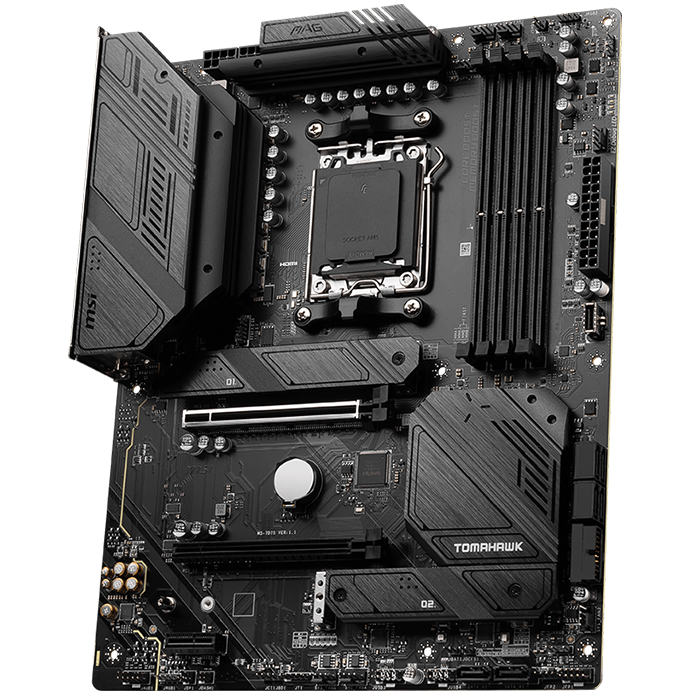 Check current priceView on Amazon: MSI MAG B650 Tomahawk WiFi (opens in a new tab)
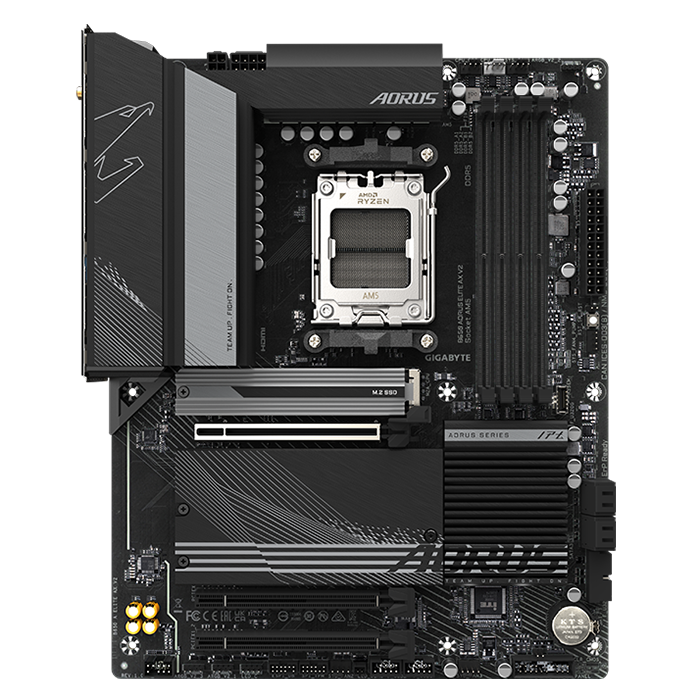 Check current priceView on Amazon: Gigabyte B650 AORUS Elite AX (opens in a new tab)
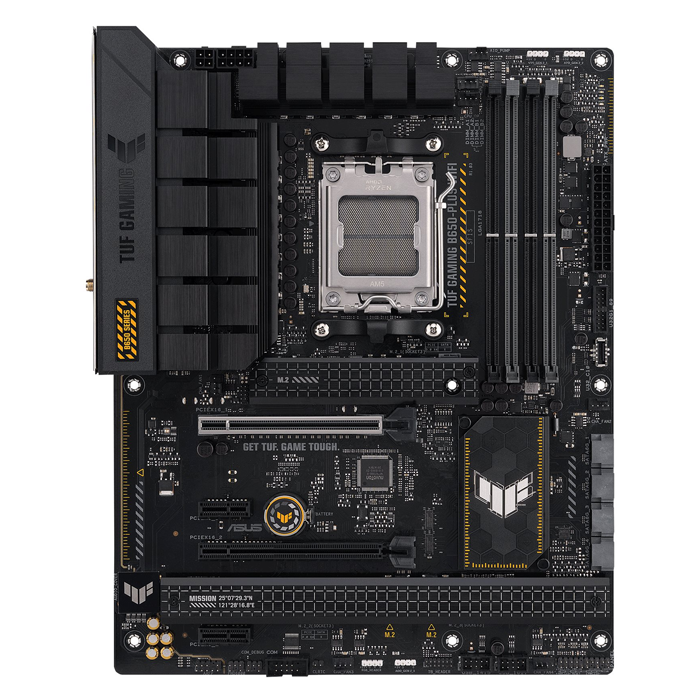 Check current priceView on Amazon: ASUS TUF Gaming B650-Plus WiFi (opens in a new tab)
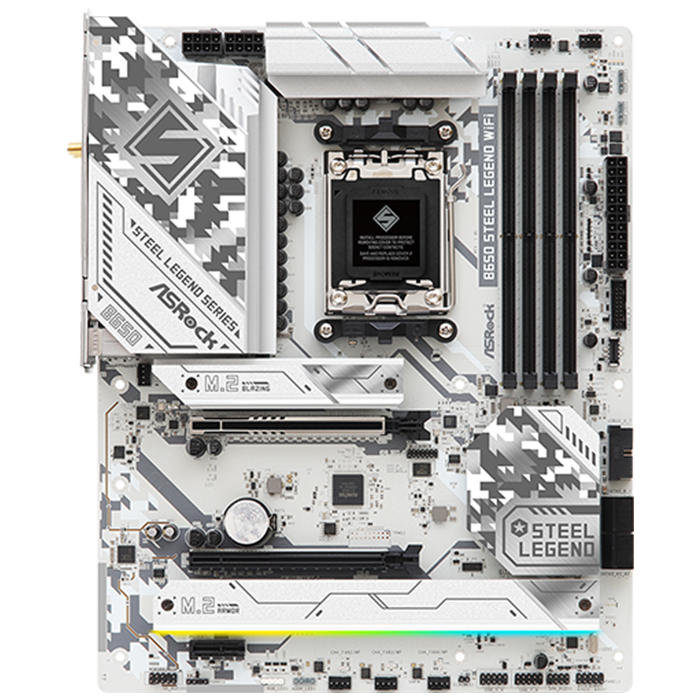 Check current priceView on Amazon: ASRock B650 Steel Legend WiFi (opens in a new tab)
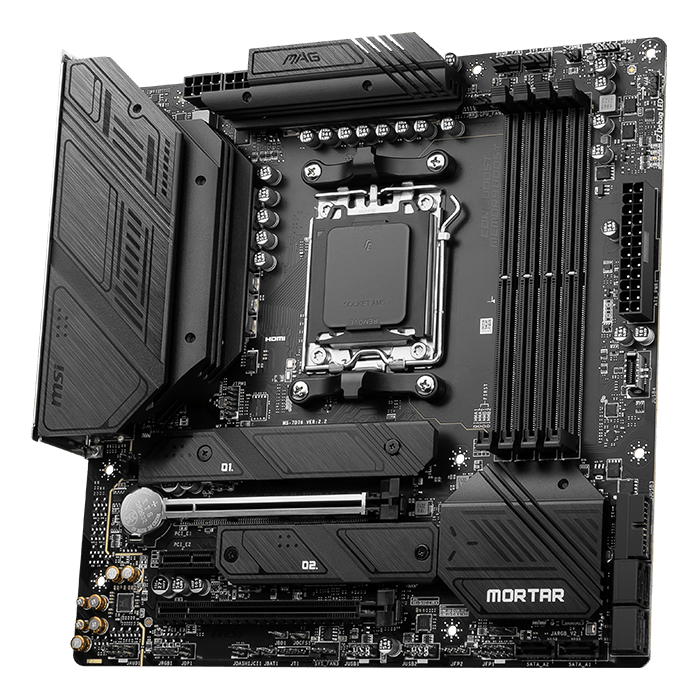 Check current priceView on Amazon: MSI MAG B650M Mortar WiFi (opens in a new tab)
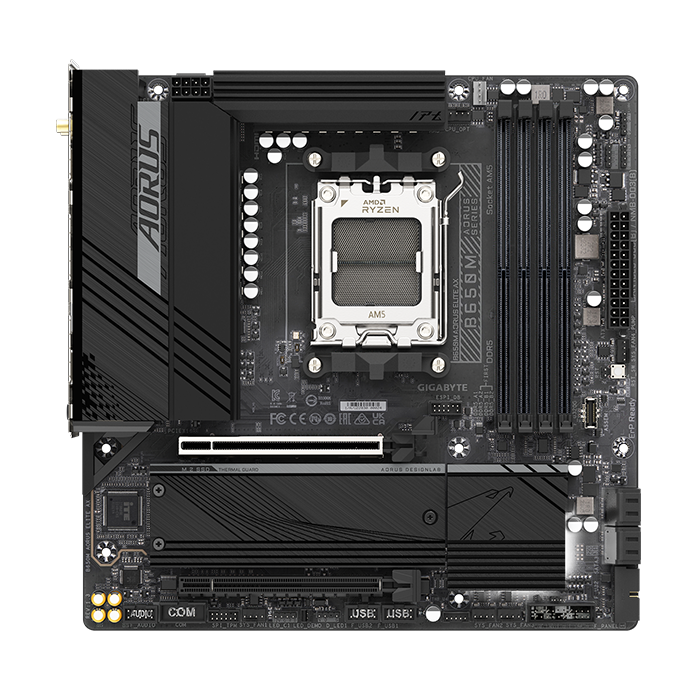 Check current priceView on Amazon: Gigabyte B650M AORUS Elite AX (opens in a new tab)
Purchase links open Amazon. Confirm the exact model, price, availability, and seller terms before ordering.
Best Motherboards for AMD Ryzen 5 7600X CPUs
MSI MAG B650 Tomahawk WiFi
Pricing and availability on Amazon
Pros & cons
Strengths
- Six SATA ports provide the most onboard storage expansion in this comparison.
- Its 14+2+1 80A VRM supports the Ryzen 5 7600X with boost headroom.
- WiFi 6E and 2.5GbE provide features typically found on pricier motherboards.
- The rear USB 3.2 Gen2x2 Type-C port supports 20Gbps transfers.
Limitations
- It lacks PCIe 5.0 support, unlike the ASRock B650 Steel Legend WiFi.
- All three M.2 slots support only PCIe 4.0 speeds.
- Its street price approaches B650E boards that include PCIe 5.0 support.
Review notes
The MSI MAG B650 Tomahawk WiFi is a full-size ATX motherboard built on the AMD B650 chipset for the AM5 socket. The board uses a 14+2+1 phase VRM with dual 8-pin CPU power connectors, delivering up to 80 A per phase and a stated CPU power capacity of 170 W. Four DDR5 DIMM slots support up to 128 GB of memory at speeds up to 6600+ MT/s (OC), with AMD EXPO profile support for one-click memory tuning.
Expansion consists of two PCIe 4.0 x16 slots (the second running at x4 electrically) and one PCIe 3.0 x1 slot. Storage totals three M.2 slots, all PCIe 4.0 x4, plus six SATA 6Gb/s ports, giving the board more onboard SATA connectivity than most other boards in this comparison. Networking includes WiFi 6E, Bluetooth 5.2 or 5.3 depending on revision, and a 2.5 GbE Realtek LAN controller. Audio runs through a Realtek ALC4080 codec. The rear I/O includes a USB 3.2 Gen 2×2 Type-C port rated at 20 Gbps, three USB 3.2 Gen 2 Type-A ports, four USB 3.2 Gen 1 ports, and two USB 2.0 ports, alongside HDMI 2.1 and DisplayPort 1.4 outputs for CPUs with integrated graphics.
The 14+2+1 phase VRM on the Tomahawk WiFi exceeds the power delivery a 105 W Ryzen 5 7600X requires, leaving headroom for sustained all-core boost and Precision Boost Overdrive tuning without VRM throttling. The 6600+ MT/s DDR5 support and EXPO compatibility let the platform take advantage of the 7600X’s memory-sensitive Zen 4 architecture, since the processor’s gaming and single-thread performance scales with memory frequency and latency.
Compared with the other boards in this list, the Tomahawk WiFi offers the highest SATA port count (six versus two to four on competing boards) and a stronger VRM than the ASUS TUF Gaming B650-Plus WiFi and both AORUS Elite AX boards. It sits below the ASRock B650 Steel Legend WiFi in PCIe generation, since the Steel Legend includes a PCIe 5.0 x16 slot and a PCIe 5.0 M.2 slot that the Tomahawk WiFi does not offer. Against the MSI MAG B650M Mortar WiFi, the Tomahawk WiFi trades the smaller Micro-ATX footprint for a larger ATX board with an additional M.2 slot and higher SATA count.
Specs & configuration
| Specification | Detail |
|---|---|
| Socket | AM5 |
| Chipset | AMD B650 |
| Form Factor | ATX |
| VRM Design | 14+2+1 phases, up to 80 A per phase |
| Memory Support | 4x DDR5 DIMM, up to 128 GB, up to 6600+ MT/s (OC), EXPO |
| PCIe Slots | 2x PCIe 4.0 x16 (x16/x4), 1x PCIe 3.0 x1 |
| M.2 Storage | 3x M.2 PCIe 4.0 x4 |
| SATA Ports | 6x SATA 6Gb/s |
| Networking | WiFi 6E, Bluetooth 5.2/5.3, 2.5 GbE LAN |
| Rear USB | 1x USB 3.2 Gen 2×2 Type-C (20Gbps), 3x USB 3.2 Gen 2, 4x USB 3.2 Gen 1, 2x USB 2.0 |
| Audio Codec | Realtek ALC4080 |
| Video Outputs | HDMI 2.1, DisplayPort 1.4 |
| Typical Street Price (USD) | $170–$230 (MSRP $259.99) |
Gigabyte B650 AORUS Elite AX
Pricing and availability on Amazon
Pros & cons
Strengths
- A PCIe 5.0 x4 M.2 slot supports next-generation NVMe SSDs.
- EZ-Latch mechanisms simplify GPU and M.2 installation without tools.
- Memory support up to 8000+ MT/s offers strong overclocking potential.
- Its twin-phase VRM design comfortably supports the Ryzen 5 7600X.
Limitations
- Four SATA ports provide less storage expansion than the MSI MAG B650 Tomahawk WiFi.
- Regional revisions vary, so buyers should confirm the exact motherboard revision.
- It lacks a PCIe 5.0 x16 graphics slot.
Review notes
The Gigabyte B650 AORUS Elite AX is an ATX motherboard on the AM5 socket built around the AMD B650 chipset. Depending on revision, the board uses either a 12+2+2 or a 14+2+1 twin-phase VRM design rated at 60 A to 70 A per stage, paired with a digital PWM controller. Four DDR5 DIMM slots support EXPO and XMP memory profiles at speeds up to 8000+ MT/s (OC) on later revisions, with a maximum capacity of 128 GB to 256 GB depending on the specific revision.
Storage includes one PCIe 5.0 x4 M.2 slot and two PCIe 4.0 x4 M.2 slots, along with four SATA 6Gb/s ports. Gigabyte’s EZ-Latch mechanism allows screwless removal of the PCIe x16 slot and M.2 modules. Networking covers WiFi 6E and a 2.5 GbE LAN controller. The rear I/O includes a USB-C port (USB 3.2 Gen 2), additional USB 3.2 Gen 2 and Gen 1 Type-A ports, HDMI, and DisplayPort outputs. The board uses a Realtek audio codec, with the exact model varying by revision.
The B650 AORUS Elite AX’s VRM design provides sufficient current for the Ryzen 5 7600X’s 105 W TDP and 142 W boost package power, keeping the CPU within its rated power envelope during sustained multi-core workloads. The board’s PCIe 5.0 M.2 slot lets the 7600X pair with next-generation NVMe storage even though the CPU itself communicates with the chipset over PCIe 4.0, since the PCIe 5.0 bandwidth on this board is chipset-fed rather than CPU-fed.
Against the MSI MAG B650 Tomahawk WiFi, the AORUS Elite AX offers a PCIe 5.0 M.2 slot that the Tomahawk WiFi lacks, but it provides fewer SATA ports (four versus six). Compared with the ASUS TUF Gaming B650-Plus WiFi, the two boards share a similar VRM phase count, but the AORUS Elite AX supports higher-rated memory overclocking on later revisions. Relative to its own Micro-ATX sibling, the Gigabyte B650M AORUS Elite AX, the full ATX AORUS Elite AX includes one additional PCIe x16 slot and generally a stronger VRM.
Specs & configuration
| Specification | Detail |
|---|---|
| Socket | AM5 |
| Chipset | AMD B650 |
| Form Factor | ATX |
| VRM Design | Twin 12+2+2 or 14+2+1 phases, 60–70 A power stages |
| Memory Support | 4x DDR5 DIMM, up to 128–256 GB, up to 8000+ MT/s (OC), EXPO/XMP |
| PCIe Slots | 2x PCIe 4.0 x16 (x16/x4) |
| M.2 Storage | 1x M.2 PCIe 5.0 x4, 2x M.2 PCIe 4.0 x4 |
| SATA Ports | 4x SATA 6Gb/s |
| Networking | WiFi 6E, 2.5 GbE LAN |
| Rear USB | USB 3.2 Gen 2 Type-C, USB 3.2 Gen 2/Gen 1 Type-A |
| Audio Codec | Realtek (model varies by revision) |
| Video Outputs | HDMI, DisplayPort |
| Typical Street Price (USD) | $150–$230 |
ASUS TUF Gaming B650-Plus WiFi
Pricing and availability on Amazon
Pros & cons
Strengths
- A USB4 header provides Thunderbolt-class connectivity uncommon among competing boards.
- The PCIe 5.0 M.2 slot supports next-generation NVMe storage.
- TUF LANGuard and military-grade testing support long-term durability.
- Its 12+2+2 VRM comfortably handles the Ryzen 5 7600X's power requirements.
Limitations
- It lacks a PCIe 5.0 x16 graphics slot found on competing boards.
- Four SATA ports provide less storage expansion than the MSI MAG B650 Tomahawk WiFi.
- WiFi 6 is older than the WiFi 6E standard found on competitors.
Review notes
The ASUS TUF Gaming B650-Plus WiFi is an ATX AM5 motherboard built on the AMD B650 chipset. The board uses a 12(60A)+2(60A)+2 power-stage VRM design with enlarged heatsinks, driven by ASUS’s Digi+ digital power controller. Four DDR5 DIMM slots support AMD EXPO and Intel XMP profiles, with total capacity and speed varying by memory kit and BIOS revision.
Storage covers three M.2 slots and four SATA 6Gb/s ports. The primary M.2 slot (M.2_1) runs at PCIe 5.0 x4 with Ryzen 7000 and 9000 series processors, while the second and third M.2 slots run at PCIe 4.0 x4. Networking includes WiFi 6, Realtek 2.5 Gb Ethernet, and ASUS TUF LANGuard for surge protection on the network jack. The rear I/O features a USB4 header for Thunderbolt-class connectivity, a rear USB 3.2 Gen 2×2 Type-C port, and additional USB Type-A ports. Audio runs through a Realtek 7.1-channel codec with DTS processing support.
The TUF Gaming B650-Plus WiFi’s 12+2+2 VRM design delivers enough sustained current for the Ryzen 5 7600X to maintain its 105 W TDP under continuous load, and the board supports AMD’s Precision Boost Overdrive and Curve Optimizer tuning features through its BIOS. Because the 7600X is a six-core part rather than a higher-core-count Ryzen 9 chip, the VRM headroom on this board is not fully taxed, which keeps VRM temperatures low during typical gaming and productivity workloads.
Compared with the MSI MAG B650 Tomahawk WiFi, the TUF Gaming B650-Plus WiFi offers a PCIe 5.0 M.2 slot that the Tomahawk WiFi does not include, though the Tomahawk WiFi provides more SATA ports. Against the ASRock B650 Steel Legend WiFi, the TUF Gaming B650-Plus WiFi lacks a PCIe 5.0 x16 graphics slot but adds a USB4 header, a feature the Steel Legend WiFi does not list. Relative to both AORUS Elite AX boards, the TUF Gaming B650-Plus WiFi has a comparable VRM phase count but distinguishes itself through TUF-branded component durability testing.
Specs & configuration
| Specification | Detail |
|---|---|
| Socket | AM5 |
| Chipset | AMD B650 |
| Form Factor | ATX |
| VRM Design | 12(60A)+2(60A)+2 power stages |
| Memory Support | 4x DDR5 DIMM, EXPO/XMP |
| PCIe Slots | 2x PCIe 4.0 x16 (x16/x4) |
| M.2 Storage | 1x M.2 PCIe 5.0 x4, 2x M.2 PCIe 4.0 x4 |
| SATA Ports | 4x SATA 6Gb/s |
| Networking | WiFi 6, 2.5 Gb Ethernet, TUF LANGuard |
| Rear USB | USB4 header, USB 3.2 Gen 2×2 Type-C, USB Type-A ports |
| Audio Codec | Realtek 7.1-channel with DTS |
| Video Outputs | HDMI, DisplayPort |
| Typical Street Price (USD) | $150–$190 |
ASRock B650 Steel Legend WiFi
Pricing and availability on Amazon
Pros & cons
Strengths
- A PCIe 5.0 x16 graphics slot is uncommon on non-E B650 motherboards.
- Its 14+2+1 80A VRM provides strong power delivery for mid-range builds.
- Three M.2 slots, including one PCIe 5.0 slot, cover most storage needs.
- Seventeen USB ports provide extensive connectivity for multiple peripherals.
Limitations
- Only two SATA ports limit expansion for multiple SATA-based storage drives.
- The secondary PCIe x16 slot operates at reduced PCIe 3.0 bandwidth.
- Some revisions use an older Realtek audio codec than competing motherboards.
Review notes
The ASRock B650 Steel Legend WiFi is an ATX AM5 motherboard on the AMD B650 chipset, distinguished by a 14+2+1 phase Dr.MOS VRM rated at up to 80 A per phase. Four DDR5 DIMM slots support dual-channel memory up to 7200+ MT/s (OC) and a maximum capacity of 256 GB, with AMD EXPO and Intel XMP profile support.
Expansion includes one PCIe 5.0 x16 slot, one PCIe 3.0 x16 slot (running at reduced lanes), and one PCIe 4.0 x1 slot. Storage totals three M.2 slots: one “Blazing M.2” running at PCIe 5.0 x4 and two “Hyper M.2” slots running at PCIe 4.0 x4, plus two SATA 6Gb/s ports. Networking includes WiFi 6E, Bluetooth 5.2, and a 2.5G Realtek LAN controller. The rear I/O provides a USB 3.2 Gen 2×2 Type-C port, a USB 3.2 Gen 2 Type-A port, and additional USB 3.2 Gen 1 and USB 2.0 ports, for a combined total of 17 USB ports across the board. Audio uses a Realtek ALC897 or ALC4082 codec depending on revision, paired with Nahimic audio software.
The B650 Steel Legend WiFi’s PCIe 5.0 x16 slot is a distinguishing feature among B650 (non-E) boards, since most B650 designs limit PCIe 5.0 signaling to a single M.2 slot rather than the graphics slot. For a Ryzen 5 7600X build, this slot provides forward compatibility with PCIe 5.0 graphics cards without requiring a move to the pricier B650E or X670E chipset tier. The 14+2+1 phase, 80 A VRM exceeds the current draw a 105 W Ryzen 5 7600X requires, giving the platform stability margin during Precision Boost Overdrive tuning.
Compared with the MSI MAG B650 Tomahawk WiFi and Gigabyte B650 AORUS Elite AX, the Steel Legend WiFi is the only board in this comparison with a PCIe 5.0 x16 graphics slot rather than PCIe 5.0 limited to M.2 storage. Its two SATA ports fall well short of the Tomahawk WiFi’s six, making it a weaker choice for builds with several SATA drives. Against the ASUS TUF Gaming B650-Plus WiFi, the Steel Legend WiFi trades a USB4 header for PCIe 5.0 graphics support.
Specs & configuration
| Specification | Detail |
|---|---|
| Socket | AM5 |
| Chipset | AMD B650 |
| Form Factor | ATX |
| VRM Design | 14+2+1 phase Dr.MOS, up to 80 A per phase |
| Memory Support | 4x DDR5 DIMM, up to 256 GB, up to 7200+ MT/s (OC), EXPO/XMP |
| PCIe Slots | 1x PCIe 5.0 x16, 1x PCIe 3.0 x16, 1x PCIe 4.0 x1 |
| M.2 Storage | 1x M.2 PCIe 5.0 x4, 2x M.2 PCIe 4.0 x4 |
| SATA Ports | 2x SATA 6Gb/s |
| Networking | WiFi 6E, Bluetooth 5.2, 2.5G LAN |
| Rear USB | USB 3.2 Gen 2×2 Type-C, USB 3.2 Gen 2 Type-A, USB 3.2 Gen 1, USB 2.0 |
| Audio Codec | Realtek ALC897/ALC4082 with Nahimic |
| Video Outputs | HDMI 2.1, DisplayPort |
| Typical Street Price (USD) | $160–$200 |
MSI MAG B650M Mortar WiFi
Pricing and availability on Amazon
Pros & cons
Strengths
- The Micro-ATX design fits smaller cases while retaining full B650 chipset functionality.
- Memory support up to 7600+ MT/s provides strong overclocking potential.
- WiFi 6E and 2.5GbE provide networking comparable to pricier boards.
- Dual 8-pin CPU connectors provide stable power under sustained loads.
Limitations
- Its 12+2+1 VRM offers less headroom than competing 14+2+1 designs.
- No PCIe 5.0 connectivity is available on any expansion slot.
- The lower PCIe x16 placement may complicate GPU clearance in some cases.
Review notes
The MSI MAG B650M Mortar WiFi is a Micro-ATX motherboard on the AM5 socket, built around the AMD B650 chipset. The board uses a 12+2+1 phase VRM with dual 8-pin CPU power connectors, supplying up to 60 A per phase and a stated CPU power capacity of 170 W. Four DDR5 DIMM slots support up to 256 GB of memory at speeds up to 7600+ MT/s (OC), with EXPO profile support for automatic memory tuning.
Expansion includes two PCIe 4.0 x16 slots (the second running at reduced bandwidth) and one additional PCIe x1 slot. Storage includes multiple M.2 slots at PCIe 4.0 speeds and SATA 6Gb/s ports, consistent with the Tomahawk WiFi’s storage layout but on a smaller PCB. Networking covers WiFi 6E, Bluetooth 5.3, and 2.5 Gbps LAN. The board’s compact Micro-ATX footprint fits smaller cases than the ATX boards in this comparison while retaining the same B650 chipset feature set.
The 12+2+1 phase VRM on the Mortar WiFi provides adequate current for the Ryzen 5 7600X’s 105 W TDP, though it offers less headroom than the 14+2+1 designs found on the MSI MAG B650 Tomahawk WiFi and ASRock B650 Steel Legend WiFi. For a six-core, 105 W processor such as the 7600X, this VRM capacity is sufficient for sustained boost clocks without thermal throttling under normal case airflow. The Mortar WiFi’s Micro-ATX form factor suits small form factor builds that still require full B650 feature support.
Compared with its ATX sibling, the MSI MAG B650 Tomahawk WiFi, the Mortar WiFi uses a lighter 12+2+1 VRM rather than 14+2+1 and a smaller PCB with one fewer expansion slot, but shares the same EXPO memory support and WiFi 6E networking. Against the Gigabyte B650M AORUS Elite AX, the Mortar WiFi lacks a PCIe 5.0 M.2 slot but includes a higher-rated memory speed ceiling on paper. Relative to the ASUS TUF Gaming B650-Plus WiFi, the Mortar WiFi trades the USB4 header for a smaller Micro-ATX footprint at a similar or slightly higher price point.
Specs & configuration
| Specification | Detail |
|---|---|
| Socket | AM5 |
| Chipset | AMD B650 |
| Form Factor | Micro-ATX |
| VRM Design | 12+2+1 phases, up to 60 A per phase |
| Memory Support | 4x DDR5 DIMM, up to 256 GB, up to 7600+ MT/s (OC), EXPO |
| PCIe Slots | 2x PCIe 4.0 x16 (x16/x4), 1x PCIe x1 |
| M.2 Storage | Multiple M.2 PCIe 4.0 x4 slots |
| SATA Ports | SATA 6Gb/s ports (chipset-dependent count) |
| Networking | WiFi 6E, Bluetooth 5.3, 2.5 Gbps LAN |
| Rear USB | USB 3.2 Gen 2, USB 3.2 Gen 1, USB 2.0 |
| Audio Codec | Realtek HD audio codec |
| Video Outputs | HDMI, DisplayPort |
| Typical Street Price (USD) | $180–$240 |
Gigabyte B650M AORUS Elite AX
Pricing and availability on Amazon
Pros & cons
Strengths
- A PCIe 5.0 M.2 slot provides fast storage on a compact board.
- EZ-Latch mechanisms simplify GPU and M.2 installation without tools.
- Memory support up to 8000+ MT/s offers strong overclocking potential.
- Its compact form factor suits small-form-factor Ryzen 5 7600X builds.
Limitations
- A single PCIe x16 slot limits multi-card expansion compared with ATX alternatives.
- It has fewer M.2 slots than the Gigabyte B650 AORUS Elite AX.
- No USB4 header is available, unlike the ASUS TUF Gaming B650-Plus WiFi.
Review notes
The Gigabyte B650M AORUS Elite AX is a Micro-ATX motherboard on the AM5 socket built on the AMD B650 chipset. The board uses a Twin 12+2+1 digital VRM design with 60 A smart power stages and a 2x copper PCB for improved heat dissipation. Four DDR5 DIMM slots support AMD EXPO and Intel XMP profiles, with memory speed support reaching up to 8000+ MT/s (OC) on newer revisions and a maximum capacity of up to 256 GB.
Storage includes one PCIe 5.0 x4 M.2 slot and one PCIe 4.0 x4 M.2 slot, both protected by Gigabyte’s M.2 Thermal Guard heatsinks, along with SATA 6Gb/s ports. Networking covers WiFi 6E and 2.5 GbE LAN. The rear I/O includes a USB 3.2 Gen 2×2 Type-C port, additional USB Type-A ports, HDMI, and DisplayPort outputs. Gigabyte’s EZ-Latch design allows screwless removal of the PCIe slot and M.2 modules on this board.
The Twin 12+2+1 VRM on the B650M AORUS Elite AX supplies sufficient current for the Ryzen 5 7600X’s 105 W TDP, since the processor’s six-core design draws less sustained current than higher core-count Ryzen 9 parts that this VRM tier is not intended to support at full overclock. The board’s PCIe 5.0 M.2 slot allows a 7600X-based build to use next-generation NVMe storage despite the more modest VRM tier, since M.2 bandwidth is independent of CPU power delivery.
Compared with its full-size ATX sibling, the Gigabyte B650 AORUS Elite AX, the Micro-ATX version includes one fewer M.2 slot and a single PCIe x16 slot rather than two, reflecting its smaller PCB. Against the MSI MAG B650M Mortar WiFi, the B650M AORUS Elite AX adds a PCIe 5.0 M.2 slot that the Mortar WiFi lacks, though the Mortar WiFi offers a marginally higher-rated VRM phase count in some configurations. Relative to the ASUS TUF Gaming B650-Plus WiFi, the B650M AORUS Elite AX matches the PCIe 5.0 M.2 support but does not include a USB4 header.
Specs & configuration
| Specification | Detail |
|---|---|
| Socket | AM5 |
| Chipset | AMD B650 |
| Form Factor | Micro-ATX |
| VRM Design | Twin 12+2+1 phases, 60 A smart power stages |
| Memory Support | 4x DDR5 DIMM, up to 256 GB, up to 8000+ MT/s (OC), EXPO/XMP |
| PCIe Slots | 1x PCIe 4.0 x16, 1 additional PCIe slot |
| M.2 Storage | 1x M.2 PCIe 5.0 x4, 1x M.2 PCIe 4.0 x4 |
| SATA Ports | SATA 6Gb/s ports (chipset-dependent count) |
| Networking | WiFi 6E, 2.5 GbE LAN |
| Rear USB | USB 3.2 Gen 2×2 Type-C, additional USB Type-A ports |
| Audio Codec | Realtek HD audio codec |
| Video Outputs | HDMI, DisplayPort |
| Typical Street Price (USD) | $150–$220 |
How to Choose a motherboard for Ryzen 5 7600X
Choose a motherboard for the Ryzen 5 7600X by matching four criteria to the build: an AM5 socket with a B650 or higher chipset, a VRM rated for at least 105 W of sustained CPU power, DDR5 memory support with AMD EXPO compatibility, and a form factor that fits the intended case.
The AM5 socket and B650 chipset requirement rules out any board built for previous AMD sockets or Intel platforms, since the Ryzen 5 7600X is not compatible with AM4 or LGA sockets. A B650 chipset provides the memory, storage, and connectivity features the 7600X needs without the added cost of a B650E or X670E board, both of which extend PCIe 5.0 signaling to the graphics slot or dual-chipset design rather than adding capability the 7600X itself requires.
VRM capacity matters less for the Ryzen 5 7600X than it does for higher-core-count Ryzen 9 processors, since the 7600X’s 105 W TDP and 142 W boost power draw far less sustained current than a 12- or 16-core chip. Any of the six boards reviewed above, each with a VRM rated at 12 phases or more and 60 A or higher per phase, exceeds the power delivery the 7600X requires, so VRM headroom becomes a secondary factor rather than a limiting one for this specific CPU.
Memory support affects the Ryzen 5 7600X’s performance more directly than VRM capacity does, since Zen 4’s gaming and single-thread performance scales with memory frequency and latency. A board with AMD EXPO support and validated memory speeds at or above 6000 MT/s allows the 7600X to reach its practical performance ceiling in memory-sensitive workloads such as gaming.
Form factor determines case compatibility rather than performance. ATX boards, such as the MSI MAG B650 Tomahawk WiFi, the Gigabyte B650 AORUS Elite AX, the ASUS TUF Gaming B650-Plus WiFi, and the ASRock B650 Steel Legend WiFi, fit mid-tower and full-tower cases and generally include more PCIe slots, SATA ports, and M.2 slots. Micro-ATX boards, such as the MSI MAG B650M Mortar WiFi and the Gigabyte B650M AORUS Elite AX, fit smaller cases while retaining the same B650 chipset feature set, at the cost of one PCIe x16 slot and, in most cases, one M.2 slot compared with their ATX counterparts.
JOIN THE CONVERSATION
Leave a comment
Have a question or something to add? Share it with our editorial team. Comments are reviewed privately and are not published automatically.