The RTX 5090 draws up to 575W and connects through a PCIe 5.0 x16 interface, so the motherboard paired with it must supply stable CPU power delivery, a reinforced PCIe 5.0 slot, and enough PCIe 5.0 M.2 storage to match the rest of a high-end build. NVIDIA’s GeForce RTX 5090 uses a single 16-pin 12V-2×6 power connector and a 304mm dual-slot cooler, which places physical clearance and slot reinforcement on the list of requirements alongside raw power-delivery capacity.
Six motherboards meet these requirements at different price points and platform choices. The ASUS ROG Crosshair X870E Hero, ASUS ROG Strix X870E-E Gaming WiFi, ASRock X870E Taichi, and MSI MAG X870E Tomahawk WiFi all use AMD’s Socket AM5 and X870E chipset, supporting Ryzen 9000, 8000, and 7000 series processors. The ASUS ROG Maximus Z890 Hero uses Intel’s Socket LGA1851 and Z890 chipset for Core Ultra 200S processors. The MSI MEG X870E Godlike returns to Socket AM5 as a flagship-tier E-ATX board built for maximum storage and connectivity.
Each board in this guide supports PCIe 5.0 x16 in its primary graphics slot, which matches the RTX 5090’s interface and avoids the bandwidth limitation that would occur on a PCIe 4.0 or PCIe 3.0 slot. Beyond the PCIe generation, the boards differ in VRM power-stage count and current rating, the number of PCIe 5.0 M.2 slots available for high-speed storage, and the networking, USB, and cooling hardware bundled at each price tier.
This guide reviews each board’s specifications, explains how it performs alongside the RTX 5090, and compares it against the other five boards. A final section explains how to choose among them based on platform, budget, and storage needs.
Best Motherboards for Nvidia RTX 5090 Graphics Card
ASUS ROG Crosshair X870E Hero
CHECK PRICE
PROS
CONS
| Specification | Detail |
|---|---|
| Chipset | AMD X870E |
| Socket | AM5 |
| CPU Support | AMD Ryzen 9000/8000/7000 series |
| Form Factor | ATX |
| VRM | 18+2+2 power stages, 18x110A + 2x80A Vishay SPS |
| Memory | 4x DDR5 DIMM, dual-channel, up to DDR5-8200+, max 192GB |
| PCIe Slots | 2x PCIe 5.0 x16 (x16, x8/x8, or x8/x4/x4) |
| M.2 Storage | 5x M.2 (3x PCIe 5.0 x4, 2x PCIe 4.0 x4) |
| SATA | 4x SATA 6Gb/s |
| Networking | WiFi 7, 2.5G + 5G Ethernet, Bluetooth 5.4 |
| USB | 2x USB4, front-panel USB 20Gbps with 60W PD |
| MSRP | $699.99 |
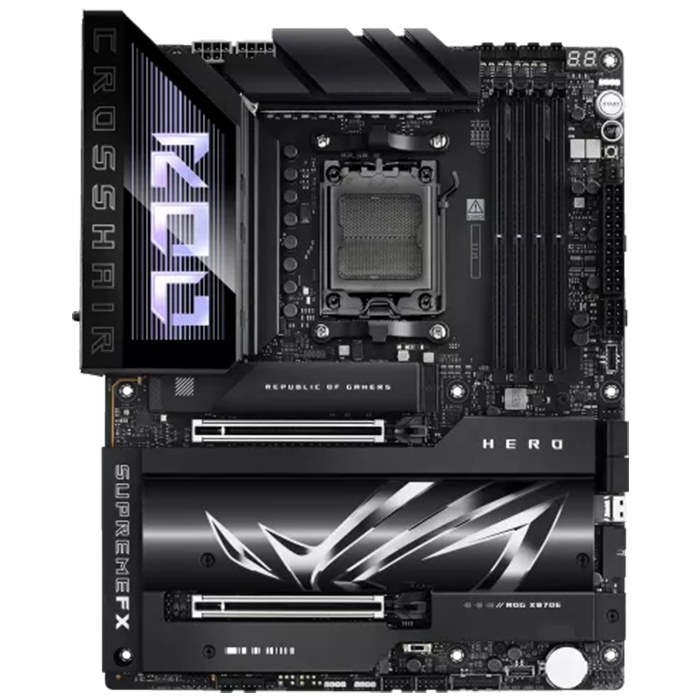
The ROG Crosshair X870E Hero is ASUS’s flagship AM5 motherboard for AMD Ryzen 9000, 8000, and 7000 series processors, built on the X870E chipset with an MSRP of $699.99. The board uses an 18+2+2 power-stage VRM composed of 18x110A and 2x80A Vishay SPS stages in a teamed configuration, controlled by an ASUS Digi+ ASP2205 controller, delivering a combined 1,980A to the CPU VCore rail. Four DDR5 DIMM slots support dual-channel memory at DDR5-8200+ with a maximum capacity of 192GB. The board carries the Polymo Lighting II RGB module across its I/O shroud and includes ASUS’s AI Cache Boost feature, which tunes CPU cache and memory pathways for Ryzen 9000 series processors.
Two PCIe 5.0 x16 slots configurable as x16, x8/x8, or x8/x4/x4 give the Crosshair X870E Hero the most flexible expansion layout among the AM5 boards in this guide. Storage totals five M.2 slots, with three running at PCIe 5.0 x4 and two at PCIe 4.0 x4, alongside four SATA 6Gb/s ports. Networking includes WiFi 7, dual 2.5G and 5G Ethernet, and Bluetooth 5.4. Connectivity includes two USB4 ports and a front-panel USB 20Gbps port supporting 60W Quick Charge 4+ output, for roughly 20 total USB ports.
The Crosshair X870E Hero connects the RTX 5090 through its top PCIe 5.0 x16 slot, matching the card’s PCIe 5.0 interface at full bandwidth. The board’s SafeSlot with Q-Release Slim reinforces the slot against the weight of the RTX 5090’s 304mm triple-slot cooler and simplifies removal without a screwdriver. The 18+2+2 VRM does not power the GPU directly, since the RTX 5090 draws its 575W load through its own 16-pin 12V-2×6 connector, but the VRM’s 1,980A capacity keeps the CPU stable under the increased system load that a flagship GPU introduces during CPU-bound frame generation and ray-tracing denoising work. The board’s spacing between the top M.2 heatsink and the PCIe slot accommodates the RTX 5090’s card height without blocking the upper M.2 slot’s airflow.
The Crosshair X870E Hero has the most flexible PCIe slot configuration of the AM5 boards, supporting x8/x4/x4 splitting that the Strix X870E-E and Taichi do not offer. Its 18+2+2 VRM is stronger than the MSI MAG X870E Tomahawk WiFi’s 14+2+1 design but rated lower in total CPU current than the ASRock X870E Taichi’s 24+2+1 phase count, though ASRock’s board uses 24 individual phases against ASUS’s teamed 18+2+2 layout, so raw phase count does not translate directly to equivalent delivered current. Among AM5 boards, only the MSI MEG X870E Godlike offers more M.2 slots, at seven against the Crosshair’s five. At $699.99, the Crosshair X870E Hero costs the same as the Intel-platform ROG Maximus Z890 Hero and roughly $200 more than the ASRock X870E Taichi.
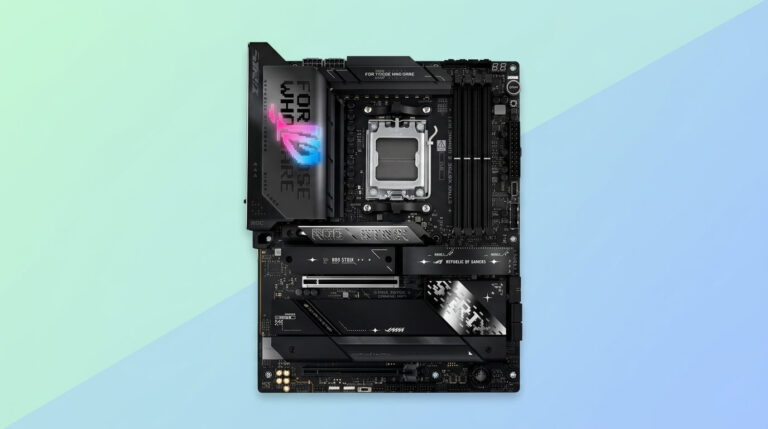
ASUS ROG Strix X870E-E Gaming WiFi
CHECK PRICE
PROS
CONS
| Specification | Detail |
|---|---|
| Chipset | AMD X870E |
| Socket | AM5 |
| CPU Support | AMD Ryzen 9000/7000 series |
| Form Factor | ATX |
| VRM | 18+2+2 power stages, 110A rated |
| Memory | 4x DDR5 DIMM, dual-channel, max 256GB |
| PCIe Slots | PCIe 5.0 x16 (CPU-connected primary slot) |
| M.2 Storage | 5x M.2 (3x PCIe 5.0 x4, 2x PCIe 4.0 x4) |
| SATA | 4x SATA 6Gb/s |
| Networking | WiFi 7, Realtek 5G Ethernet |
| USB | 2x USB4 Type-C, USB 20Gbps Type-C with 30W PD, ~13 rear USB ports |
| MSRP | $499.99 |
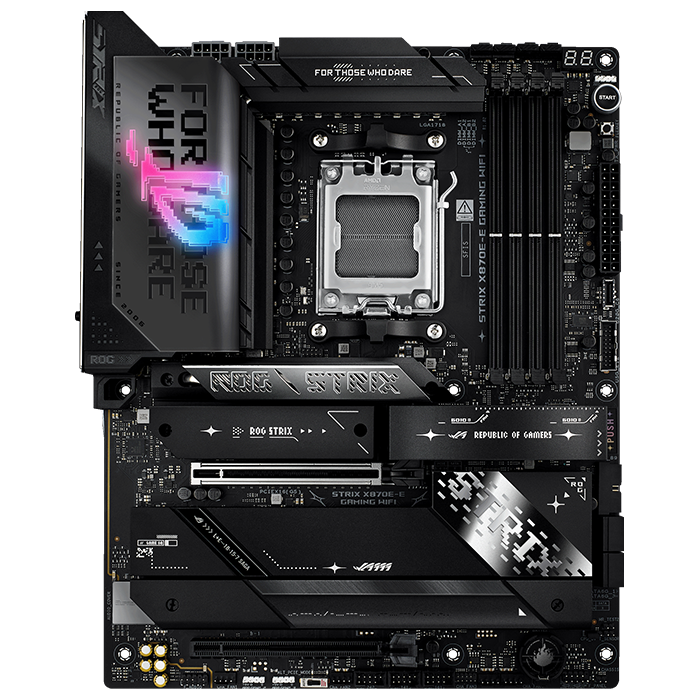
The ROG Strix X870E-E Gaming WiFi is ASUS’s upper-mid-tier AM5 motherboard, priced at an MSRP of $499.99 and built around the X870E chipset for AMD Ryzen 9000 and 7000 series processors. The board runs an 18+2+2 power-stage VRM rated at 110A per stage, fed by two ProCool II 8-pin EPS connectors and cooled by two heatpipe-connected VRM heatsinks. Four DDR5 DIMM slots support up to 256GB of dual-channel memory. The all-black, 8-layer PCB pairs oversized heatsinks over the top three M.2 slots with a secondary RGB lighting strip along the board’s lower edge.
Storage totals five M.2 slots split across three PCIe 5.0 x4 slots (M.2_1, M.2_2, M.2_3) and two PCIe 4.0 x4 chipset slots (M.2_4, M.2_5), plus four SATA 6Gb/s ports. The board provides dual USB4 Type-C ports, a USB 20Gbps Type-C port with 30W Power Delivery, and roughly 13 total rear USB ports. Networking runs through WiFi 7 and Realtek 5G Ethernet. ASUS’s AI Overclocking, AI Cooling II, and AI Networking II features automate tuning for the board’s power, thermal, and network settings.
The RTX 5090 installs into the Strix X870E-E’s top PCIe slot, which connects directly to the CPU at PCIe 5.0 x16 speeds and matches the card’s native interface. A second, chipset-connected PCIe slot sits below the primary slot for additional expansion cards without competing for GPU bandwidth. The board’s 18+2+2 VRM, rated at 110A per stage, sustains CPU power delivery for Ryzen 9000 series processors paired with the RTX 5090 in CPU-intensive workloads such as physics simulation and AI-assisted frame generation. Three PCIe 5.0 M.2 slots let a builder pair the RTX 5090 with equally fast Gen5 NVMe storage for texture streaming and level-load performance, though the second and third M.2 slots share bandwidth with the second PCIe x16 slot when both are populated.
The Strix X870E-E shares its 18+2+2 VRM configuration with the pricier Crosshair X870E Hero, delivering comparable CPU power delivery for roughly $200 less. It offers the same five-M.2, three-Gen5 storage layout as the Crosshair but with fewer USB4 ports (two versus the Crosshair’s two, though the Crosshair adds more total USB ports). Compared with the ASRock X870E Taichi, the Strix X870E-E provides one more PCIe 5.0 M.2 slot but one fewer usable PCIe 5.0 x16 slot for a second graphics card, since the Taichi supports x8/x8 dual-slot operation. Against the MSI MAG X870E Tomahawk WiFi, the Strix X870E-E’s 18+2+2 VRM exceeds the Tomahawk’s 14+2+1 design and adds a third PCIe 5.0 M.2 slot the Tomahawk does not offer.

ASRock X870E Taichi
CHECK PRICE
PROS
CONS
| Specification | Detail |
|---|---|
| Chipset | AMD X870E |
| Socket | AM5 |
| CPU Support | AMD Ryzen 9000/8000/7000 series |
| Form Factor | E-ATX |
| VRM | 24+2+1 power phases, 110A SPS Dr.MOS |
| Memory | 4x DDR5 DIMM, up to 8200+ MT/s |
| PCIe Slots | 2x PCIe 5.0 x16 (x16 single or x8/x8 dual) |
| M.2 Storage | 4x M.2 (1x PCIe 5.0 x4, 3x PCIe 4.0 x4) |
| SATA | 6x SATA 6Gb/s |
| Networking | WiFi 7, 5GbE LAN |
| USB | 2x USB4 Type-C, 15x USB 3.2, 23 total USB connections |
| MSRP | $449 |
The X870E Taichi is ASRock’s flagship AM5 motherboard, priced at an MSRP of $449 and built in an E-ATX form factor around the X870E chipset. The board uses a 24+2+1 power-phase design with 110A SPS Dr.MOS stages, cooled by an XXL VRM heatsink connected by a heatpipe to an integrated cooling fan. ASRock rates the board’s capacitors at 20,000 hours with 1000uF capacitance, an increase from the 560uF capacitors on the prior X670E Taichi. An 8-layer, 2oz copper server-grade PCB supports signal integrity for the board’s PCIe 5.0 and DDR5 interfaces. Four DDR5 DIMM slots support memory speeds up to 8200+ MT/s.
Two full PCIe 5.0 x16 slots support both single x16 and dual x8/x8 configurations. Storage includes four M.2 slots, with one running at PCIe 5.0 x4 and three at PCIe 4.0 x4, plus six SATA 6Gb/s ports, giving the Taichi the highest SATA count among the boards in this guide. The board totals 23 USB connections, including two USB4 Type-C ports and 15 USB 3.2 ports across Gen 2×2, Gen 2, and Gen 1 speeds. Networking includes WiFi 7 and 5GbE LAN. ASRock’s EZ Release mechanism uses a spring-loaded lock rather than a push-button to release installed graphics cards.
The X870E Taichi’s dual full-length PCIe 5.0 x16 slots let the RTX 5090 run at full x16 bandwidth in the primary slot while keeping a second x16 slot available for a capture card or additional expansion hardware without reducing the GPU’s lane allocation. The board’s 24+2+1 phase VRM, rated at 110A per phase, supplies ample current headroom for Ryzen 9 9950X-class processors paired with the RTX 5090 in mixed CPU-and-GPU workloads. The single PCIe 5.0 M.2 slot sits with clearance above the primary PCIe slot, avoiding interference with the RTX 5090’s backplate, though its position may cause a fully populated Gen5 SSD to run warmer under sustained sequential transfers. The Taichi’s EZ Release mechanism simplifies removing the RTX 5090’s 304mm card during future upgrades.
The Taichi is the only AM5 board in this guide with six SATA ports, giving it an advantage over the Crosshair X870E Hero and Strix X870E-E Gaming WiFi, which both offer four. Its dual x8/x8 PCIe 5.0 support matches the Crosshair X870E Hero’s flexibility but exceeds the Strix X870E-E’s single-slot design. Against the MSI MAG X870E Tomahawk WiFi, the Taichi offers two more PCIe 5.0 x16 slots and a stronger 24+2+1 VRM versus the Tomahawk’s single-slot, 14+2+1 layout, at a higher price. Compared with the MSI MEG X870E Godlike, the Taichi costs $650 less but provides three fewer M.2 slots and a lower-tier 24+2+1 VRM against the Godlike’s 27-phase Duet Rail design.

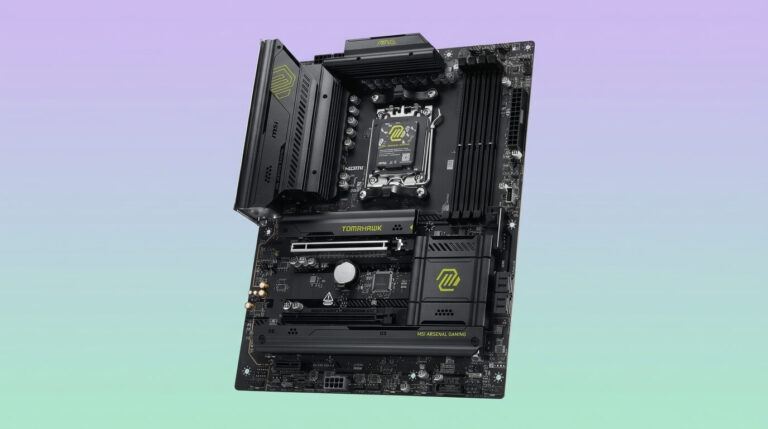
MSI MAG X870E Tomahawk WiFi
CHECK PRICE
PROS
CONS
| Specification | Detail |
|---|---|
| Chipset | AMD X870E |
| Socket | AM5 |
| CPU Support | AMD Ryzen 9000/8000/7000 series |
| Form Factor | ATX |
| VRM | 14+2+1 Duet Rail Power System, 80A SPS |
| Memory | 4x DDR5 DIMM, up to 8400+ MT/s (OC) |
| PCIe Slots | 1x PCIe 5.0 x16 (128GB/s), 1x PCIe 4.0 x4, 1x PCIe 3.0 x1 |
| M.2 Storage | 4x M.2 (2x PCIe 5.0 x4, 2x PCIe 4.0 x4) |
| Networking | WiFi 7, 5G LAN |
| USB | 2x USB4 Type-C (40Gbps) |
| Audio | Realtek ALC4080, 7.1-channel |
| MSRP | $399.99 |
The MAG X870E Tomahawk WiFi is MSI’s mid-range AM5 motherboard, launched at an MSRP of $399.99 and now commonly found closer to $299 to $300. Built on the X870E chipset in ATX form factor, the board supports AMD Ryzen 9000, 8000, and 7000 series processors through Socket AM5. Its VRM uses a 14+2+1 Duet Rail Power System with 80A SPS stages, delivering 1,120A of combined CPU VCore current across 14 physical stages. The board sits on an 8-layer PCB with 2oz thickened copper and includes overcurrent and overvoltage protection circuitry. Four DDR5 DIMM slots support memory speeds up to 8400+ MT/s when overclocked. The board omits integrated RGB lighting, relying instead on header-based connections for third-party lighting.
The Tomahawk WiFi provides one CPU-connected PCIe 5.0 x16 slot rated at 128GB/s, alongside a chipset-connected PCIe 3.0 x1 slot and a PCIe 4.0 x4 slot. Storage totals four M.2 slots, with two running at PCIe 5.0 x4 (128Gbps) and two at PCIe 4.0 x4 (64Gbps), protected by MSI’s EZ M.2 Shield Frozr II heatsinks. Networking includes WiFi 7 and 5G LAN. The board offers two USB4 Type-C ports rated at 40Gbps and a Realtek ALC4080 audio codec supporting 7.1-channel sound with 32-bit/384kHz playback.
The Tomahawk WiFi’s single PCIe 5.0 x16 slot connects the RTX 5090 to the CPU at full 128GB/s bandwidth, matching the GPU’s native PCIe 5.0 interface without a secondary slot competing for lanes. The 14+2+1 VRM’s 1,120A of combined CPU current comfortably supports Ryzen 9000 series processors running alongside the RTX 5090 in gaming and content-creation workloads, though it offers less current headroom than the 18+2+2 and 24+2+1 designs on the pricier boards in this guide for sustained all-core overclocking. The board’s two PCIe 5.0 M.2 slots let a builder pair Gen5 NVMe storage with the RTX 5090 for fast asset streaming without paying for the additional Gen5 M.2 slots found on flagship boards. The absence of a second full x16 slot means the RTX 5090 occupies the board’s only PCIe 5.0 expansion point without options for a secondary card.
At $299 to $399, the Tomahawk WiFi is the least expensive board in this guide, undercutting the ASRock X870E Taichi by roughly $150 and the ASUS ROG Strix X870E-E Gaming WiFi by a similar margin. Its 14+2+1 VRM is the weakest power-stage design among the AM5 boards, falling behind the Strix X870E-E and Crosshair X870E Hero’s 18+2+2 layouts and the Taichi’s 24+2+1 design. The Tomahawk WiFi matches the Taichi’s two-slot Gen5 M.2 layout but offers only one PCIe 5.0 x16 slot against the Taichi’s two. Against the MSI MEG X870E Godlike from the same manufacturer, the Tomahawk WiFi costs roughly $700 to $800 less but provides three fewer M.2 slots and a VRM rated at less than half the Godlike’s current capacity.
ASUS ROG Maximus Z890 Hero
CHECK PRICE
PROS
CONS
| Specification | Detail |
|---|---|
| Chipset | Intel Z890 |
| Socket | LGA1851 |
| CPU Support | Intel Core Ultra 200S series |
| Form Factor | ATX |
| VRM | 22+1+2+2 power stages, 22x110A CPU stages |
| Memory | 4x DDR5 DIMM, up to 9200+ MT/s (OC), max 256GB |
| PCIe Slots | PCIe 5.0 x16 SafeSlot |
| M.2 Storage | 6x M.2 (3x PCIe 5.0 x4, 3x PCIe 4.0 x4) |
| Networking | WiFi 7, Intel 2.5Gb + Realtek 5Gb Ethernet |
| USB | 2x Thunderbolt 4, USB 20Gbps front panel with 60W PD, 5x USB 10Gbps |
| Audio | SupremeFX ALC4082, ESS ES9219 DAC, Dolby Atmos |
| MSRP | $699 |
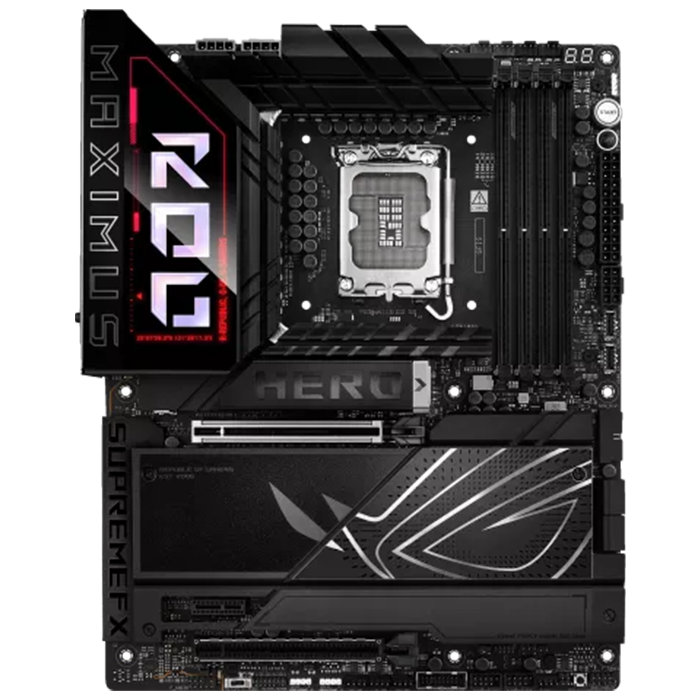
The ROG Maximus Z890 Hero is ASUS’s flagship Intel-platform motherboard, launched at an MSRP of $699 and now widely available below $450. The board uses Socket LGA1851 and the Intel Z890 chipset to support Intel Core Ultra 200S series processors, including the Core Ultra 9 285K. Its VRM uses a 22+1+2+2 power-stage design, with 22x110A stages dedicated to the CPU core rail, paired with ProCool II power connectors and MicroFine alloy chokes. Four DDR5 DIMM slots support memory speeds up to 9200+ MT/s when overclocked, with a maximum capacity of 256GB. The board’s Polymo Lighting II module and large aluminum heatsinks, connected by a U-shaped heatpipe to the I/O cover, carry over ASUS’s ROG design language from its AM5 counterpart.
The Maximus Z890 Hero provides a PCIe 5.0 x16 SafeSlot for the primary graphics card. Storage totals six M.2 slots, split across three PCIe 5.0 x4 and three PCIe 4.0 x4 slots with dedicated ROG M.2 PowerBoost circuitry, giving it the second-highest M.2 count among the boards in this guide behind only the MSI MEG X870E Godlike. Networking combines WiFi 7 with dual Intel 2.5Gb and Realtek 5Gb Ethernet. Connectivity includes dual Thunderbolt 4 USB Type-C ports, a USB 20Gbps front-panel connector with 60W Quick Charge 4+ support, and five additional USB 10Gbps ports. Audio runs through a SupremeFX ALC4082 codec paired with an ESS ES9219 DAC and Dolby Atmos support.
The Maximus Z890 Hero’s PCIe 5.0 x16 SafeSlot connects the RTX 5090 at full bandwidth while its reinforced slot design supports the card’s weight during transport and repeated GPU swaps. The board’s 22+1+2+2 VRM, rated at 110A on its primary stages, is the strongest CPU power-delivery design in this guide, supplying stable voltage to Intel Core Ultra 9 285K processors under the CPU-bound loads that accompany RTX 5090-class rendering and AI-assisted workflows. Three PCIe 5.0 M.2 slots give builders room to match the RTX 5090 with equally fast Gen5 storage for asset streaming, while dual Thunderbolt 4 ports support external GPU or high-bandwidth peripheral connections alongside the primary card. Because the Maximus Z890 Hero runs on Intel’s LGA1851 platform, RTX 5090 performance depends on Core Ultra 200S processor selection rather than the AMD Ryzen chips supported by the other boards in this guide.
The Maximus Z890 Hero is the only Intel-platform board in this guide, making platform choice the primary factor separating it from the five AM5 boards. Its 22+1+2+2 VRM exceeds the CPU current rating of every AM5 board except the MSI MEG X870E Godlike, and its six M.2 slots trail only the Godlike’s seven. At its $699 MSRP, the Maximus Z890 Hero costs the same as the ASUS ROG Crosshair X870E Hero, and both share ASUS’s Polymo Lighting II and AI-assisted tuning features, though the Maximus Z890 Hero adds Thunderbolt 4 support the Crosshair does not offer. Current street pricing below $450 makes the Maximus Z890 Hero notably less expensive than the Crosshair X870E Hero at full price, despite comparable feature sets.

MSI MEG X870E Godlike
CHECK PRICE
PROS
CONS
| Specification | Detail |
|---|---|
| Chipset | AMD X870E |
| Socket | AM5 |
| CPU Support | AMD Ryzen 9000/8000/7000 series |
| Form Factor | E-ATX |
| VRM | 27-phase (24+2+1) Duet Rail Power System, 110A SPS |
| Memory | 4x DDR5 DIMM, up to DDR5-9000+ (OC) |
| PCIe Slots | 2x PCIe 5.0 x16, 1x additional PCIe slot |
| M.2 Storage | 7x M.2 (5 onboard + 2 via M.2 XPANDER-Z SLIDER GEN5 card) |
| SATA | 4x SATA 6Gb/s |
| Networking | WiFi 7, 10G LAN |
| USB | 7x USB Type-C rear ports including USB4 |
| Notable Feature | 3.99″ Dynamic Dashboard III LCD |
| MSRP | $1,099 |
The MEG X870E Godlike is MSI’s flagship AM5 motherboard, priced at an MSRP of $1,099 in an E-ATX form factor built around the X870E chipset for AMD Ryzen 9000, 8000, and 7000 series processors. The board’s VRM uses a 27-phase (24+2+1) Duet Rail Power System built from 110A Smart Power Stages, fed by dual 8-pin EPS connectors, and cooled by a wavy-fin, direct-touch heatpipe design MSI calls Frozr Guard. A 10-layer PCB with 2oz thickened copper supports the board’s power and signal integrity. Four DDR5 DIMM slots support memory speeds up to DDR5-9000+ when overclocked. The board integrates a 3.99-inch Dynamic Dashboard III LCD screen for hardware monitoring and includes an EZ Bridge connector system that consolidates multiple headers into a single connection point.
Storage totals seven M.2 slots, the highest count in this guide, combining five onboard slots with two additional PCIe 5.0 slots delivered through MSI’s included M.2 XPANDER-Z SLIDER GEN5 expansion card. The board provides three PCIe slots, including two PCIe 5.0 x16 slots that can run at full x16 bandwidth on the primary slot or split bandwidth between both. Four SATA ports round out storage connectivity. Networking includes WiFi 7 and 10G LAN, while the rear I/O panel carries seven USB Type-C ports, including USB4, arranged alongside dual Ethernet jacks.
The Godlike’s primary PCIe 5.0 x16 slot connects the RTX 5090 at full bandwidth, and MSI’s additional power-excursion circuitry allows the PCIe slots to draw up to 165W of peak instantaneous power alongside the card’s dedicated 16-pin connector, though sustained PCIe slot power remains limited to the standard 75W. The 27-phase Duet Rail VRM, rated at 110A per stage, provides the highest CPU current capacity in this guide, supporting flagship Ryzen 9000 series processors under maximum load without throttling alongside the RTX 5090. Seven total M.2 slots, including two delivered via the bundled XPANDER-Z SLIDER GEN5 card, let builders pair the RTX 5090 with a fully populated Gen5 storage array for texture streaming and large asset libraries without sacrificing SATA connectivity. The board’s dual 8-pin EPS connectors and 420W total board power budget accommodate the combined draw of a flagship Ryzen CPU and the RTX 5090’s 575W GPU load without approaching the board’s power delivery limits.
The Godlike is the most expensive board in this guide at $1,099, costing roughly $400 more than the next-most-expensive boards, the Crosshair X870E Hero and Maximus Z890 Hero, both at $699. Its seven M.2 slots exceed every other board, including the Maximus Z890 Hero’s six and the Crosshair X870E Hero’s five. The Godlike’s 27-phase VRM surpasses the Taichi’s 24+2+1 design, the Crosshair and Strix X870E-E’s 18+2+2 designs, and the Tomahawk WiFi’s 14+2+1 design in total phase count, though the Maximus Z890 Hero’s 22+1+2+2 design on the Intel platform remains close in per-stage current rating. Builders who do not need the Godlike’s seven M.2 slots, integrated LCD dashboard, or dual 10G LAN ports can match its core PCIe 5.0 x16 and VRM capability at less than half the price with the Crosshair X870E Hero or Taichi.
How to Choose a Motherboard For RTX 5090
Choose a motherboard for the RTX 5090 based on CPU platform, PCIe 5.0 x16 slot availability, and the amount of PCIe 5.0 M.2 storage the build requires, since the RTX 5090 itself draws power independently through its own 16-pin connector rather than through the motherboard’s VRM. Platform selection narrows the field first: AMD Ryzen 9000, 8000, or 7000 series processors require an AM5, X870E board such as the Crosshair X870E Hero, Strix X870E-E Gaming WiFi, X870E Taichi, Tomahawk WiFi, or MEG X870E Godlike, while an Intel Core Ultra 200S processor requires the LGA1851 Maximus Z890 Hero.
Budget and feature requirements narrow the remaining choice. A builder prioritizing maximum Gen5 storage and workstation-class connectivity benefits from the MSI MEG X870E Godlike’s seven M.2 slots and 27-phase VRM, at the cost of a $1,099 price tag. A builder balancing price against features finds the ASUS ROG Crosshair X870E Hero or ASUS ROG Maximus Z890 Hero suitable at $699, each offering flexible PCIe lane configurations and strong VRM current ratings without the Godlike’s premium storage expansion. Builders on a tighter budget who still want PCIe 5.0 and USB4 connectivity can choose the ASUS ROG Strix X870E-E Gaming WiFi at $499.99 or the MSI MAG X870E Tomahawk WiFi at $299 to $399, trading VRM phase count and M.2 slot count for a lower price. The ASRock X870E Taichi fits builders who need six SATA ports or dual full-bandwidth PCIe 5.0 x16 slots for secondary expansion cards, at a $449 MSRP between the Strix X870E-E and Crosshair X870E Hero price points.