Choosing a gaming GPU in 2027 means picking between NVIDIA’s Blackwell-based GeForce RTX 50 series, AMD’s RDNA 4 Radeon RX 9000 series, and Intel’s Battlemage-based Arc B-series. Each of these architectures introduces faster GDDR7 or GDDR6 memory, upgraded ray-tracing hardware, and AI-driven upscaling tools such as DLSS 4, FSR 4, and XeSS 2. Board partners including ASUS, MSI, Gigabyte, Sapphire, PowerColor, and ASRock take these reference chips and add factory overclocks, larger coolers, and reinforced power delivery, which changes clock speeds, noise levels, and price without changing the underlying GPU.
This guide reviews fifteen specific graphics cards spanning the full price range of 2027’s gaming GPU market, from the 32GB flagship ASUS ROG Astral GeForce RTX 5090 OC Edition down to the budget-focused ASRock Intel Arc B580 Steel Legend. Each card is evaluated on its core specifications, how those specifications translate into gaming performance, and how it stacks up against the other cards in this list. Specification tables accompany every review, alongside a pros and cons summary to support side-by-side comparison.
Card selection in this guide spans four resolution tiers. The GeForce RTX 5090 and RTX 5080 cards target native 4K gaming with heavy ray tracing. The RTX 5070 Ti and Radeon RX 9070 XT sit in the high-end 1440p and entry-level 4K segment. The RTX 5070, RX 9070, RTX 5060 Ti, and RX 9060 XT cover mainstream 1440p and 1080p gaming. The RTX 5060 and Arc B580 serve budget-conscious 1080p builds. A closing section explains the criteria that matter most when narrowing this list down to a single purchase.
Pricing referenced throughout reflects U.S. dollar figures reported by retailers and manufacturers at the time of writing. Actual street prices fluctuate with supply, regional availability, and currency conditions, so figures should be treated as a guide rather than a guaranteed purchase price.
ASUS ROG Astral GeForce RTX 5090 OC Edition 32GB
The ASUS ROG Astral GeForce RTX 5090 OC Edition is a flagship, factory-overclocked partner card built on NVIDIA’s GeForce RTX 5090 and the Blackwell GB202 GPU. It targets buyers who want the fastest available consumer graphics card for native 4K and 8K gaming, heavy ray tracing, and AI-assisted rendering workloads.
The GB202 chip on this card carries 21,760 CUDA cores, 680 fifth-generation Tensor cores, and fourth-generation RT cores, paired with 32GB of GDDR7 memory across a 512-bit bus. This memory configuration runs at 28 Gbps and produces 1,792 GB/s of bandwidth, a 77% increase over the RTX 4090’s GDDR6X subsystem. ASUS raises the boost clock to 2,610 MHz in OC mode and 2,580 MHz in default mode, up from the RTX 5090 Founders Edition’s reference 2,407 MHz. The card draws up to 600W and ships with a quad-fan cooler, a patented vapor chamber, and a phase-change GPU thermal pad, housed in a 3.8-slot, 357.6mm shroud that requires a case with substantial clearance.
In gaming, the RTX 5090 platform runs roughly 27–35% ahead of the RTX 4090 at native 4K without frame generation, with the largest gains appearing in path-traced titles. DLSS 4 Multi Frame Generation can add further frames on top of this baseline by generating up to three AI frames for every natively rendered frame. Reviewers note that the difference between reference and heavily overclocked RTX 5090 cards, including this ROG Astral model, is only a few percentage points in raw frame rate; the GB202 chip itself sets the performance ceiling, so the ROG Astral’s premium buys cooling, noise reduction, and build quality more than additional speed. Against the MSI GeForce RTX 5090 32G SUPRIM SOC reviewed next, the ROG Astral posts a similar 2,610 MHz peak OC clock versus the SUPRIM SOC’s 2,580 MHz Extreme Performance mode, making the two functionally close in gaming frame rates.
| Specification | ASUS ROG Astral RTX 5090 OC Edition |
|---|---|
| GPU / Architecture | NVIDIA GeForce RTX 5090 (Blackwell, GB202) |
| CUDA Cores | 21,760 |
| Boost Clock | 2,610 MHz (OC mode) / 2,580 MHz (default) |
| Memory | 32GB GDDR7, 512-bit, 28 Gbps |
| Memory Bandwidth | 1,792 GB/s |
| Power Draw | Up to 600W |
| Recommended PSU | 1,000W+ |
| Cooling | Quad-fan, vapor chamber, phase-change thermal pad, 3.8-slot |
| Street Price | Approximately $2,800 |
Pros and cons of the ASUS ROG Astral RTX 5090 OC Edition:
- Performance: Delivers the highest native 4K frame rates of any card in this list.
- Memory capacity: 32GB of GDDR7 supports large ray-traced scenes and AI workloads without VRAM limits.
- Cooling: Quad-fan vapor-chamber design keeps the GPU quieter under sustained 600W load than smaller coolers.
- Size: The 3.8-slot, 357.6mm footprint requires a large case and may not fit compact builds.
- Power requirements: A 1,000W or higher PSU and a 16-pin power connector add cost and installation complexity.
- Price: Street prices near $2,800 place this card well above NVIDIA’s $1,999 RTX 5090 MSRP.
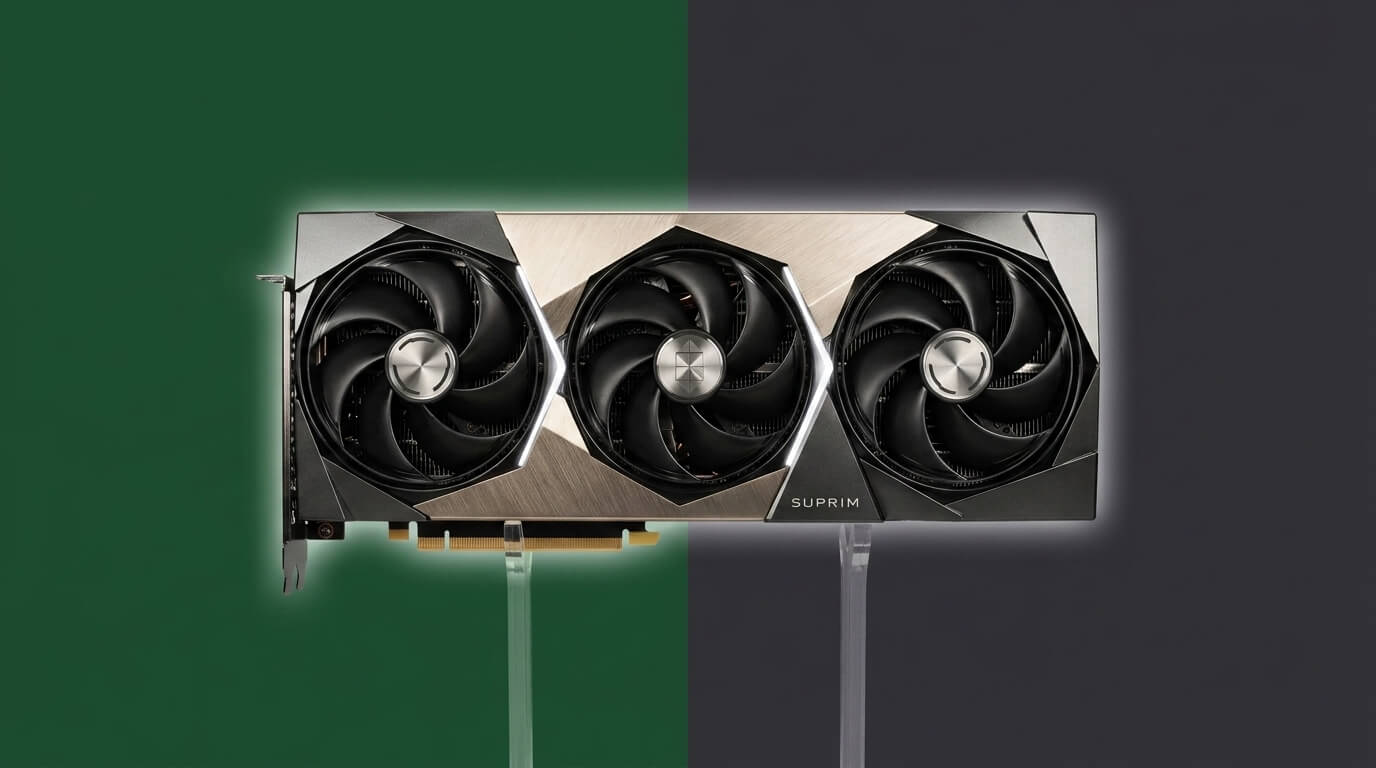
MSI GeForce RTX 5090 32G SUPRIM SOC
The MSI GeForce RTX 5090 32G SUPRIM SOC is MSI’s flagship air-cooled partner card for the GeForce RTX 5090, positioned as a direct rival to the ASUS ROG Astral RTX 5090 OC Edition within the same 4K gaming and content-creation segment.
This card shares the RTX 5090’s 21,760 CUDA cores, 32GB of GDDR7 memory on a 512-bit bus, and 1,792 GB/s of memory bandwidth. MSI ships the SUPRIM SOC with a dual-BIOS switch: Gaming mode runs a 2,565 MHz boost clock (2,580 MHz through the MSI Center Extreme Performance profile) at up to 600W, while Silent mode drops to a 2,512 MHz boost clock (2,527 MHz Extreme Performance) at the reference 575W. Independent testing recorded real-world clocks averaging 2,728 MHz in Gaming mode, roughly 200 MHz above the card’s own rated boost figure. Cooling comes from MSI’s Hyper Frozr system, combining StormForce fans, an advanced vapor chamber, and direct-contact heat pipes across a large tri-fan shroud.
Because the RTX 5090’s performance ceiling is set by the GB202 chip rather than by board-partner tuning, the SUPRIM SOC’s gaming frame rates track closely with the ROG Astral RTX 5090 OC Edition, generally within a few percent in either direction depending on the title and BIOS mode selected. The SUPRIM SOC’s main practical differentiators are its dual-BIOS flexibility, which lets a buyer trade some noise for lower power draw, and its typically higher retail price, with listings ranging from roughly $2,700 on sale to over $3,200 at full price. Compared with the RX 9070 XT and RTX 5070 Ti reviewed later in this guide, the SUPRIM SOC sits in an entirely different tier, aimed at buyers prioritizing outright 4K and 8K performance over value.
| Specification | MSI RTX 5090 32G SUPRIM SOC |
|---|---|
| GPU / Architecture | NVIDIA GeForce RTX 5090 (Blackwell, GB202) |
| CUDA Cores | 21,760 |
| Boost Clock | 2,565 MHz (Gaming) / 2,512 MHz (Silent), up to 2,580 MHz Extreme |
| Memory | 32GB GDDR7, 512-bit, 28 Gbps |
| Memory Bandwidth | 1,792 GB/s |
| Power Draw | Up to 600W (Gaming) / 575W (Silent) |
| Recommended PSU | 1,000W+ |
| Cooling | Hyper Frozr tri-fan, vapor chamber, dual BIOS |
| Street Price | Approximately $2,700–$3,200 |
Pros and cons of the MSI RTX 5090 32G SUPRIM SOC:
- Dual BIOS: Gaming and Silent modes let the owner balance clock speed against noise and power draw.
- Cooling headroom: The Hyper Frozr cooler sustains its Gaming-mode clocks without significant throttling.
- Real-world clocks: Recorded gameplay clocks exceed MSI’s rated boost specification.
- Price volatility: Retail pricing has ranged from roughly $2,700 to over $3,200, well above the $1,999 RTX 5090 MSRP.
- Size and weight: The large tri-fan shroud demands significant case clearance and PSU capacity.
- Marginal gains over reference: Factory overclocking adds only a small percentage of extra frame rate versus the Founders Edition.
ASUS ROG Astral GeForce RTX 5080 OC Edition 16GB
The ASUS ROG Astral GeForce RTX 5080 OC Edition is ASUS’s flagship partner card for the GeForce RTX 5080, aimed at 4K gamers who want most of the RTX 5090’s build quality and cooling at a lower CUDA core count and price.
This card pairs the RTX 5080’s 10,752 CUDA cores with 16GB of GDDR7 memory on a 256-bit bus running at 30 Gbps. ASUS raises the boost clock to 2,790 MHz in OC mode, 173 MHz above the RTX 5080 Founders Edition’s reference 2,617 MHz clock, a 6.6% increase. The card uses the same ROG Astral design language as the RTX 5090 variant: a quad-fan cooler, patented vapor chamber, phase-change GPU thermal pad, and a die-cast frame with metal GPU bracket, at a TDP around 360W.
Independent testing shows the ROG Astral RTX 5080 OC Edition running 27% and 22% faster at 4K than the previous-generation RTX 4080 and RTX 4080 SUPER respectively, a larger generational gain than NVIDIA’s reference RTX 5080 posted at launch, which points to clock speed being a meaningful factor in RTX 5080 performance. Compared with the Gigabyte GeForce RTX 5080 GAMING OC 16G reviewed next, the ROG Astral’s 2,790 MHz peak clock is 60 MHz higher than the Gigabyte card’s 2,730 MHz, a gap of roughly 2%, while the ROG Astral commands a noticeably higher price of around $2,999 versus the Gigabyte card’s sub-$1,600 street pricing. Against the RTX 5090 cards above, the RTX 5080 trades roughly 20% fewer CUDA cores and lower memory bandwidth for a substantially lower cost of entry into 4K-capable gaming.
| Specification | ASUS ROG Astral RTX 5080 OC Edition |
|---|---|
| GPU / Architecture | NVIDIA GeForce RTX 5080 (Blackwell) |
| CUDA Cores | 10,752 |
| Boost Clock | 2,790 MHz (OC mode) / 2,760 MHz (default) |
| Memory | 16GB GDDR7, 256-bit, 30 Gbps |
| Power Draw | Approximately 360W |
| Recommended PSU | 850W |
| Cooling | Quad-fan, vapor chamber, phase-change thermal pad, 3.8-slot |
| Street Price | Approximately $2,999 |
Pros and cons of the ASUS ROG Astral RTX 5080 OC Edition:
- 4K performance: Delivers double-digit frame-rate gains over the prior-generation RTX 4080 and RTX 4080 SUPER.
- Highest 5080 clock in this list: 2,790 MHz OC mode outpaces the Gigabyte GAMING OC’s 2,730 MHz.
- Cooling and build: Shares the ROG Astral’s quad-fan vapor-chamber cooler and reinforced frame with the flagship RTX 5090 card.
- Price: At roughly $2,999, it costs nearly double comparable RTX 5080 partner cards for a modest clock-speed advantage.
- Size: The 3.8-slot design requires the same case clearance as the larger RTX 5090 ROG Astral card.
- VRAM ceiling: 16GB is less headroom than the RTX 5090’s 32GB for the most demanding ray-traced or AI workloads.
Gigabyte GeForce RTX 5080 GAMING OC 16G
The Gigabyte GeForce RTX 5080 GAMING OC 16G is a mid-tier partner card for the GeForce RTX 5080, positioned as a value-focused alternative to premium models like the ASUS ROG Astral RTX 5080 OC Edition within Gigabyte’s own lineup, which spans the budget Windforce, the mid-range Gaming OC, and the high-end Aorus Master and Aorus Xtreme series.
The card carries the RTX 5080’s full 10,752 CUDA cores and 16GB of GDDR7 memory on a 256-bit bus at 30 Gbps. Gigabyte factory-overclocks the boost clock to 2,730 MHz, up from the reference 2,617 MHz. Cooling uses Gigabyte’s WINDFORCE system, which combines server-grade thermal conductive gel, Hawk-blade fans, composite copper heat pipes, and a vapor chamber, delivering up to a 53.6% increase in air pressure and a 12.5% increase in air volume over Gigabyte’s prior fan design.
Reviewers describe the GAMING OC as sitting “in the middle” of Gigabyte’s RTX 5080 lineup, trading the ROG Astral’s higher 2,790 MHz clock and more elaborate quad-fan cooler for standard dimensions and a lower price. At a street price between roughly $1,450 and $1,850, the GAMING OC costs about half of the ROG Astral RTX 5080 OC Edition while running only about 2% slower based on rated boost clocks. Against the MSI GeForce RTX 5070 Ti 16G GAMING TRIO OC reviewed next, the GAMING OC’s 10,752 CUDA cores represent roughly 20% more compute resources, translating into a meaningful step up in 4K frame rates for buyers who can absorb the price difference.
| Specification | Gigabyte RTX 5080 GAMING OC 16G |
|---|---|
| GPU / Architecture | NVIDIA GeForce RTX 5080 (Blackwell) |
| CUDA Cores | 10,752 |
| Boost Clock | 2,730 MHz (Reference: 2,617 MHz) |
| Memory | 16GB GDDR7, 256-bit, 30 Gbps |
| Power Draw | Approximately 360W |
| Cooling | WINDFORCE triple-fan, vapor chamber |
| Street Price | Approximately $1,450–$1,850 |
Pros and cons of the Gigabyte RTX 5080 GAMING OC 16G:
- Value: Offers close to ROG Astral-level RTX 5080 performance at roughly half the price.
- Cooling: WINDFORCE’s Hawk fan design increases air pressure while keeping noise in check.
- Standard dimensions: Fits a broader range of cases than the larger, heavier ROG Astral model.
- Lower clock ceiling: 2,730 MHz trails the ROG Astral RTX 5080 OC Edition’s 2,790 MHz peak.
- Fewer premium extras: Lacks the die-cast frame and phase-change thermal pad found on the ROG Astral series.
- Still a 360W card: Requires an 850W-class power supply despite its mid-tier positioning.
MSI GeForce RTX 5070 Ti 16G GAMING TRIO OC
The MSI GeForce RTX 5070 Ti 16G GAMING TRIO OC is a factory-overclocked partner card for the GeForce RTX 5070 Ti, positioned as a high-1440p and entry-4K option that sits directly below the RTX 5080 tier covered above.
The card includes 8,960 CUDA cores, 280 fifth-generation Tensor cores, and 70 fourth-generation RT cores, paired with 16GB of GDDR7 memory on a 256-bit bus at 28 Gbps, producing 896 GB/s of bandwidth. MSI sets the Gaming and Silent mode boost clock at 2,572 MHz, with an Extreme Performance profile reaching 2,580 MHz through MSI Center; this compares with the RTX 5070 Ti Founders Edition’s reference 2,452 MHz boost clock. Rated board power is 300W, and MSI’s Tri Frozr 4 cooling keeps the card in the 59–66°C range across 1440p and 4K testing while remaining close to inaudible under load.
Because the RTX 5070 Ti shares its 16GB GDDR7 capacity with the RTX 5080 above it, but with 20% fewer CUDA cores and 25% fewer RT cores, the GAMING TRIO OC delivers strong 1440p and usable 4K performance without matching the RTX 5080’s headroom in the most demanding ray-traced titles. Against the ASUS TUF Gaming RTX 5070 Ti OC Edition reviewed next, the two cards are close on paper: the TUF’s 2,610 MHz OC-mode clock is roughly 40 MHz higher than the GAMING TRIO OC’s 2,572 MHz rated boost, a gap of under 2% in specification, though the MSI card’s Extreme Performance profile narrows that further to 8 MHz. At a starting price around $749 to $900 depending on retailer, the GAMING TRIO OC undercuts the RTX 5080 tier by several hundred dollars while retaining the same 16GB memory pool.
| Specification | MSI RTX 5070 Ti 16G GAMING TRIO OC |
|---|---|
| GPU / Architecture | NVIDIA GeForce RTX 5070 Ti (Blackwell) |
| CUDA Cores | 8,960 |
| Boost Clock | 2,572 MHz (Gaming/Silent), 2,580 MHz (Extreme Performance) |
| Memory | 16GB GDDR7, 256-bit, 28 Gbps |
| Memory Bandwidth | 896 GB/s |
| Power Draw | 300W |
| Recommended PSU | 750W |
| Cooling | Tri Frozr 4, triple-fan |
| Street Price | Approximately $749–$900 |
Pros and cons of the MSI RTX 5070 Ti 16G GAMING TRIO OC:
- Cooling efficiency: Tri Frozr 4 keeps GPU temperatures under 66°C at 4K while staying near-silent.
- Memory capacity: 16GB of GDDR7 matches the RTX 5080 tier, useful for texture-heavy titles.
- Value: Costs several hundred dollars less than RTX 5080 partner cards while sharing the same memory pool.
- Compute gap: 20% fewer CUDA cores than the RTX 5080 limits headroom in the heaviest ray-traced workloads.
- Retail markup: Real-world pricing regularly exceeds NVIDIA’s $749 baseline.
- Slightly lower clock ceiling: Trails the ASUS TUF RTX 5070 Ti OC Edition’s rated OC-mode boost clock.
ASUS TUF Gaming GeForce RTX 5070 Ti OC Edition 16GB
The ASUS TUF Gaming GeForce RTX 5070 Ti OC Edition is a mid-range partner card for the GeForce RTX 5070 Ti that emphasizes durability and component reinforcement over the flashier styling of the ROG Astral series, aimed at buyers who want military-grade construction at a lower price point than ASUS’s flagship line.
The card carries the same 8,960 CUDA core, 16GB GDDR7, 256-bit memory configuration as the MSI GAMING TRIO OC reviewed above, with memory running at 28 Gbps for 896 GB/s of bandwidth. ASUS lists a 2,610 MHz boost clock in OC mode and 2,588 MHz in default mode. TUF-series components include certified military-grade chokes and MOSFETs for stable power delivery, TUF 5K black metallic capacitors rated for a 52% wider temperature tolerance and 2.5 times the lifespan of standard capacitors, and a phase-change GPU thermal pad shared with the ROG Astral line.
Against the MSI GAMING TRIO OC, the TUF Gaming card’s 2,610 MHz OC-mode clock edges out MSI’s 2,572 MHz Gaming/Silent rating by roughly 1.5%, though the practical frame-rate difference between the two cards in most titles is small given they share the same GPU die and memory configuration. The TUF Gaming RTX 5070 Ti OC Edition typically retails in a similar $850–$900 band to the MSI card, making the choice between the two largely a matter of cooler design, aesthetics, and warranty terms rather than raw specification. Compared with the RX 9070 XT cards reviewed next, the RTX 5070 Ti brings DLSS 4 and a larger 16GB frame buffer, while AMD’s competing card typically undercuts it on price.
| Specification | ASUS TUF Gaming RTX 5070 Ti OC Edition |
|---|---|
| GPU / Architecture | NVIDIA GeForce RTX 5070 Ti (Blackwell) |
| CUDA Cores | 8,960 |
| Boost Clock | 2,610 MHz (OC mode) / 2,588 MHz (default) |
| Memory | 16GB GDDR7, 256-bit, 28 Gbps |
| Memory Bandwidth | 896 GB/s |
| Power Draw | 300W |
| Recommended PSU | 750W |
| Cooling | TUF axial-tech triple-fan, phase-change thermal pad |
| Street Price | Approximately $850–$900 |
Pros and cons of the ASUS TUF Gaming RTX 5070 Ti OC Edition:
- Build durability: Military-grade chokes, MOSFETs, and reinforced capacitors target long-term reliability.
- Clock speed: 2,610 MHz OC mode is marginally higher than the comparable MSI GAMING TRIO OC.
- Cooling: Phase-change thermal pad and protective PCB coating guard against moisture and temperature extremes.
- Price parity with rivals: Offers no significant price advantage over the similarly specified MSI GAMING TRIO OC.
- Large footprint: A 3.125-slot design still requires a roomy case despite being a mid-range card.
- No memory advantage over AMD: The RX 9070 XT reviewed next matches its 16GB capacity at a lower typical price.
Sapphire NITRO+ Radeon RX 9070 XT OC
The Sapphire NITRO+ Radeon RX 9070 XT OC is AMD’s high-end RDNA 4 partner card, built on the Navi 48 GPU and positioned as a direct rival to the RTX 5070 Ti cards reviewed above in the high-1440p and entry-4K segment.
Navi 48 packs 53.9 billion transistors on a 357mm² die manufactured on a 4nm process. The full configuration used here delivers 64 RDNA 4 Compute Units, 4,096 Stream Processors, 64 Ray Accelerators, and 128 AI Accelerators, paired with 16GB of GDDR6 memory on a 256-bit bus running at 20 Gbps for 640 GB/s of bandwidth, plus 64MB of third-generation Infinity Cache. AMD’s reference RX 9070 XT specification calls for a 2,400 MHz game clock and a 2,970 MHz boost clock at a 304W board power. Sapphire’s NITRO+ raises this to a rated 3,060 MHz boost clock, and independent testing recorded an average in-game clock of 2,878 MHz over a 30-minute stress run, only slightly ahead of the rival PowerColor Red Devil model reviewed next.
Clock-for-clock, the RX 9070 XT represents a 28–32% performance increase over AMD’s previous RX 7900 GRE at reference settings, with FP16 and FP32 compute posting the largest generational gains at roughly 35%. Compared with the RTX 5070 Ti cards above, the RX 9070 XT matches their 16GB memory capacity but uses slower GDDR6 rather than GDDR7, and it lacks NVIDIA’s DLSS 4 Multi Frame Generation, relying instead on FSR 4 for AI upscaling. At AMD’s $599 MSRP for the base RX 9070 XT, the NITRO+ OC’s typical premium places it in the same general price band as the RTX 5070 Ti partner cards, making the choice largely dependent on whether DLSS 4 or FSR 4 better suits the buyer’s game library.
| Specification | Sapphire NITRO+ RX 9070 XT OC |
|---|---|
| GPU / Architecture | AMD Radeon RX 9070 XT (RDNA 4, Navi 48) |
| Stream Processors | 4,096 |
| Boost Clock | Up to 3,060 MHz |
| Memory | 16GB GDDR6, 256-bit, 20 Gbps |
| Memory Bandwidth | 640 GB/s |
| Infinity Cache | 64MB |
| Power Draw | 304W (reference); higher on NITRO+ |
| Recommended PSU | 750W |
| Cooling | Triple-fan, vapor chamber, 12V-2×6 connector |
Pros and cons of the Sapphire NITRO+ RX 9070 XT OC:
- Highest rated clock among RX 9070 XT partner cards in this list: 3,060 MHz boost tops AMD’s 2,970 MHz reference figure.
- Memory bandwidth: 640 GB/s across 16GB GDDR6 supports high-1440p and entry-4K textures comfortably.
- Value versus RTX 5070 Ti: Frequently priced close to or below comparable RTX 5070 Ti partner cards.
- No DLSS 4: Relies on FSR 4 rather than NVIDIA’s Multi Frame Generation for AI-assisted upscaling.
- GDDR6 memory: Runs at 20 Gbps versus the 28 Gbps GDDR7 used on rival RTX 5070 Ti cards.
- Power connector adapter: Ships with a 3×8-pin adapter for PSUs lacking a native 12V-2×6 connector.
PowerColor Red Devil Radeon RX 9070 XT 16GB
The PowerColor Red Devil Radeon RX 9070 XT is a second high-end RDNA 4 partner card built on the same Navi 48 GPU as the Sapphire NITRO+ reviewed above, giving buyers a direct alternative within AMD’s top RX 9070 XT tier.
Specifications mirror the NITRO+ in most respects: 64 Compute Units, 4,096 Stream Processors, 64 Ray Accelerators, and 16GB of GDDR6 memory on a 256-bit bus at 20 Gbps for 645 GB/s of bandwidth, alongside 64MB of Infinity Cache. PowerColor rates the Red Devil’s boost clock at 3,060 MHz, matching the NITRO+ figure, while pushing board power to 330W, 26W higher than the NITRO+’s rated power draw. In sustained testing, the Red Devil averaged 2,853 MHz over a 30-minute run, within 25 MHz of the NITRO+’s measured average, indicating the two cards deliver near-identical real-world clocks despite PowerColor’s slightly higher power ceiling.
Because the Red Devil and NITRO+ share the same silicon and comparable factory tuning, the practical differences between them come down to cooler design, physical dimensions, power-connector layout, and price rather than gaming performance. Independent comparisons list the Red Devil as roughly 8% lower in rated thermal design power than some NITRO+ configurations while running a slightly higher core clock in certain listings, underscoring how close these two cards sit to one another. Against the Sapphire PULSE Radeon RX 9070 16GB reviewed next, the Red Devil’s full 4,096-Stream-Processor Navi 48 configuration offers roughly 14% more compute resources and a substantially higher clock ceiling, reflecting the step up from the RX 9070 to the RX 9070 XT tier.
| Specification | PowerColor Red Devil RX 9070 XT 16GB |
|---|---|
| GPU / Architecture | AMD Radeon RX 9070 XT (RDNA 4, Navi 48) |
| Stream Processors | 4,096 |
| Boost Clock | Up to 3,060 MHz |
| Memory | 16GB GDDR6, 256-bit, 20 Gbps |
| Memory Bandwidth | 645 GB/s |
| Infinity Cache | 64MB |
| Power Draw | 330W |
| Recommended PSU | 750W |
| Cooling | Triple-fan, vapor chamber |
Pros and cons of the PowerColor Red Devil RX 9070 XT 16GB:
- Matches NITRO+ clocks: 3,060 MHz rated boost equals Sapphire’s top RX 9070 XT partner card.
- Sustained performance: Averaged 2,853 MHz over extended testing, close to the NITRO+’s measured clock.
- Distinct cooler and styling: Offers buyers a design alternative to the Sapphire NITRO+ at similar performance.
- Higher rated power draw: 330W board power is 26W above the NITRO+’s rating for essentially the same performance.
- Premium over MSRP: Like most RX 9070 XT cards, street pricing sits above AMD’s $599 baseline.
- No DLSS 4 support: Shares the same FSR 4-only upscaling limitation as other Radeon cards in this list.
Sapphire PULSE Radeon RX 9070 16GB
The Sapphire PULSE Radeon RX 9070 16GB is a mainstream RDNA 4 partner card built on the cut-down RX 9070 configuration of the Navi 48 GPU, positioned as a more affordable alternative to the RX 9070 XT cards reviewed above within the same 16GB memory class.
The RX 9070 reduces Navi 48 to 56 Compute Units and 3,584 Stream Processors, roughly 14% fewer than the RX 9070 XT’s 4,096, alongside 56 Ray Accelerators. Memory remains at 16GB of GDDR6 on a 256-bit bus at 20 Gbps, delivering the same 640 GB/s of bandwidth as its XT sibling. AMD’s reference specification sets a 2,070 MHz game clock and 2,520 MHz boost clock at 220W board power; this particular Sapphire PULSE model ships at those reference clocks and power limit, unlike many RX 9070 partner cards on the market that raise the boost clock toward 2,700 MHz and the power limit toward 245W.
Because it runs at reference clocks, this PULSE model tends to land slightly behind more aggressively tuned RX 9070 partner cards, such as Sapphire’s own PURE and Gigabyte’s Gaming OC variants, in benchmark testing. Against the RX 9070 XT cards above, the RX 9070’s 14% fewer Compute Units and lower clock ceiling translate into a real-world performance gap, while its 220W power draw is substantially lower than the XT’s 304–330W range, easing PSU and cooling requirements. At AMD’s $549 MSRP, the RX 9070 sits $50 below the RX 9070 XT’s $599 baseline; reviewers have suggested that gap needs to narrow further, since 16GB of memory and similar bandwidth to the XT model make the RX 9070 XT the stronger value once its price premium is factored against the extra compute headroom it provides.
| Specification | Sapphire PULSE RX 9070 16GB |
|---|---|
| GPU / Architecture | AMD Radeon RX 9070 (RDNA 4, Navi 48) |
| Stream Processors | 3,584 |
| Game Clock / Boost Clock | 2,070 MHz / 2,520 MHz (reference) |
| Memory | 16GB GDDR6, 256-bit, 20 Gbps |
| Memory Bandwidth | 640 GB/s |
| Power Draw | 220W |
| Recommended PSU | 650W |
| Cooling | Dual-fan, Dual-X cooling technology |
Pros and cons of the Sapphire PULSE RX 9070 16GB:
- Lower power draw: 220W is significantly below the RX 9070 XT’s 304–330W range, easing PSU requirements.
- Full 16GB memory: Matches the RX 9070 XT’s frame buffer despite the lower Stream Processor count.
- Compact cooling: Dual-fan design suits smaller cases better than the RX 9070 XT’s larger triple-fan coolers.
- Reference clocks: This model ships without the factory overclock found on many rival RX 9070 partner cards.
- Fewer compute resources: 3,584 Stream Processors trail the RX 9070 XT by roughly 14%.
- Narrow price gap to RX 9070 XT: A modest price increase often buys meaningfully more performance from the XT tier.
Gigabyte GeForce RTX 5070 GAMING OC 12G
The Gigabyte GeForce RTX 5070 GAMING OC 12G is a mainstream partner card for the GeForce RTX 5070, positioned below the RTX 5070 Ti tier reviewed earlier as a 1440p-focused option with a smaller memory footprint and lower price.
The card includes 6,144 CUDA cores, 192 fifth-generation Tensor cores, and 48 fourth-generation RT cores, paired with 12GB of GDDR7 memory on a 192-bit bus at 28 Gbps for 672 GB/s of bandwidth. Gigabyte factory-overclocks the boost clock to 2,625 MHz, up from the RTX 5070 Founders Edition’s reference 2,512 MHz. Rated board power is 250W, and the card uses Gigabyte’s WINDFORCE triple-fan cooling system in a 327mm-long design.
Against the RTX 5070 Ti cards reviewed earlier, the RTX 5070 GAMING OC gives up roughly 31% of CUDA core count and 4GB of memory capacity, a meaningful step down suited to 1440p gaming rather than the RTX 5070 Ti’s stronger entry-4K performance. Compared with the Radeon RX 9070 reviewed above, the two cards compete closely on price, with the RTX 5070 typically starting near $549–$680 depending on the specific model and retailer; the RTX 5070’s 12GB of faster GDDR7 trades against the RX 9070’s larger 16GB GDDR6 pool, meaning the better choice depends on whether a buyer’s games are more sensitive to memory bandwidth or memory capacity. Against the MSI RTX 5060 Ti 16G GAMING TRIO OC reviewed next, the RTX 5070 GAMING OC’s 6,144 CUDA cores represent a third more compute resources, positioning it as the stronger card for 1440p ray tracing at a moderate price premium.
| Specification | Gigabyte RTX 5070 GAMING OC 12G |
|---|---|
| GPU / Architecture | NVIDIA GeForce RTX 5070 (Blackwell) |
| CUDA Cores | 6,144 |
| Boost Clock | 2,625 MHz (Reference: 2,512 MHz) |
| Memory | 12GB GDDR7, 192-bit, 28 Gbps |
| Memory Bandwidth | 672 GB/s |
| Power Draw | 250W |
| Recommended PSU | 750W |
| Cooling | WINDFORCE triple-fan |
| Street Price | Approximately $680 |
Pros and cons of the Gigabyte RTX 5070 GAMING OC 12G:
- 1440p performance: 6,144 CUDA cores and 672 GB/s of bandwidth handle 1440p ray tracing comfortably.
- DLSS 4 support: Gains access to Multi Frame Generation, unlike the competing RX 9070.
- Efficient cooling: WINDFORCE’s triple-fan design keeps a 250W card well within thermal limits.
- Smaller memory pool: 12GB trails the RX 9070’s 16GB, a consideration for texture-heavy or modded titles.
- Meaningful gap to RTX 5070 Ti: 31% fewer CUDA cores than the RTX 5070 Ti limits entry-4K headroom.
- Retail markup: Street prices around $680 run above NVIDIA’s original RTX 5070 baseline.
MSI GeForce RTX 5060 Ti 16G GAMING TRIO OC
The MSI GeForce RTX 5060 Ti 16G GAMING TRIO OC is a mainstream-to-budget partner card for the GeForce RTX 5060 Ti, aimed at 1080p and 1440p gamers who want a larger 16GB memory buffer without stepping up to the RTX 5070 tier reviewed above.
The card uses the GB206-300 GPU with 4,608 CUDA cores, paired here with 16GB of GDDR7 memory on a 128-bit bus at 28 Gbps for 448 GB/s of bandwidth. MSI’s GAMING TRIO OC variant is rated at a 2,647 MHz boost clock, above the RTX 5060 Ti’s reference 2,572 MHz boost and 2,470 MHz base clock. Board power is rated at 180W, notably lower than the RTX 5070’s 250W, making this card easier to accommodate in smaller cases and lower-wattage power supplies. The RTX 5060 Ti is also sold in an 8GB configuration that is otherwise identical, but this 16GB model avoids the memory-capacity limitations that can affect the smaller variant in newer titles.
Compared with the previous-generation RTX 4060 Ti, the RTX 5060 Ti delivers a 5.8% increase in CUDA core count and a 1.4% uplift in boost clock, a modest generational gain on paper that benefits more from GDDR7’s bandwidth improvement than from raw core scaling. Against the Gigabyte RTX 5070 GAMING OC 12G reviewed above, the RTX 5060 Ti GAMING TRIO OC trades 25% fewer CUDA cores and roughly a third less memory bandwidth for a substantially lower price, typically starting around $550. Against the ASUS TUF Gaming Radeon RX 9060 XT OC Edition reviewed next, the two cards compete directly in the same 16GB, sub-$550 segment, with NVIDIA’s card offering DLSS 4 and AMD’s offering FSR 4 and a narrower memory bus.
| Specification | MSI RTX 5060 Ti 16G GAMING TRIO OC |
|---|---|
| GPU / Architecture | NVIDIA GeForce RTX 5060 Ti (Blackwell, GB206-300) |
| CUDA Cores | 4,608 |
| Boost Clock | 2,647 MHz (Reference: 2,572 MHz) |
| Memory | 16GB GDDR7, 128-bit, 28 Gbps |
| Memory Bandwidth | 448 GB/s |
| Power Draw | 180W |
| Cooling | Dual-fan |
| Street Price | Approximately $550 |
Pros and cons of the MSI RTX 5060 Ti 16G GAMING TRIO OC:
- 16GB memory: Avoids the capacity constraints of the RTX 5060 Ti’s 8GB variant in newer, texture-heavy games.
- Lower power draw: 180W TDP suits compact builds and lower-wattage power supplies.
- DLSS 4 support: Offers NVIDIA’s Multi Frame Generation, unlike the competing RX 9060 XT.
- Narrower memory bus: 128-bit interface caps bandwidth at 448 GB/s, below the RTX 5070’s 672 GB/s.
- Modest generational gain: Only a 5.8% CUDA core increase and 1.4% clock uplift over the RTX 4060 Ti.
- Smaller compute budget: 4,608 CUDA cores trail the RTX 5070 GAMING OC by roughly 25%.
ASUS TUF Gaming Radeon RX 9060 XT OC Edition 16GB
The ASUS TUF Gaming Radeon RX 9060 XT OC Edition sits at the top of ASUS’s RX 9060 XT lineup, above its Prime and Dual series cards, and is built on AMD’s smaller Navi 44 GPU to compete directly with the RTX 5060 Ti in the mainstream 1080p-to-1440p segment.
Navi 44 is a 199mm² die with 29.7 billion transistors, fully enabled here with 32 Compute Units and 2,048 Stream Processors, half the Stream Processor count of the Navi 48-based RX 9070 reviewed earlier. Memory is 16GB of GDDR6 on a 128-bit bus at 20 Gbps, yielding 320 GB/s of bandwidth. AMD’s reference RX 9060 XT specification lists a 2,530 MHz game clock and up to a 3,130 MHz boost clock at 182W for the 16GB variant. ASUS’s TUF Gaming OC Edition raises the game clock to 2,787 MHz and the boost clock to 3,324 MHz, with measured power draw around 182W, and uses a three-fan cooler that reviewers describe as one of the quietest and best-performing RX 9060 XT designs available.
Against the MSI RTX 5060 Ti 16G GAMING TRIO OC reviewed above, the two cards land in a similar price range near $470–$550, with the TUF Gaming RX 9060 XT’s much higher clock speed compensating in part for its narrower 128-bit memory bus and smaller Stream Processor count relative to CUDA cores, though the architectures are not directly comparable core-for-core. Compared with the RX 9070 reviewed earlier, the RX 9060 XT gives up 43% of Stream Processor count and half the memory bandwidth in exchange for a substantially lower 182W power draw and a lower price point, positioning it as AMD’s mainstream rather than high-end 1440p option.
| Specification | ASUS TUF Gaming RX 9060 XT OC Edition |
|---|---|
| GPU / Architecture | AMD Radeon RX 9060 XT (RDNA 4, Navi 44) |
| Stream Processors | 2,048 |
| Game Clock / Boost Clock | 2,787 MHz / 3,324 MHz |
| Memory | 16GB GDDR6, 128-bit, 20 Gbps |
| Memory Bandwidth | 320 GB/s |
| Power Draw | Approximately 182W |
| Cooling | Triple-fan, dual BIOS |
| Street Price | Approximately $470 |
Pros and cons of the ASUS TUF Gaming RX 9060 XT OC Edition:
- High clock speed: 3,324 MHz boost clock is among the highest of any card in this list.
- Quiet operation: Reviewers rate its cooling among the best and quietest available for the RX 9060 XT.
- Full 16GB memory: Comfortably supports 1440p textures at this price tier.
- Narrow memory bus: 128-bit interface limits bandwidth to 320 GB/s, well below higher-tier cards.
- Price near RTX 5060 Ti territory: Street pricing overlaps with NVIDIA’s competing 16GB card.
- No DLSS 4: Relies on FSR 4 rather than NVIDIA’s Multi Frame Generation.
Sapphire PULSE Radeon RX 9060 XT OC 16GB
The Sapphire PULSE Radeon RX 9060 XT OC 16GB is a mainstream RDNA 4 partner card built on the same Navi 44 GPU as the ASUS TUF Gaming RX 9060 XT OC Edition above, offered as a more affordably positioned alternative within Sapphire’s own RX 9060 XT range, which also includes the entry-level base PULSE model.
The card shares the RX 9060 XT’s 32 Compute Units, 2,048 Stream Processors, and 16GB of GDDR6 memory on a 128-bit bus at 20 Gbps for 320 GB/s of bandwidth. Sapphire’s PULSE OC variant is rated at up to a 3,290 MHz boost clock, above AMD’s reference 3,130 MHz figure and close to the 3,324 MHz peak of the ASUS TUF Gaming model. Sapphire uses a Dual-X cooling design with AeroCurve fan blades intended to reduce air friction and noise while maintaining static pressure, in a more compact form factor than the triple-fan TUF Gaming card.
Compared with the ASUS TUF Gaming RX 9060 XT OC Edition, the PULSE OC’s 3,290 MHz rated boost trails by only 34 MHz, a difference of roughly 1%, while its dual-fan cooler is more compact and typically less expensive than ASUS’s triple-fan design. Against the base-clocked Sapphire PULSE Radeon RX 9070 reviewed earlier, the RX 9060 XT’s 2,048 Stream Processors represent a 43% reduction in compute resources and half the memory bandwidth, reflecting its position one tier below the RX 9070 in AMD’s current RDNA 4 lineup. This positions the PULSE RX 9060 XT OC as one of the more space-efficient mainstream options in this guide for smaller cases at 1080p and 1440p resolutions.
| Specification | Sapphire PULSE RX 9060 XT OC 16GB |
|---|---|
| GPU / Architecture | AMD Radeon RX 9060 XT (RDNA 4, Navi 44) |
| Stream Processors | 2,048 |
| Boost Clock | Up to 3,290 MHz |
| Memory | 16GB GDDR6, 128-bit, 20 Gbps |
| Memory Bandwidth | 320 GB/s |
| Power Draw | Approximately 160W |
| Cooling | Dual-fan, Dual-X, AeroCurve blades |
Pros and cons of the Sapphire PULSE RX 9060 XT OC 16GB:
- Compact cooler: Dual-fan Dual-X design fits smaller cases better than triple-fan RX 9060 XT alternatives.
- Strong clock speed: 3,290 MHz rated boost trails the ASUS TUF Gaming model by only about 1%.
- Full 16GB memory: Matches other RX 9060 XT cards in this list for texture headroom.
- Narrow memory bus: 128-bit interface caps bandwidth at 320 GB/s, the lowest of any 16GB card in this guide.
- Fewer compute resources than RX 9070: 2,048 Stream Processors are 43% below the RX 9070 tier.
- No DLSS 4: Limited to FSR 4 for AI upscaling, consistent with other Radeon cards here.
ASUS Dual GeForce RTX 5060 OC Edition 8GB
The ASUS Dual GeForce RTX 5060 OC Edition 8GB is a budget-tier partner card for the GeForce RTX 5060, aimed at 1080p gamers who want NVIDIA’s DLSS 4 feature set at the lowest practical price point in the RTX 50 series lineup covered in this guide.
The card carries 3,840 CUDA cores and 8GB of GDDR7 memory on a 128-bit bus at 28 Gbps. ASUS rates the boost clock at 2,565 MHz in OC mode and 2,535 MHz in default mode. The card uses a compact 2.5-slot, dual-fan cooler measuring 228 x 123 x 50mm, drawing power from a single 8-pin connector with a 550W recommended power supply, making it one of the most compact and power-efficient cards in this guide.
Against the MSI RTX 5060 Ti 16G GAMING TRIO OC reviewed earlier, the RTX 5060 gives up 17% of CUDA core count and drops from 16GB to 8GB of memory, a reduction that limits the RTX 5060 to lighter 1080p workloads rather than the RTX 5060 Ti’s broader 1080p-to-1440p range. Against the ASRock Intel Arc B580 Steel Legend reviewed next, the RTX 5060 offers DLSS 4 and a smaller physical footprint, while the Arc B580’s 12GB of memory provides more headroom for texture-heavy titles despite a lower core count on paper. At a typical street price of roughly $300–$355, the RTX 5060 sits close to the B580’s price range, making memory capacity and upscaling technology preference the primary factors distinguishing the two.
| Specification | ASUS Dual RTX 5060 OC Edition 8GB |
|---|---|
| GPU / Architecture | NVIDIA GeForce RTX 5060 (Blackwell) |
| CUDA Cores | 3,840 |
| Boost Clock | 2,565 MHz (OC mode) / 2,535 MHz (default) |
| Memory | 8GB GDDR7, 128-bit, 28 Gbps |
| Power Draw | Approximately 145W |
| Recommended PSU | 550W |
| Power Connector | 1 x 8-pin |
| Cooling | Dual-fan, 2.5-slot |
| Street Price | Approximately $300–$355 |
Pros and cons of the ASUS Dual RTX 5060 OC Edition 8GB:
- Compact size: A 2.5-slot, dual-fan design fits small-form-factor builds more easily than larger cards in this guide.
- Low power requirements: A single 8-pin connector and 550W recommended PSU simplify budget builds.
- DLSS 4 support: Provides access to NVIDIA’s Multi Frame Generation at an entry-level price.
- 8GB memory limit: Smaller than the RTX 5060 Ti’s 16GB option and the Arc B580’s 12GB, a constraint in newer titles.
- Narrow memory bus: 128-bit interface limits bandwidth relative to higher-tier RTX 50 series cards.
- Entry-level compute: 3,840 CUDA cores position it for 1080p gaming rather than 1440p.
ASRock Intel Arc B580 Steel Legend 12GB OC
The ASRock Intel Arc B580 Steel Legend 12GB OC is a factory-overclocked partner card for Intel’s Arc B580, built on the Xe2 “Battlemage” architecture and positioned as a budget-focused alternative to the ASUS Dual RTX 5060 OC Edition reviewed above, with a larger memory buffer at a comparable price.
The B580 GPU uses the BMG-G21 die, built on TSMC’s 5nm process with 19.6 billion transistors across a 272mm² area. It includes 20 Xe2 cores, 160 XMX engines for AI acceleration, 160 Xe Vector Engines, and 20 ray-tracing units, paired with 12GB of GDDR6 memory on a 192-bit bus at 19 Gbps for 456 GB/s of bandwidth. Intel’s reference B580 clock is 2,670 MHz; ASRock’s Steel Legend OC model raises this to 2,800 MHz by default, a 130 MHz factory overclock, while manual overclocking in testing added a further 3–5% in select titles. Total board power is 190W, delivered through two 8-pin connectors, and the card uses a triple-fan Steel Legend cooler with 0dB silent mode, a metal backplate, and Polychrome SYNC RGB lighting across a 2.6-slot, 298mm design.
Independent testing found the Arc B580 outperforming the RTX 4060 by roughly 10% on average at 1440p and even ahead in some ray-traced comparisons, while its 12GB of VRAM exceeds the 8GB found on both the RTX 4060 and the ASUS Dual RTX 5060 reviewed above. Because the Steel Legend OC’s 2,800 MHz default clock already reaches close to the same 2,850 MHz peak boost seen on Intel’s reference Limited Edition card, ASRock’s factory overclock delivers only marginal additional performance over the baseline B580, similar to the pattern seen among the RTX 5090 partner cards earlier in this guide. At an MSRP around $249–$280, the Steel Legend OC undercuts the RTX 5060 while offering 50% more memory, making it the most memory-generous card per dollar among the budget options covered here, at the cost of NVIDIA’s or AMD’s more mature driver ecosystems.
| Specification | ASRock Arc B580 Steel Legend 12GB OC |
|---|---|
| GPU / Architecture | Intel Arc B580 (Xe2 “Battlemage,” BMG-G21) |
| Xe Cores | 20 |
| GPU Clock | 2,800 MHz (Reference: 2,670 MHz) |
| Memory | 12GB GDDR6, 192-bit, 19 Gbps |
| Memory Bandwidth | 456 GB/s |
| Power Draw | 190W |
| Power Connectors | 2 x 8-pin |
| Cooling | Triple-fan, 0dB silent mode, 2.6-slot |
| Street Price | Approximately $249–$280 |
Pros and cons of the ASRock Arc B580 Steel Legend 12GB OC:
- Memory capacity: 12GB of GDDR6 exceeds the 8GB found on the competing ASUS Dual RTX 5060.
- Price: At roughly $249–$280, it undercuts most other cards in this guide.
- 1440p-capable performance: Outperforms the previous-generation RTX 4060 by around 10% at 1440p in independent testing.
- Modest factory overclock gain: The 2,800 MHz default clock adds little over Intel’s own reference boost ceiling.
- PCIe bandwidth limitation: Uses a PCIe 4.0 x8 interface, which can affect performance on older or CPU-limited systems.
- Smaller software ecosystem: Offers less mature driver support and game optimization history than NVIDIA or AMD.
How To Choose a Gaming GPU
Choosing a gaming GPU comes down to matching three factors: the resolution and frame rate a monitor requires, the amount of VRAM upcoming games will need, and the total power and case space available in the build. A card should be selected by first identifying the target resolution, then filtering the available options by memory capacity and power draw, and finally comparing price against the performance tier that resolution demands.
Resolution sets the baseline requirement. A 1080p monitor is well served by cards such as the ASUS Dual RTX 5060 OC Edition or the ASRock Arc B580 Steel Legend, both of which pair adequate compute with 8GB to 12GB of memory at under $355. A 1440p monitor benefits from the added compute of the RTX 5060 Ti, RX 9060 XT, RTX 5070, or RX 9070 tiers, each offering 12GB to 16GB of memory and meaningfully higher frame rates in demanding titles. A 4K monitor, particularly one used with ray tracing enabled, calls for the RTX 5070 Ti, RX 9070 XT, RTX 5080, or RTX 5090 tiers reviewed above, where memory bandwidth and CUDA or Stream Processor counts scale with the pixel count being rendered.
Memory capacity matters independently of resolution because modern game textures and ray-traced effects consume VRAM regardless of frame rate targets. An 8GB card, such as the RTX 5060 reviewed above, risks stuttering in newer titles at higher texture settings even at 1080p, while a 12GB or 16GB card provides more headroom for future game releases. Power draw and case compatibility should be checked next: flagship cards like the RTX 5090 partner cards in this guide require 1,000W-class power supplies and 3.8-slot clearance, while budget cards such as the RTX 5060 or Arc B580 operate comfortably on 550–600W supplies in compact cases.
Software ecosystem is a final consideration. NVIDIA’s RTX 50 series cards support DLSS 4 Multi Frame Generation, which can significantly increase displayed frame rates in supported titles. AMD’s RX 9000 series relies on FSR 4, an AI-based upscaler that does not require dedicated Tensor cores but is supported in fewer titles than DLSS at the time of writing. Intel’s Arc B580 uses XeSS 2 and offers the largest memory buffer per dollar among the budget cards in this guide, at the cost of a smaller driver optimization history than NVIDIA or AMD. Balancing these four factors against a fixed budget is the most reliable way to select the right card from the fifteen options reviewed above.