The Intel Core i9-14900K carries a 125 W base power limit (PL1) and a 253 W maximum turbo power limit (PL2), with boost clocks reaching 6.0 GHz on select P-cores. This power profile places significant thermal load on a cooling solution, particularly during sustained multi-core workloads such as rendering, encoding, or compilation. A cooler that cannot dissipate heat near the 253 W ceiling forces the processor to throttle its clock speed to remain within safe temperature limits, reducing the performance the CPU is otherwise capable of delivering.
Cooling options for the i9-14900K fall into two categories: closed-loop liquid coolers (all-in-one, or AIO units) and large dual-tower air coolers. Liquid coolers use a radiator, pump, and one or more fans to move heat away from the CPU through a sealed loop of coolant, while air coolers rely on heatpipes and stacked aluminum fins to transfer heat directly into airflow generated by mounted fans. Radiator size for liquid coolers ranges from 240 mm to 420 mm, with larger radiators offering more surface area for heat dissipation at the cost of case space.
This guide reviews six CPU coolers suited to the i9-14900K, covering three ARCTIC Liquid Freezer III variants, the EK-Nucleus AIO CR360 Lux D-RGB, the Noctua NH-D15 G2 air cooler, and the Cooler Master MasterLiquid 360 Atmos. Each review addresses the cooler’s specifications, its behavior when paired with the i9-14900K’s power draw, and how it compares with similar coolers in its class.
Socket compatibility, radiator or heatsink size, and fan noise at a given thermal load are the primary factors that separate these coolers in practice. The sections that follow examine each unit individually before addressing how to select among them based on case space, budget, and noise tolerance.
Best CPU Coolers for Intel i9 14900K CPU
ARCTIC Liquid Freezer III 420
CHECK PRICE
PROS
CONS
| Specification | Detail |
|---|---|
| Radiator size | 420 mm (458 x 130 x 38 mm) |
| Fans | 3 x 140 mm P14 PWM PST |
| Fan speed | Up to 1,700–1,900 RPM |
| Airflow | 72.8 CFM |
| Static pressure | 2.40 mmH₂O |
| Pump speed | Up to 2,800 RPM |
| VRM fan | Up to 2,500 RPM |
| Socket support | Intel LGA1700, LGA1851; AMD AM4, AM5 |
| Noise (max load) | ~40 dB(A) |
| Warranty | 6 years |
| Street price | ~$120–$155 |
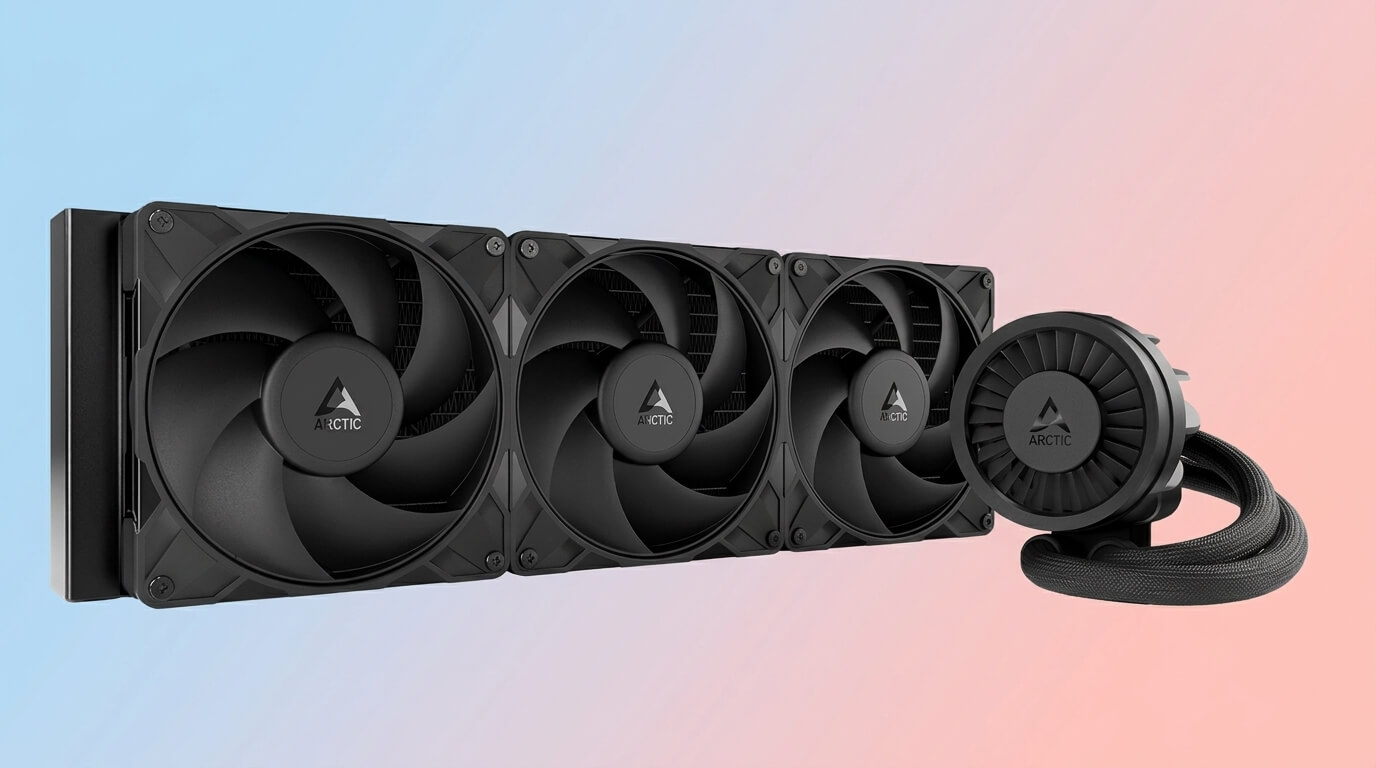
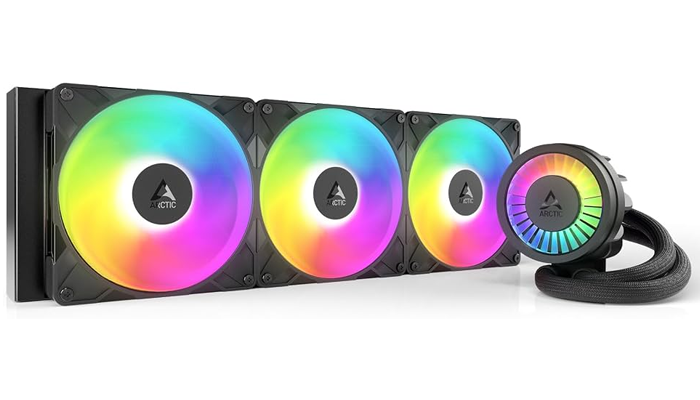
The ARCTIC Liquid Freezer III 420 is a 420 mm all-in-one liquid cooler built around a 458 x 130 x 38 mm aluminum radiator and three 140 mm P14 PWM PST fans arranged with a fin density of 14 FPI across 12 internal channels. The cooler ships with an ARCTIC-designed mounting frame for Intel sockets that replaces the stock Independent Loading Mechanism, reducing the mechanical pressure the standard Intel bracket applies to the CPU package. This frame allows the cooler to be screwed onto a backplate rather than clamped through the motherboard, which lowers stress on the board and die while keeping installation straightforward.
Paired with the i9-14900K, the 420 mm radiator provides substantial surface area for a processor that draws up to 253 W under PL2. Independent testing with a comparable high-power Raptor Lake chip, the Core i9-13900K, kept the CPU under 80°C while running at a full 253 W power draw, a result the reviewer had not previously observed from an air-cooled or smaller-radiator setup. The three 140 mm fans run up to a maximum of 1,900 RPM, alongside a 2,500 RPM VRM fan and a 2,800 RPM pump, giving the cooler headroom to sustain heavy loads without immediately maxing out fan speed.
Noise performance benefits from the larger 140 mm fan diameter. The P14 PWM fans are rated for up to 1,700 RPM, produce a combined airflow of 72.80 CFM at 2.40 mmH₂O static pressure, and the complete unit runs at approximately 40 dB(A) at full load. Separate testing recorded a maximum load noise level of approximately 1,700 RPM with a comparatively low measured noise reading, an advantage for builders prioritizing a quiet case.
Compared with the ARCTIC Liquid Freezer III 360 and Liquid Freezer III Pro 360 covered below, the 420 offers a larger radiator surface at the cost of case space; a chassis must support a 420 mm radiator mounting position, which not all mid-tower cases provide. Against the EK-Nucleus AIO CR360 Lux D-RGB, the Liquid Freezer III 420 costs less while still supplying comparable or superior thermal headroom at high power draw, and it runs quieter at equivalent load.
ARCTIC backs the Liquid Freezer III 420 with a 6-year warranty and includes a 0.8 g tube of MX-6 thermal paste. Pricing has fluctuated with promotional periods; the model has been observed at a promotional price below $120 against an MSRP closer to $155, while a separate listing placed the price at approximately €124.

ARCTIC Liquid Freezer III Pro 360
CHECK PRICE
PROS
CONS
| Specification | Detail |
|---|---|
| Radiator size | 360 mm (398 x 120 x 38 mm) |
| Fans | 3 x 120 mm P12 Pro PWM |
| Fan speed | 600–3,000 RPM |
| Airflow | 77 CFM |
| Pump speed | 800–2,800 RPM |
| VRM fan | 400–2,500 RPM |
| Rated dissipation | Up to 300 W |
| Socket support | Intel LGA1700, LGA1851; AMD AM4, AM5 |
| Weight | ~2,020 g |
| Warranty | 6 years |
| Street price | ~$70–$160 |
The ARCTIC Liquid Freezer III Pro 360 is a 360 mm liquid cooler built on a 398 x 120 x 38 mm radiator with three 120 mm P12 Pro fans. The radiator fans use an RPM range of 600 to 3,000 with a maximum CFM rating of 77, while the separate VRM fan operates across a 400 to 2,500 RPM range. The pump runs between 800 and 2,800 RPM under PWM control.
The Pro variant’s defining upgrade over the standard Liquid Freezer III 360 is its revised Intel contact frame. ARCTIC states the frame is designed to produce a 5- to 9-degree Celsius temperature drop on Intel platforms compared with earlier mounting hardware, a change directly relevant to the i9-14900K given the CPU’s high turbo power draw and known sensitivity to socket-induced pressure. The wide RPM range on both the radiator fans and the VRM fan is intended to keep the system close to silent at idle or light load, while still permitting a high maximum noise output when the CPU is pushed toward its 253 W ceiling.
The Pro 360 is rated to dissipate up to 300 W}, which provides margin above the i9-14900K’s 253 W PL2 ceiling for sustained all-core boost scenarios. ARCTIC confirms compatibility with Intel LGA1700 and LGA1851 sockets as well as AMD AM4 and AM5. The unit weighs approximately 2,020 g and uses a copper cold plate with micro-skived fins, alongside a 450 mm tube length.
Against the standard Liquid Freezer III 360, the Pro model adds the improved contact frame, P12 Pro fans rated for a higher maximum RPM, and more accurate PWM speed reporting, with ARCTIC stating the improved PWM technology corrects previous inaccuracies between a set fan curve and the actual reported RPM. Against the Liquid Freezer III 420, the Pro 360 trades radiator surface area for a smaller footprint that fits a wider range of cases. Pricing for the Pro 360 has been observed as low as roughly $70 to $80 and as high as $125 to $160 depending on region and retailer, making it one of the more affordable 360 mm options with a dedicated Intel-specific contact frame.
ARCTIC backs the Liquid Freezer III Pro 360 with a 6-year warranty.

ARCTIC Liquid Freezer III 360
CHECK PRICE
PROS
CONS
| Specification | Detail |
|---|---|
| Radiator size | 360 mm (398 x 120 x 38 mm) |
| Fans | 3 x 120 mm P12 PWM |
| VRM fan | 60 mm, PWM-controlled |
| Cold plate | Copper, extended fin surface |
| Radiator surface | 23% larger fin stack vs. Liquid Freezer II |
| Socket support | Intel LGA1700, LGA1851; AMD AM4, AM5 |
| Tube | Reinforced, sleeved |
| Warranty | 6 years |
| Street price | ~$105–$130 |
The ARCTIC Liquid Freezer III 360 is the standard, non-Pro version of ARCTIC’s 360 mm AIO, using the same 398 x 120 x 38 mm radiator footprint as the Pro 360 but equipped with the earlier P12 fan rather than the P12 Pro. ARCTIC selected the P-series fans specifically for their high static pressure, which the company states performs better on radiators with dense fin stacks than fans optimized for open-air circulation. A PWM-controlled 60 mm VRM fan on the pump housing provides socket-area cooling in situations with poor case airflow or during overclocking.
The cold plate uses an extended fin surface and optimized water channels compared with the prior Liquid Freezer II generation, and the 38 mm radiator’s cooling surface has been extended by 23% through an increased fin stack. This directly benefits high-power CPUs like the i9-14900K, which generate concentrated heat at the die that must be transferred efficiently to the coolant before it reaches the radiator. GamersNexus rated the Liquid Freezer III 360 favorably, noting it performs well and offers good value, following the earlier Liquid Freezer II, which the outlet had considered the best liquid cooler it had tested over the preceding four years.
Relative to the Pro 360, the standard 360 uses the earlier P12 fan generation, lacks the refined Intel contact frame, and does not include the corrected PWM speed reporting ARCTIC added to the Pro line. Relative to the Liquid Freezer III 420, the 360 fits a broader range of cases at the cost of a smaller radiator. ARCTIC’s original MSRP for the Liquid Freezer III lineup spanned $105 to $164 depending on radiator size, positioning the 360 mm model near the lower end of that range and below the pricing of the EK-Nucleus AIO CR360 Lux D-RGB.
EK-Nucleus AIO CR360 Lux D-RGB
CHECK PRICE
PROS
CONS
| Specification | Detail |
|---|---|
| Radiator size | 360 mm (400 x 124 x 27 mm) |
| Fans | 3 x 120 mm EK-Loop FPT, 27 mm thickness |
| Fan airflow | Up to 72 CFM |
| Fan lifespan | 70,000 hours rated |
| Fin density | 20–21 FPI |
| Sustained package power (tested) | 245 W |
| Max noise | 50.4 dBA |
| Socket support | Intel LGA1700, LGA1851; AMD AM4, AM5 |
| Warranty | 5 years (6 with registration) |
| MSRP | $205–$209 |
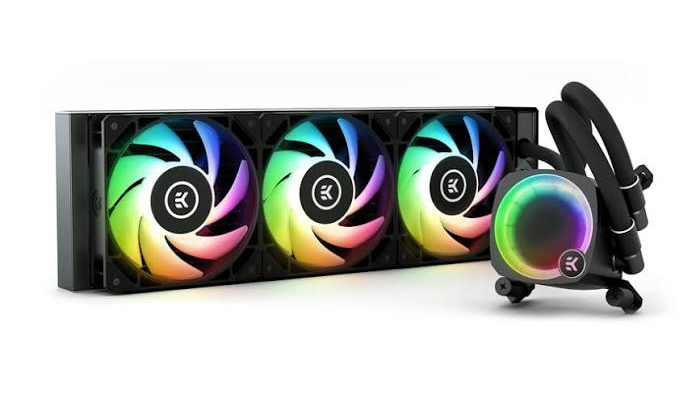
The EK-Nucleus AIO CR360 Lux D-RGB is a 360 mm liquid cooler with an aluminum radiator using a fin density of 20 to 21 FPI and 400 mm sleeved rubber tubing. The radiator on the current-generation model measures 400 x 124 x 27 mm, and installing the bundled 27 mm EK-Loop FPT fans brings the total assembly height to 54 mm. The included fans carry a maximum airflow rating of 72 CFM and a rated life expectancy of 70,000 hours.
On Intel test platforms, the CR360 Lux D-RGB has shown strong thermal results relative to competing 360 mm AIOs. In one comparison, the cooler tied for the best thermal result recorded in that test at 66°C over a 23°C ambient temperature, and on a separate Intel test bench, the cooler took the top performance position in nearly all tests, beating the Lian Li Galahad II Trinity Performance 360. In a power-boost overclocking test, the EK-Nucleus recorded the highest sustained package power among tested coolers at 245 W, a result directly relevant to the i9-14900K’s 253 W PL2 ceiling, since it indicates the cooler can extract that level of sustained heat without forcing a clock-speed reduction.
This thermal performance carries a noise cost at maximum fan speed. Maximum noise was measured at 50.4 dBA, which the reviewer described as near the edge of acceptable noise levels for general use. Reducing fan speed to a normalized 40.3 dBA in a lighter 125 W workload still kept the CR360 Lux D-RGB 3°C cooler than its nearest competitor, indicating the cooler retains a performance edge even when tuned for quieter operation.
Compared with the ARCTIC Liquid Freezer III Pro 360, the EK-Nucleus generally posts similar or slightly better peak thermal results on Intel platforms but does so at a higher maximum noise level and a substantially higher price. Compared with the Cooler Master MasterLiquid 360 Atmos, independent testing placed the two coolers within about 1°C of each other under load, with the Cooler Master unit running at 42.3 dBA against roughly 46 dBA for the EK cooler under the same conditions.
EKWB backs the CR360 Lux D-RGB with a 5-year warranty, extendable to 6 years through product registration. MSRP is listed at $209, though retail pricing has been observed closer to $205, and a non-RGB “Dark” variant with equivalent cooling hardware is sold for $159.

Noctua NH-D15 G2
CHECK PRICE
PROS
CONS
| Specification | Detail |
|---|---|
| Type | Dual-tower air cooler |
| Height | 168 mm |
| Fans | 2 x 130 mm NF-A14x25r G2 PWM |
| Fan speed | Up to 1,500 RPM |
| Airflow | 91.5 CFM combined |
| Rated fan noise | 24.8 dBA |
| Heatpipes | 8 |
| Sustained wattage (tested, Intel) | 323.0 W |
| Socket support | Intel LGA1851, LGA1700, LGA1200, LGA115x; AMD AM5, AM4 |
| Fan MTTF | 150,000+ hours |
| Warranty | 6 years |
| MSRP | $149.95 (currently ~$165–$180) |
The Noctua NH-D15 G2 is a dual-tower air cooler and the successor to the original NH-D15. It increases the heatpipe count from six to eight and adds a larger CPU contact plate compared with its predecessor. The cooler ships with two 130 mm NF-A14x25r G2 fans capable of up to 1,500 RPM, producing a combined airflow of 91.5 CFM at a rated noise level of 24.8 dBA, and the assembled unit stands 168 mm tall.
As an air cooler, the NH-D15 G2 has no pump or liquid loop, reducing the number of moving parts to the two fans and eliminating any risk of coolant leakage. On an Intel LGA1700 test bench, independent testing recorded the NH-D15 G2 handling 323.0 W of sustained thermal load at maximum fan speed, a 2 W lead over its closest air-cooling competitor, a result that places it above the i9-14900K’s 253 W PL2 ceiling and suggests the cooler can sustain the CPU’s maximum turbo power without throttling under most ambient conditions. At a noise-normalized 45 dBA, the same testing found the NH-D15 G2 pulling ahead of its nearest air-cooling competitor by 12 W on the Intel test bench, translating to a 1–3°C or larger temperature lead over rivals such as be quiet!’s Dark Rock Elite and DeepCool’s Assassin IV.
Noctua includes shim washers for LGA1700 systems, intended for use without a separate contact frame, along with a thermal-paste guard for AM5 builds. The bundled NF-A14x25r G2 fans carry an MTTF rating in excess of 150,000 hours, and the heatsink’s fins are soldered rather than press-fitted to the heatpipes, a construction method intended to prevent the thermal-interface degradation that can occur from differing expansion rates between copper and aluminum over repeated heating and cooling cycles.
Compared with the liquid coolers in this guide, the NH-D15 G2 delivers competitive or superior sustained wattage handling without a pump, tubing, or coolant to maintain, but it does so at a higher price than most of the 360 mm AIOs reviewed above. GamersNexus noted the NH-D15 G2 costs more than the ARCTIC Liquid Freezer III 360, the top-performing cooler on its charts, by around $42, while reviewers have also observed that Thermalright and ID-Cooling air coolers, as well as several AIOs, offer more favorable price-to-performance ratios. At maximum fan speed, measured noise levels ranged between 44.2 and 44.6 dBA, higher than the ARCTIC Liquid Freezer III 420 at equivalent load.

Cooler Master MasterLiquid 360 Atmos
CHECK PRICE
PROS
CONS
| Specification | Detail |
|---|---|
| Radiator size | 360 mm (393 mm length) |
| Fans | 3 x 120 mm SickleFlow Edge |
| Fan speed | 690–2,500 RPM |
| Noise floor | 27.2 dB |
| Pump | Dual-chamber design, copper cold plate |
| Socket support | Intel LGA1150/1151/1155/1156/1200/1700/1851; AMD AM4/AM5/sTRX4/sTR4 |
| Measured noise (load) | ~42.3 dBA |
| Warranty | 5 years |
| Street price | ~$118–$170 |
The Cooler Master MasterLiquid 360 Atmos is a 360 mm AIO built around a reworked dual-chamber pump and a copper cold plate design that improves on Cooler Master’s previous generation of liquid coolers. The unit ships with pre-installed SickleFlow Edge fans, and the fans operate across a 690 to 2,500 RPM range with a rated noise floor of 27.2 dB.
Cooler Master markets the Atmos around a “Next Gen Dual Chamber Pump,” which the company states increases water pressure and directs flow toward CPU hotspots, a design detail relevant to a concentrated-heat processor like the i9-14900K. In direct comparison testing against other 360 mm AIOs on a high-power test platform, the MasterLiquid 360 Atmos came within 1°C of the top-performing EK-Nucleus CR360 Lux D-RGB while operating at 42.3 dBA compared with roughly 46 dBA for the EK cooler, and it also tied with the Lian Li Galahad II Trinity Performance. Separately, reviewers found that even at a comparatively low 1,000 RPM fan speed, the Atmos clearly outperformed Cooler Master’s own prior-generation MasterLiquid 360L Core, indicating the redesigned pump and cold plate contribute meaningfully to cooling capacity independent of raw fan speed.
At 393 mm in length, the radiator is slightly more compact than the 397 mm length common to many competing 360 mm units, which can ease installation in cases with tighter radiator mounting clearance. Socket support spans Intel LGA1700, 1200, 1150, 1151, 1155, and 1156, along with AMD AM4, AM3, AM2, sTRX4, and sTR4.
Compared with the EK-Nucleus AIO CR360 Lux D-RGB, the Atmos delivers nearly identical thermal performance at a meaningfully lower noise level and a lower price. Compared with the ARCTIC Liquid Freezer III Pro 360, the Atmos uses a lower maximum fan RPM (2,500 versus 3,000) but compensates with its redesigned pump and cold plate. Tech4Gamers priced the Atmos at $144 and rated its thermal performance and noise output among the best in its class, while EnosTech listed the cooler at approximately $159.99, alongside a 5-year warranty.
How to Choose a CPU Cooler for i9 14900K
A CPU cooler for the i9-14900K must sustain the processor’s 253 W PL2 power draw without forcing a clock-speed reduction under sustained multi-core load. Confirming a cooler’s rated or independently tested wattage handling against this 253 W figure is the first filter to apply, since coolers rated below this threshold will throttle the CPU during extended workloads such as rendering or video encoding.
Radiator or heatsink size is the second consideration and is dictated by available case space rather than personal preference. A 420 mm liquid cooler, such as the ARCTIC Liquid Freezer III 420, provides the largest thermal margin in this comparison but requires a case with a corresponding radiator mount. A 360 mm liquid cooler fits a broader range of mid-tower cases while still comfortably handling the i9-14900K’s power draw, as demonstrated by the ARCTIC Liquid Freezer III Pro 360, the EK-Nucleus AIO CR360 Lux D-RGB, and the Cooler Master MasterLiquid 360 Atmos. A dual-tower air cooler such as the Noctua NH-D15 G2 avoids radiator clearance requirements entirely but instead requires sufficient vertical clearance above the motherboard and adequate case airflow to exhaust the heat it transfers into the surrounding air.
Noise tolerance under sustained load varies meaningfully between these coolers, from approximately 24.8 dBA at the fan level on the Noctua NH-D15 G2 up to a measured 50.4 dBA at maximum fan speed on the EK-Nucleus AIO CR360 Lux D-RGB. Builders assembling a system for a quiet environment, such as a home office, should weight noise-normalized comparisons more heavily than maximum-RPM thermal results, since most of these coolers can be tuned via fan curves to trade some thermal headroom for reduced noise.
Budget separates these coolers into three tiers: the ARCTIC Liquid Freezer III 360 and Liquid Freezer III Pro 360 occupy the lower end near $70–$130, the Cooler Master MasterLiquid 360 Atmos and ARCTIC Liquid Freezer III 420 sit in the middle near $120–$170, and the Noctua NH-D15 G2 and EK-Nucleus AIO CR360 Lux D-RGB command a premium near $150–$210. Warranty length, ranging from 5 years on the EK-Nucleus and Cooler Master units to 6 years on the ARCTIC and Noctua coolers, provides an additional data point for long-term ownership cost, particularly for liquid coolers where pump failure is the primary long-term risk.