The Intel Core i9-13900K reaches turbo power draws above 250 W under sustained multi-core loads, which places heavy thermal demands on any cooling solution paired with it. A cooler that cannot dissipate this heat load causes the processor to throttle its clock speed, reducing performance in gaming and productivity workloads alike. Selecting an adequate cooler therefore directly affects the sustained performance the i9-13900K can deliver.
This article evaluates six CPU coolers across two categories: high-performance liquid coolers (AIOs) with 360 mm radiators and premium dual-tower air coolers. The ARCTIC Liquid Freezer III Pro 360, ARCTIC Liquid Freezer III 360, EK-Nucleus AIO CR360 Lux D-RGB, and Corsair iCUE LINK H150i represent the liquid-cooling category. The Noctua NH-D15 G2 and Thermalright Phantom Spirit 120 SE represent the air-cooling category.
Each section below covers the cooler’s specifications, how it performs with the i9-13900K’s thermal profile, and how it compares with functionally similar coolers in this list. Specification tables and separate pros and cons lists accompany each review to support side-by-side evaluation.
The final section explains how to choose among these options based on case clearance, budget, noise tolerance, and overclocking plans for an i9-13900K build.
Best CPU Coolers for Intel i9 13900K CPU

ARCTIC Liquid Freezer III Pro 360
CHECK PRICE
PROS
CONS
| Specification | Value |
|---|---|
| Radiator size | 360 mm (398 x 120 x 38 mm) |
| Radiator material | Aluminum |
| Cold plate | Copper, micro-skived fins |
| Socket support | Intel LGA 1851, LGA 1700; AMD AM5, AM4 |
| Radiator fans | 3x P12 Pro, 120 mm, 600–3,000 RPM, 77 CFM max |
| VRM fan | 50 mm, 400–2,500 RPM |
| Pump speed | 800–2,800 RPM (PWM) |
| Tube length | 450 mm |
| Weight | 2,020 g |
| Warranty | 6 years |
The ARCTIC Liquid Freezer III Pro 360 is a 360 mm all-in-one liquid cooler built around a 38 mm-thick aluminum radiator, a design that departs from the 27 mm radiators common on competing AIOs. The thicker radiator increases coolant volume and surface area, which ARCTIC states improves handling of transient power spikes on high-TDP processors such as the i9-13900K.
The cooler uses three P12 Pro radiator fans rated at 600–3,000 RPM with a maximum airflow of 77 CFM, paired with a PWM-controlled pump rated at 800–2,800 RPM. A dedicated 50 mm VRM fan sits on the pump housing and directs airflow toward the motherboard’s voltage regulation area, a feature not present on most AIOs in this price range. The copper cold plate uses a micro-skived fin design and a slightly convex surface to improve contact with the i9-13900K’s integrated heat spreader.
On the i9-13900K, the combination of a thick 38 mm radiator and a wide pump RPM range allows the Liquid Freezer III Pro 360 to manage the processor’s turbo power spikes while keeping the pump at lower, quieter speeds during typical loads. The bundled Intel contact frame further improves mounting pressure distribution across the die, addressing the uneven contact that stock Intel brackets can produce on LGA 1700.
Compared with the standard ARCTIC Liquid Freezer III 360, the Pro variant adds the VRM fan, an Intel contact frame, and higher-spec P12 Pro fans, at a moderate price premium. Compared with the Corsair iCUE LINK H150i and EK-Nucleus AIO CR360 Lux D-RGB, both of which use 27 mm radiators, the Liquid Freezer III Pro 360’s 38 mm radiator gives it a thermal capacity advantage, though its 63 mm total installation clearance requirement is larger and can create case-compatibility issues that the thinner competitors avoid.

ARCTIC Liquid Freezer III 360
CHECK PRICE
PROS
CONS
| Specification | Value |
|---|---|
| Radiator size | 360 mm (397.5 x 120 x 38 mm) |
| Radiator material | Aluminum |
| Cold plate | Copper |
| Socket support | Intel LGA 1851, LGA 1700; AMD AM5, AM4 |
| Radiator fans | 3x P-series, 120 mm, up to 1,800 RPM |
| VRM fan | 60 mm |
| Pump speed | 800–2,800 RPM (PWM) |
| Tube length | 450 mm |
| Warranty | 6 years |
The ARCTIC Liquid Freezer III 360 is a 360 mm all-in-one liquid cooler that shares the same 38 mm radiator platform as the Pro variant but omits the dedicated VRM fan and the upgraded P12 Pro fans. It uses ARCTIC’s P-series radiator fans in a push configuration, factory-installed to reduce assembly steps during installation.
The radiator retains the 38 mm thickness and 23% larger fin-stack surface area that ARCTIC introduced with the Liquid Freezer III generation, which increases both heat dissipation and coolant volume relative to standard 27 mm AIO radiators. A smaller 60 mm fan mounted on the pump housing supplies supplementary airflow to the motherboard’s VRM area, though it runs at a lower maximum RPM than the Pro variant’s dedicated fan. The pump is PWM-controlled, and all fan cables integrate into the tubing sleeve so that only a single connector requires attachment to the motherboard.
ARCTIC states that the Liquid Freezer III has been tested and confirmed compatible with the i9-13900K, i9-13900KS, and i9-14900K in its Enthusiast and Desktop cooling category, with testing covering both the standard mounting bracket and the optional contact frame. The 38 mm radiator gives the cooler sufficient thermal headroom to manage the i9-13900K’s turbo boost behavior without requiring maximum fan speed under typical workloads.
Compared with the Liquid Freezer III Pro 360, the standard version costs less but lacks the dedicated 50 mm VRM fan and the higher-airflow P12 Pro fans, resulting in slightly reduced airflow to motherboard components under sustained load. Compared with the EK-Nucleus AIO CR360 Lux D-RGB and Corsair iCUE LINK H150i, both using thinner 27 mm radiators, the Liquid Freezer III 360 offers greater coolant capacity but the same 63 mm clearance requirement as its Pro sibling.

Noctua NH-D15 G2
CHECK PRICE
PROS
CONS
| Specification | Value |
|---|---|
| Cooler type | Dual-tower air cooler |
| Dimensions | 168 x 150 x 152 mm |
| Weight | 1,525 g |
| Heat pipes | 8 |
| Fans | 2x NF-A14x25r G2, 140 mm, up to 1,500 RPM |
| Combined airflow | 91.6 CFM |
| Max noise | 24.8 dBA |
| Socket support | Intel LGA 1851, LGA 1700, LGA 1200, LGA 115x; AMD AM5, AM4 |
| Warranty | 6 years |
The Noctua NH-D15 G2 is a dual-tower air cooler that succeeds the original NH-D15, using eight heat pipes instead of six and a 20% larger fin surface area to increase thermal capacity at high heat loads. Noctua states the additional heat pipes provide their largest performance benefit at loads of 250 W and above, which corresponds closely to the i9-13900K’s turbo power draw.
The heatsink measures 168 mm in height, 150 mm in width, and 152 mm in depth, and weighs 1,525 g. Two NF-A14x25r G2 PWM fans, rated up to 1,500 RPM with a combined maximum airflow of 91.6 CFM, run at a speed offset from each other to reduce resonance and noise. Noctua rates the maximum noise output at 24.8 dBA per fan. The cooler ships in variants with different base convexity levels; the standard version uses medium convexity suited to a broad range of CPU platforms, including the LGA 1700 socket used by the i9-13900K.
On the i9-13900K, the NH-D15 G2’s eight-heat-pipe design and larger fin surface allow it to manage sustained turbo loads while running its fans below their maximum 1,500 RPM ceiling, keeping noise output close to the rated 24.8 dBA. Because it uses no pump or liquid loop, the NH-D15 G2 also removes the failure risk associated with AIO pump components.
Compared with the Thermalright Phantom Spirit 120 SE, the other air cooler in this list, the NH-D15 G2 is substantially larger, heavier, and more expensive, but its eight heat pipes and larger fin-stack surface area give it greater thermal capacity for the i9-13900K’s power draw. Compared with the 360 mm AIOs in this list, the NH-D15 G2 avoids the pump noise and long-term liquid-loop maintenance concerns of liquid cooling, though its 168 mm height and 150 mm width can interfere with tall memory modules or wide cases with limited clearance.
EK-Nucleus AIO CR360 Lux D-RGB
CHECK PRICE
PROS
CONS
| Specification | Value |
|---|---|
| Radiator size | 360 mm (400 x 124 x 27 mm) |
| Radiator material | Aluminum |
| Cold plate | Copper |
| Socket support | Intel LGA 115x, 1200, 1700, 2011, 2011-3, 2066; AMD AM4, AM5 |
| Fans | 3x EK-FPT 120 mm, 550–2,300 RPM, 72 CFM max |
| Pump speed | 3,100 RPM ± 10% |
| Max noise | 36 dBA |
| Tube length | 400 mm |
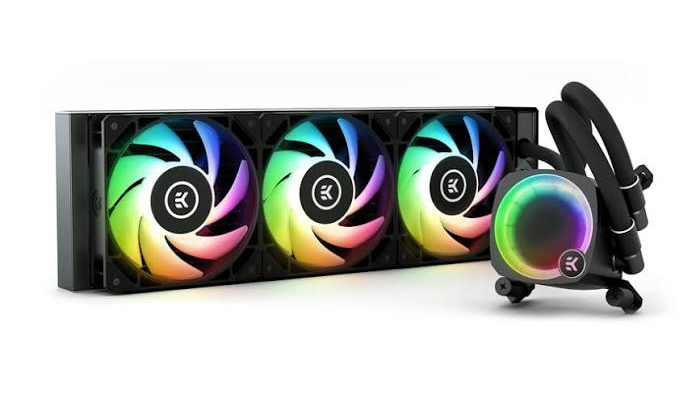
The EK-Nucleus AIO CR360 Lux D-RGB is a 360 mm all-in-one liquid cooler using a standard 27 mm-thick aluminum radiator with a fin density of 20–21 FPI. EK adds brushed-aluminum side plates with diamond-cut edges to the radiator for visual contrast, alongside an addressable RGB pump top with a rotatable cover.
The pump operates at a rated speed of 3,100 RPM ± 10% across a PWM range of 20–100%, and the cold plate uses a copper base with pre-applied thermal paste. Three EK-FPT 120 mm fans ship pre-installed, rated across a speed range of 550–2,300 RPM with a maximum airflow of 72 CFM and a maximum noise level of 36 dBA. The radiator measures 400 x 124 x 27 mm, and the tubing runs 400 mm in ultra-low-evaporation rubber with a nylon braided sleeve.
With the i9-13900K, the EK-Nucleus AIO CR360’s 3,100 RPM pump and three 120 mm fans provide enough coolant flow and airflow to manage sustained all-core turbo loads, though the standard 27 mm radiator gives it less thermal headroom under extreme power spikes than the 38 mm-radiator ARCTIC Liquid Freezer III models. The cooler supports Intel LGA 1700 natively through its included mounting kit, which covers the i9-13900K’s socket without requiring a separate contact frame purchase.
Compared with the Corsair iCUE LINK H150i, both coolers use a 27 mm radiator and a similar three-fan configuration, but the EK-Nucleus reaches a higher maximum noise level of 36 dBA versus the Corsair’s centrifugal pump design rated below 20 dBA. Compared with the ARCTIC Liquid Freezer III 360, the EK-Nucleus uses a thinner radiator with lower coolant capacity, trading some thermal headroom for broader case compatibility due to its lower installation clearance requirement.

Corsair iCUE LINK H150i
CHECK PRICE
PROS
CONS
| Specification | Value |
|---|---|
| Radiator size | 360 mm |
| Radiator material | Aluminum |
| Cold plate | Split-flow copper |
| Socket support | Intel LGA 1700; AMD AM5 |
| Fans | 3x QX120 RGB, 120 mm, up to 2,400 RPM |
| Pump flow rate | 0.82 L/min |
| Pump noise | Below 20 dBA |
| Tube length | 450 mm |
The Corsair iCUE LINK H150i is a 360 mm all-in-one liquid cooler built around Corsair’s iCUE LINK ecosystem, which connects the pump, fans, and system hub through a single daisy-chained cable network to reduce cable clutter during installation. The radiator uses a standard 27 mm aluminum core with a fin density of 20–21 FPI and a split-flow copper cold plate designed to distribute coolant evenly across the surface.
Three QX120 RGB fans, using a magnetic-levitation bearing design, ship pre-installed and operate up to 2,400 RPM under PWM control, with support for a zero-RPM mode that stops the fans entirely at low temperatures. The centrifugal pump delivers a flow rate of 0.82 L/min while generating less than 20 dBA of noise, a lower noise ceiling than the pump designs used in the EK-Nucleus and ARCTIC coolers in this list. Corsair pre-applies XTM70 thermal paste to the cold plate, which ships compatible with Intel LGA 1700 and AMD AM5 sockets.
On the i9-13900K, the iCUE LINK H150i’s 360 mm radiator and 2,400 RPM fan ceiling provide adequate heat dissipation for sustained turbo loads, while the sub-20 dBA pump keeps baseline noise lower than competing AIO pumps during idle and light workloads. The included iCUE LINK System Hub allows fan curves to be tied to more than 20 different system sensors, which supports fine-tuned cooling profiles for the i9-13900K’s variable power draw between single-core and all-core turbo states.
Compared with the EK-Nucleus AIO CR360 Lux D-RGB, both use a 27 mm radiator and a three-fan layout, but the Corsair pump’s sub-20 dBA rating is quieter than the EK-Nucleus’s 36 dBA maximum fan noise. Compared with the ARCTIC Liquid Freezer III Pro 360, the Corsair unit lacks a dedicated VRM fan and uses a thinner radiator, trading some thermal capacity for the iCUE LINK ecosystem’s cable-management and sensor-integration features.

Thermalright Phantom Spirit 120 SE
CHECK PRICE
PROS
CONS
| Specification | Value |
|---|---|
| Cooler type | Dual-tower air cooler |
| Dimensions | 154 x 125 x 110 mm |
| Weight | 765 g |
| Heat pipes | 7 x 6 mm |
| TDP rating | 105–280 W |
| Fans | 2x TL-C12B V2, 120 mm, up to 1,500 RPM |
| Max airflow | 66.17 CFM |
| Max noise | 25.6 dBA |
| Socket support | Intel LGA 1851, 1700, 115x, 1200; AMD AM4, AM5 |
| Warranty | 2 years |
The Thermalright Phantom Spirit 120 SE is a dual-tower air cooler using a side-flow architecture with seven 6 mm heat pipes and AGHP fourth-generation heat pipe technology. Thermalright rates the cooler for a TDP range of 105 W to 280 W, which covers the i9-13900K’s turbo power draw under most cooling configurations.
The heatsink stands 154 mm tall, 125 mm wide, and 110 mm deep, and weighs 765 g, making it substantially smaller and lighter than the Noctua NH-D15 G2. The base plate uses nickel-plated C1100 pure copper for corrosion resistance. Two 120 mm TL-C12B V2 fans, using S-FDB bearings rated for up to 20,000 hours of service life, spin at a maximum of 1,500 RPM with a maximum airflow of 66.17 CFM and a maximum noise level of 25.6 dBA.
With the i9-13900K, the Phantom Spirit 120 SE’s seven heat pipes and 280 W TDP rating provide sufficient thermal capacity for stock and moderately overclocked configurations, though it offers less thermal headroom at sustained all-core turbo loads than the eight-heat-pipe NH-D15 G2. The cooler’s 154 mm height fits a wider range of mid-tower cases than the taller 168 mm NH-D15 G2, which improves case compatibility for smaller builds running the i9-13900K.
Compared with the Noctua NH-D15 G2, the Phantom Spirit 120 SE is smaller, lighter, and considerably less expensive, but its seven heat pipes and lower TDP ceiling give it less thermal capacity for sustained i9-13900K turbo loads. Compared with the 360 mm AIOs in this list, the Phantom Spirit 120 SE avoids pump noise and liquid-loop maintenance but provides less thermal headroom under the i9-13900K’s highest power states.
How to Choose a CPU Cooler for i9 13900K
Choose a CPU cooler for the i9-13900K by matching its thermal capacity to the processor’s turbo power draw, then narrowing the selection by case clearance, noise tolerance, and budget. The i9-13900K draws more than 250 W under sustained all-core turbo, so a cooler rated for at least 250 W of sustained dissipation is required to avoid thermal throttling.
A 360 mm AIO with a 38 mm radiator, such as the ARCTIC Liquid Freezer III Pro 360 or ARCTIC Liquid Freezer III 360, provides the largest thermal margin for sustained turbo loads and heavy overclocking, at the cost of a larger installation footprint that requires at least 63 mm of clearance. A 360 mm AIO with a standard 27 mm radiator, such as the Corsair iCUE LINK H150i or EK-Nucleus AIO CR360 Lux D-RGB, fits a broader range of cases while still providing adequate cooling for stock and moderate overclocking configurations.
An air cooler such as the Noctua NH-D15 G2 removes the maintenance and failure risks associated with a liquid loop, and its eight heat pipes provide enough thermal capacity for sustained i9-13900K turbo loads, though its 168 mm height and 150 mm width require verifying clearance against case dimensions and RAM height. A smaller air cooler such as the Thermalright Phantom Spirit 120 SE fits tighter cases at a lower price, but suits stock or lightly overclocked configurations rather than sustained heavy multi-core loads.
Noise tolerance affects the choice between pump-driven and fan-driven designs. AIO pumps rated below 20 dBA, such as the Corsair iCUE LINK H150i’s centrifugal pump, produce less baseline noise than higher-speed pumps rated above 3,000 RPM. Air coolers with speed-offset fan pairs, such as the Noctua NH-D15 G2, reduce resonance-driven noise at the cost of the larger physical footprint air cooling requires.